
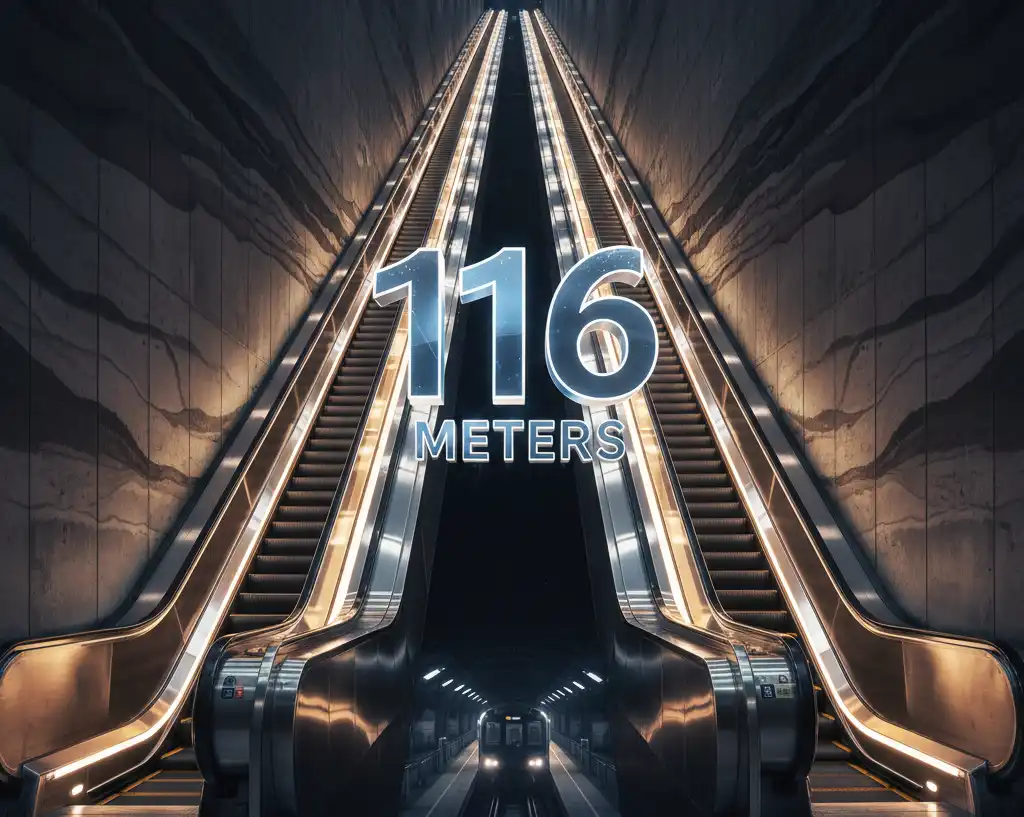
- Exact Depth: Why is 116 Meters a New World Record?
- Previous record holder: Mention of the legendary Arsenalnaya station
- Engineering challenges of construction in the “Mountain City”
- Multi-level structure and transfer hub
- Journey into the Deep: Chongqing’s Longest Escalators
- Geopolitical significance and infrastructure development
- The Future of Underground Records
Hongtudi Station in Chongqing, China, is officially recognized as the deepest metro station in the world, taking the title from Kyiv’s Arsenalna Station. This engineering feat is a direct result of Chongqing’s complex geography-a metropolis known as the “mountain city.” Hongtudi’s platforms reach an impressive 116 meters (approximately 380 feet) below ground level. This construction presented a formidable challenge, but also demonstrated the capabilities of modern technology.
Exact Depth: Why is 116 Meters a New World Record?
The record-breaking depth of 116 meters at Hongtudian Station exceeded that of its predecessor, Kyiv’s Arsenalna Station, by more than 10 meters. Although the Chongqing Metro opened to passengers relatively recently, engineers had to build tunnels and stations deep underground to circumvent dense urban development and mountainous topography. Unlike flat cities, where subway lines can be relatively shallow, in Chongqing, the elevation changes necessitated such extensive submersion.
Previous record holder: Mention of the legendary Arsenalnaya station
For decades, the title of the world’s deepest metro station belonged to Kyiv’s Arsenalna Station in Ukraine. With an estimated depth of 105.5 meters, it remained a symbol of 20th-century engineering excellence. Opened in 1960, Arsenalna was built under extremely challenging conditions: construction took place through so-called “plavun” (water-saturated soil) near the Dnieper River. This required the use of soil freezing technology and other innovative methods.
- Key differences between the record holders:
- Geography: Arsenalnaya is deep due to complex geology, Hongtudian due to mountainous terrain and other tunnels above.
- Technologies: The Kyiv station is the result of 1950s engineering, while Hongtudian is the fruit of modern tunneling systems and AI technologies.
- Functionality: Arsenalnaya has one line, Hongtudian is a key multi-level transfer hub for two lines.
Engineering challenges of construction in the “Mountain City”
The construction of Hongtudian Station was predetermined by Chongqing’s unique geography. The city is located on hills and has significant elevation changes. To ensure smooth and safe train travel, tunnels had to be dug deep beneath dense buildings and other infrastructure. The project’s total budget reached billions of dollars, demonstrating its scale and complexity. Modern engineering solutions were critical to traversing rocky and unstable terrain.
Multi-level structure and transfer hub
Hongtudian Metro Station serves two lines: Line 6 and Line 10 of the local rail system. The platforms for these lines are located on different levels, further complicating the design and adding depth. Passengers arriving at one level must use additional walkways and escalators to reach the other line, which is located even lower. This multi-level architecture is necessary due to the limited space available.
Journey into the Deep: Chongqing’s Longest Escalators
For passengers, the descent to the record-breaking depth is a true journey. To reach the platform, passengers must take several escalators in a row. The total length of the descent is one of the longest in the world. The escalators operate continuously, and the entire descent takes over three minutes. This turns an ordinary public transport ride into a unique experience. For this reason, managing such long descents requires enhanced safety measures and constant maintenance.
Fact: A 116-meter descent is equivalent to a journey to the bottom of a 39-story skyscraper. The engineering teams working on this project deserve recognition for their flawless execution under extreme conditions.
Geopolitical significance and infrastructure development
The construction of engineering marvels like the world’s deepest metro station carries not only technical but also significant infrastructural and symbolic significance. It highlights the rapid development of transportation systems in densely populated metropolitan areas. Chongqing, one of the world’s largest cities, is constantly expanding its metro network, providing residents with high-quality and fast transportation.
Such deep metro lines also serve as additional bomb shelters, an important element of urban resilience planning. They can protect thousands of people in the event of an emergency. The Hongtudian project exemplifies how cities can adapt their transportation systems to the most challenging environmental conditions while maintaining high safety and efficiency standards.
The Future of Underground Records
Will this depth record be broken as technology advances? Currently, the Hongtudian metro station holds the undisputed title. However, ongoing engineering advances and the need to tunnel in the face of increasing global urbanization may lead to even deeper stations in the future. Perhaps the next record will be set in another mountainous city or a densely populated country.
The main lesson of this project is that no engineering limit can be overcome with sufficient resources and an innovative approach. Stations like Hongtudian and Arsenalnaya remain monuments to human ingenuity and the ability to adapt to complex geological and geographical challenges.



0 Comments