
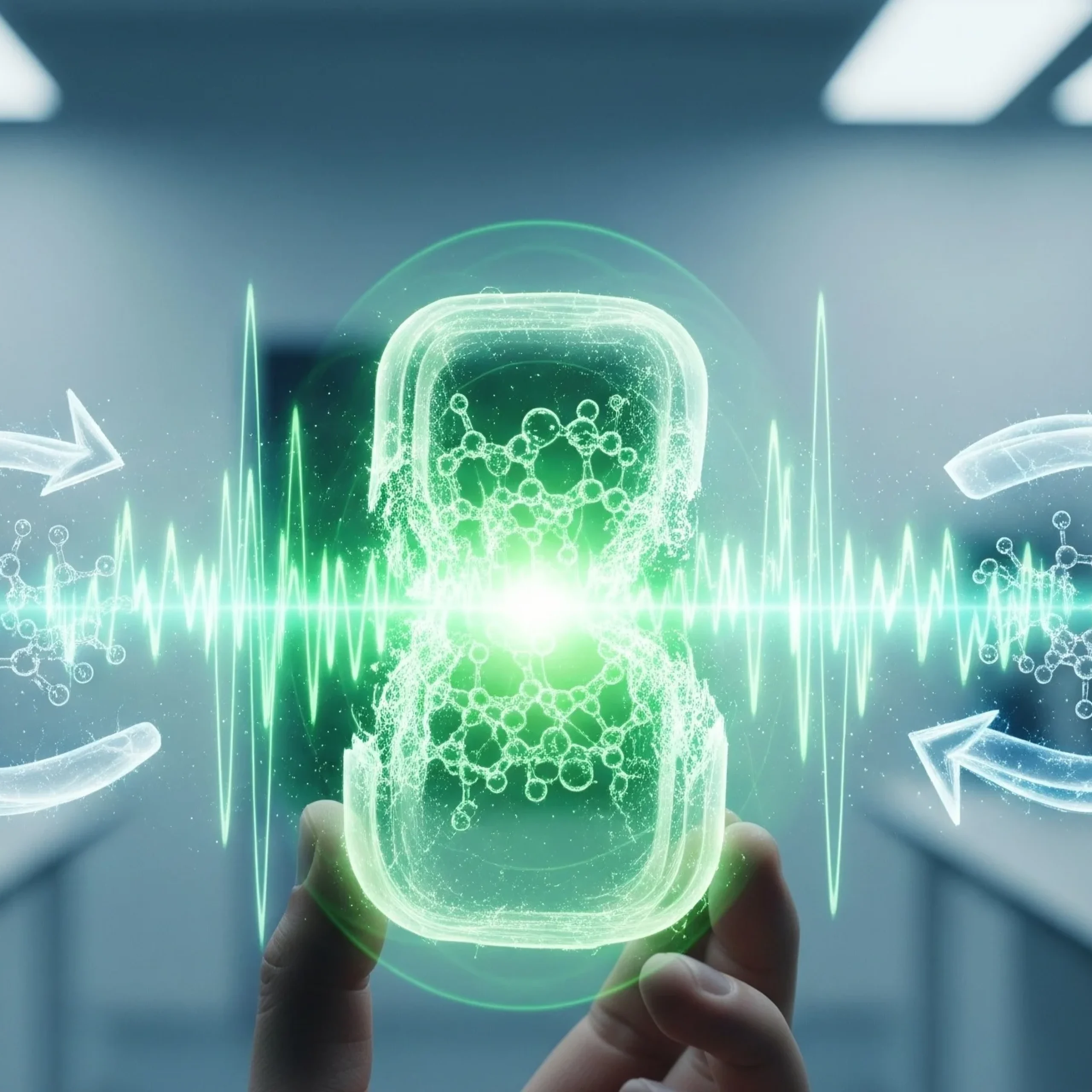
The problem of plastic pollution is one of the most pressing environmental threats of our time. Millions of tons of plastic end up in landfills or oceans every year, as most existing plastics cannot be fully recycled without losing their quality. However, scientists at Lawrence Berkeley National Laboratory in the US have made a significant breakthrough by developing a new class of plastic called poly(diketoenamine) or PDK. This material is not only extremely durable but also possesses a unique property: it can be infinitely recycled into its original monomers without any loss. This eco-friendly solution has the potential to revolutionize the future of recycling and help create a true circular economy.
Chemical Structure: How the PDK Magic Works
The secret of this innovative material lies in its chemical structure. Traditional plastics are composed of long polymer chains tightly linked together. When such plastics are recycled, these bonds break randomly, leading to degradation and a decrease in quality with each cycle. PDK plastic, however, has a different type of bond. These bonds are designed to be recyclable and controllable. When exposed to a special acid solution, these bonds break, dissolving the polymer into its basic building blocks-monomers. These monomers are completely purified of any impurities and can then be reused to create a new material with properties identical to the virgin material.
Endless Recycling: The Path to Zero Waste
PDK recycling creates an unprecedented opportunity to build a zero-waste economy. Currently, most plastic products we discard are not recycled at all, or their recycling results in lower-quality products (known as “downcycling”). Thanks to PDK technology, any product, whether a smartphone case or a car part, can be completely decomposed and recycled into the same or a completely new product. This means that instead of ending up in landfills, this ultra-strong plastic can be recycled forever, saving resources and energy.
Advantages: not only eco-friendliness
While the environmental aspect is key, the new PDK plastic also has other important advantages.
- Strength and durability: PDK is as strong as traditional plastics, making it suitable for use in applications where high reliability is required.
- Flexibility in production: Since the material is completely decomposed into its initial monomers, it can be used to create products of any shape, color and density, which significantly expands its application.
- Ease of processing: The processing process, although requiring a special solution, is relatively simple and effective.
Potential areas of application
The potential uses for infinitely recyclable plastic are enormous.
- Electronics: Cases from smartphones, computers, and household appliances. This will simplify the recycling of electronic waste.
- Automotive: Interior parts, bumpers and other components that can be easily reworked.
- Construction: Durable and long-lasting building materials with a full recycling cycle.
- Packaging: Creation of reusable and fully recyclable containers.
From Lab to Mass Production: Current State
Although the technology has already proven its effectiveness in laboratory conditions, scientists face the challenge of scaling it up. For PDK plastic to become available for mass production, cost-effective methods for its production and recycling on an industrial scale must be developed. This is currently a long-term goal, but successful research already offers hope that in the future we will be able to significantly reduce plastic pollution and create a more sustainable society.


0 Comments