
- Atlas Eon 100: An Engineering Breakthrough in Long-Lasting Archiving
- How does DNA data storage work? The coding principle
- Benefits and challenges of DNA storage
- Key benefits of DNA data storage:
- Main challenges and limitations:
- Target Market and Competitors in the DNA Storage Industry
- Future Data Storage: No Longer Science Fiction
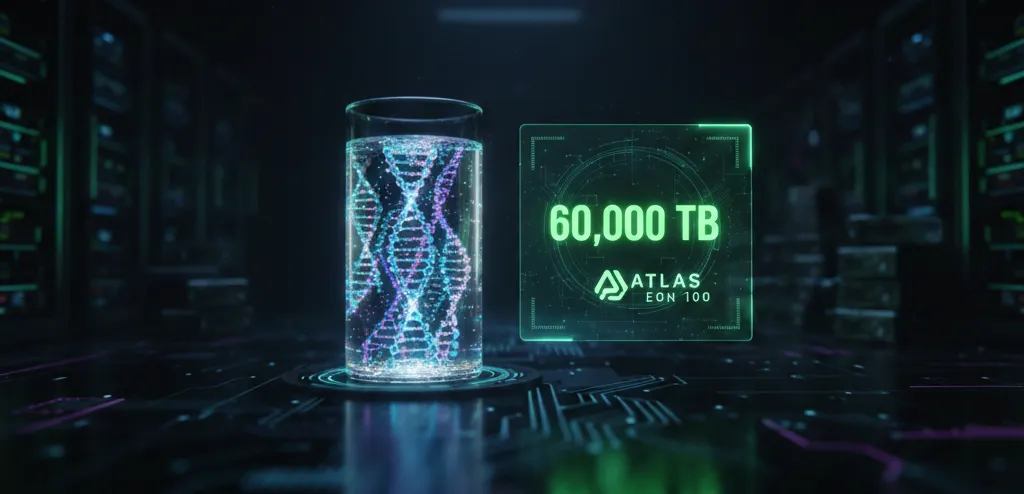
The world is creating digital information at an incredible rate. Every year, the volume of data grows exponentially, requiring ever more physical space, energy, and storage resources. However, Catalog recently unveiled its answer to this challenge: Atlas Eon 100. It is the world’s first scalable DNA-based data storage system, offering unprecedented DNA data storage density-a staggering 60,000 TB in a volume no larger than a typical liter bottle.
Atlas Eon 100: An Engineering Breakthrough in Long-Lasting Archiving
The Atlas Eon 100 was designed to address a problem traditional drives cannot: the need for long-lasting storage and tremendous space efficiency. Modern data centers are forced to regularly migrate “cold” data from HDDs or magnetic tapes due to their relatively short lifespan (typically 10-50 years) and significant cooling and power consumption costs. In contrast, the DNA at the heart of the Atlas Eon 100 requires no power after writing and can retain information for thousands of years.
How does DNA data storage work? The coding principle
The secret to this colossal density lies in the very structure of life. Traditional computer systems use binary code (0 and 1), while DNA operates with four nucleotide bases: adenine (A), guanine (G), cytosine (C), and thymine (T). This transforms binary code into quaternary code, where each base encodes two bits of information, providing orders of magnitude greater data packing density.
- The “Recording” process (encoding): Digital data is converted into a unique sequence of nucleotides. Instead of silicon chips, information is recorded by chemically synthesizing billions of short, artificial DNA strands known as oligonucleotides.
- Reading Process (Decoding): High-precision DNA sequencing technology is used to access the data, reading the A, T, C, G sequence. Special software then reconstructs these sequences back into the original binary format.
This revolutionary storage technology allows Catalog to achieve a density millions of times greater than conventional hard drives, allowing 60,000 TB to be stored in a single liter of physical volume.
Benefits and challenges of DNA storage
Key benefits of DNA data storage:
- Phenomenal Density: A single gram of DNA can theoretically hold the equivalent of millions of terabytes of data. The Atlas Eon 100 demonstrates this advantage at a commercial level, providing archives of up to 100 PB (petabytes) in compact modules.
- Unprecedented Durability: Data encoded in DNA can remain intact and accessible for thousands of years when stored in a cool, dry place, significantly reducing the total lifecycle cost of storage (TCO).
- Energy independence: Once data is written, DNA storage does not require continuous power consumption, which is critical for creating true cold data storage.
Main challenges and limitations:
- Speed: Current chemical synthesis (writing) and sequencing (reading) speeds are much slower than those of traditional electronic storage media. This makes the Atlas Eon 100 ideal for archiving, but unsuitable for online (hot) data.
- Cost: While the price of the Atlas Eon 100 has not been publicly disclosed, the initial cost of the equipment and chemical reagents for DNA synthesis is higher than traditional archiving solutions. However, thanks to technological advances and economies of scale, the cost of storing 1 TB is expected to drop to a few US cents.
Target Market and Competitors in the DNA Storage Industry
Catalog positions its product for large organizations that generate colossal amounts of rarely used data but must be preserved permanently. These include government agencies, research centers, and companies working with medical, genomic, and historical data.
It’s worth noting that Catalog isn’t alone in developing DNA-based long-term storage technologies. Tech giants like Microsoft have also been investing in DNA storage development for years, encoding hundreds of megabytes of data in their lab projects, confirming the strategic importance of this industry for archiving the data of the future. These revolutionary storage technologies are advancing rapidly, bringing us closer to an era when all the world’s digital information can fit in a truck.
Future Data Storage: No Longer Science Fiction
The introduction of the Atlas Eon 100 is more than just another product launch. It signals that DNA data storage has moved from the stage of academic experimentation to the stage of large-scale commercial implementation. With the world rapidly approaching the zettabyte mark, this technology offers an environmentally friendly and sustainable solution for generations to come.
The Atlas Eon 100 proves that biology is the best storage medium imaginable. Although the technology is still young, it has every chance of becoming the dominant standard for cold data storage in the coming decades.

0 Comments