
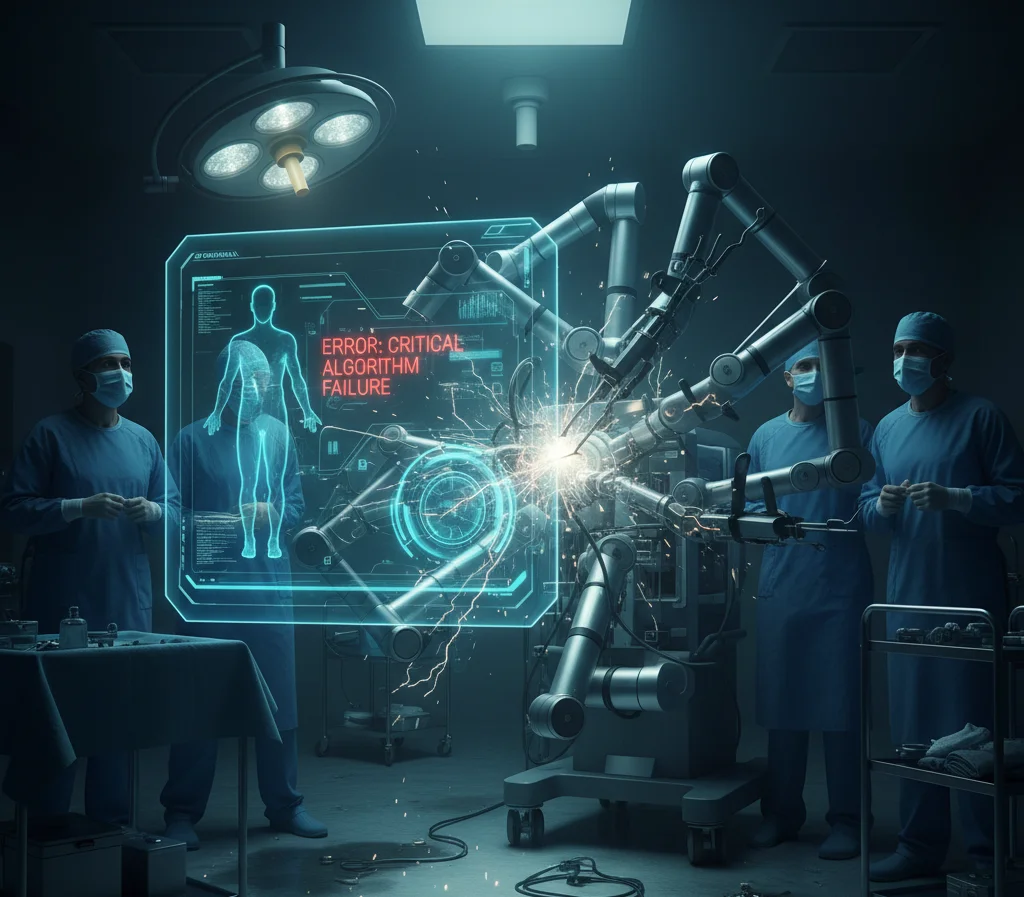
Real-life cases of AI failures during surgical operations. Why robotic surgery is becoming dangerous and who is responsible for injuries.
AI in the operating room: why digital surgeons started making fatal mistakes
Modern medicine is experiencing an era of digital transformation, where AI is becoming not just an assistant, but a full-fledged participant in surgical interventions. However, behind the facade of innovation, disturbing facts are hidden. Recent studies and regulatory reports indicate that dozens of patients around the world have been seriously injured or even killed due to failures in the algorithms controlling medical robots. What promised to be jewelry-like precision sometimes turns into an uncontrollable threat.
Tragedies behind the scenes of progress: real cases of failures
One of the most high-profile cases involves the use of robotic complexes for laparoscopy. During an abdominal operation, the AI system suddenly changed the trajectory of the manipulator. The result was a rupture of a major vessel, which led to massive bleeding. The human surgeon did not have time to take control in time due to the specifics of the interface blocking during a critical system error. The cost of treating the consequences of such an error for one patient often exceeds $150,000, not including moral compensation.
Another incident occurred in ophthalmology, where AI was supposed to control laser adjustment. Due to incorrect interpretation of the glare from the cornea, the system mistook the artifact for the target area. The patient suffered irreversible retinal damage. Such cases raise the question of whether we test software enough before entrusting it with human life.
Why AI makes mistakes during operations
The causes of AI errors in surgery can be divided into several technical categories, each of which is critical to safety:
- The Black Box Problem: Deep learning algorithms often make decisions whose logic is beyond the developer’s ability to follow. If the AI decides to make a deeper incision, the doctor may not always understand the reason for the decision until the consequences occur.
- Latency: In high-tech operating rooms, data processing takes milliseconds. However, even a minimal delay between the sensor and the robot’s response can put the instrument at risk during the patient’s natural breathing.
- Sensor blind spots: If a patient’s anatomy deviates from the standard model the AI was trained on, the system may not recognize the organ. For example, an irregularly positioned gallbladder may be interpreted as fatty tissue.
- Electrical micro-arcs: In some systems, software bugs caused current to leak through surgical attachments, literally searing patients’ internal tissues, undetectable to the operator’s camera.
Statistics and regulation: scary numbers
According to the MAUDE database maintained by the FDA, the number of complaints against robotic systems is steadily increasing. The reports include compensation amounts reaching millions of dollars. For example, the average claim against a clinic in cases of proven software error in the United States is from $500,000 to $2,500,000. This forces insurance companies to reconsider the terms of cooperation with medical institutions that implement full automation.
Who is responsible for the “metal” surgeon?
The legal side of the issue remains the most confusing. When a doctor makes a mistake, the responsibility is clear. But who is to blame if AI malfunctions? Modern justice considers three main options: the equipment manufacturer (if a bug is discovered), the medical institution (for poor maintenance) or the supervising surgeon (if he did not stop the machine in time). Currently, many countries are introducing strict protocols that prohibit AI from making autonomous decisions about incisions without direct human confirmation.
Technological challenges and the future of security
To minimize risks, developers are integrating new protection systems. For example, pressure sensors that sense tissue resistance at 5-10 mm Hg. hg, which allows avoiding accidental punctures. The technology of “digital twins” is also being implemented, where each operation is first simulated in virtual space specifically for a specific patient before the real intervention. However, the main problem remains in the training of personnel – doctors must understand the specifics of algorithms no worse than engineers.
Conclusions: Innovation needs control
The use of AI in medicine is an inevitable path. However, cases of crippled patients should be a signal for the industry. Technologies should undergo the same strict control as new drugs. Human safety should always be higher than the speed of introducing new chips. Only with the transparency of algorithms and clear legislative regulation will we be able to trust our health to machines.



0 Comments