
- Why are traditional media no longer relevant?
- 5D Memory: Concept and Benefits
- What does “5D” mean in technology?
- Operating Principle: How 5D Data Recording Works
- Recording tool: Femtosecond laser
- Reading information
- Historical progress and demonstration projects
- Prospects for application and commercialization
- Key areas of application:
- Challenges and Costs
- 5D Memory vs. the World’s Data Capacity
Learn about revolutionary 5D memory technology, which can store up to 360 TB of information for billions of years. Learn about its operating principles, applications, and the future of storage media.
5D Memory: A Revolution in Data Storage for Tens of Billions of Years
The world generates unprecedented volumes of information every day. From corporate archives to human cultural heritage, the need for reliable and long-term storage of information is becoming critical. Modern storage media, such as magnetic tapes or optical discs, have a limited lifespan, measured in decades. This creates enormous challenges for long-term data storage.
Why are traditional media no longer relevant?
- Limited lifespan: Hard disk drives (HDDs) and SSDs fail within 5-10 years, while Blu-ray discs only last for 50-100 years.
- Environmental Sensitivity: Data is sensitive to humidity, temperature, magnetic fields, and physical wear.
- Energy consumption: Maintaining huge data centers and constantly migrating data requires significant energy consumption.
These challenges have prompted scientists to develop a technology deserving of the title of information carrier of the future. This technology is known as 5D memory.
5D Memory: Concept and Benefits
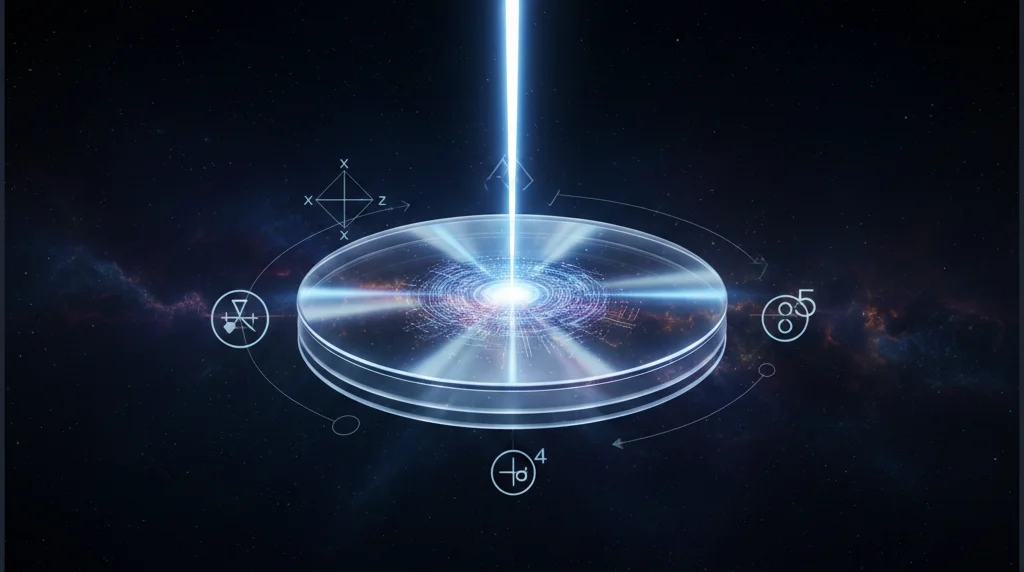
5D memory is an innovative data recording method developed by scientists at the University of Southampton. It uses fused silica to record information in nanostructures. This technology has been nicknamed “Superman memory crystal” due to its incredible stability.
- Extreme durability: the main advantage. According to research, at a temperature of 190°C, data recorded on a 5D disc can be stored for approximately 13.8 billion years. At room temperature, this lifespan is virtually indefinite.
- High recording density: 5D memory can hold up to 360 TV channels of information on a single, coin-sized disk. This significantly exceeds the capacity of any commercial storage media.
- Resistance to extreme conditions: Quartz glass can withstand temperatures up to 1000^circtext{C} and is virtually immune to chemical corrosion or physical impact.
What does “5D” mean in technology?
The name “5D” comes from the five dimensions used to encode information:
- Three spatial dimensions (x, y, z): This is the position of each nanodot or nanograting within the three-dimensional space of the quartz glass.
- Two optical dimensions: light intensity (brightness) and laser beam polarization, change the optical properties of nanostructures.
#VALUE! (Function GOOGLETRANSLATE parameter 1 value should be non-empty.)
Thanks to these five dimensions, each physical object (nanodot) inside the glass can contain much more information than a bit in a traditional 2D or 3D storage medium.
Operating Principle: How 5D Data Recording Works
Recording tool: Femtosecond laser
A high-precision femtosecond laser is used to write 5D memory. “Femtosecond” means that the laser emits pulses lasting only a few femtoseconds (10^{-15} text{ seconds}). These ultra-short pulses allow:
- Avoid thermal damage: Energy is released so quickly that it does not have time to dissipate as heat, preventing destruction of surrounding material.
- Create nanostructures: The laser pulse creates three layers of nanograin, changing the internal structure of the quartz glass.
Reading information
Data is read using a simple optical microscope and a polarizer. Nanostructures created by a laser alter the properties of the light passing through them. By analyzing the changes in polarization and light intensity, a specialized reading device decodes the information recorded in five dimensions.
Historical progress and demonstration projects
The initial research leading to the creation of 5D memory technology was presented to the public in 2013-2015. Scientists demonstrated the technology’s ability to store civilization’s most important documents.
Among the historical documents that have been successfully recorded on a 5D disc:
- The Great Charter of Liberties (Magna Carta).
- Declaration of Human Rights (Universal Declaration of Human Rights).
- “Opticks” by Isaac Newton.
These successful demonstrations confirmed that long-term information storage could be transformed from science fiction into technical reality.
Prospects for application and commercialization
While 5D memory technology will not replace everyday storage devices due to current write speed limitations, it has ideal applications in the archival data storage space.
Key areas of application:
- National Archives and Libraries: Preserving millions of books, documents, and cultural artifacts for future generations.
- Enterprise data centers: Cold storage for data that is rarely accessed but must be retained forever (such as legal records or backups).
- Space and scientific research: Storing data from missions and experiments lasting decades or centuries.
Challenges and Costs
One of the main challenges remains recording speed. Current speeds are relatively slow compared to SSDs or HDDs, making 5D memory impractical for immediate use. Furthermore, recording equipment, including a femtosecond laser, is expensive. Initial installation costs can reach hundreds of thousands of US dollars.
However, given that 5D drives do not require constant maintenance or migration, the overall cost of storing data forever becomes more cost-effective over time than the ongoing support of traditional systems.
5D Memory vs. the World’s Data Capacity
Analysts predict that by the end of the decade, the volume of data generated globally could exceed 175 zettabytes. Each 5D memory disk, with a capacity of 360 TB, is a small but powerful building block in solving this global problem.
The introduction of this 5D data recording technology paves the way for the creation of archives that will outlast civilization itself, ensuring the preservation of knowledge for all future generations. This is truly the most significant breakthrough in information storage in decades.


0 Comments