
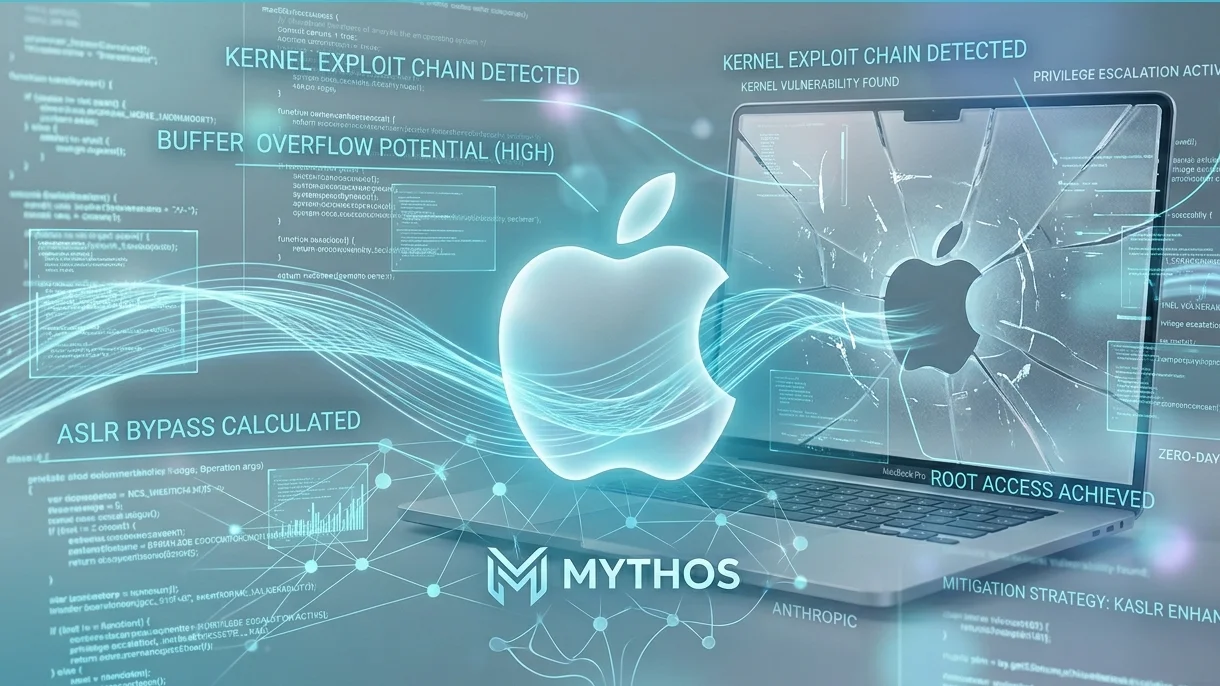
AI vs Apple – A New Era of Cyber Threats
Security researchers have officially confirmed the use of a specialized AI model from Anthropic, dubbed Mythos, to successfully breach the macOS kernel. This study marks the first documented case where a Large Language Model (LLM) was able to independently identify and exploit vulnerabilities within Apple’s closed ecosystem without prior knowledge of the source code.
How Mythos Operates in the macOS Environment
Unlike traditional fuzzing tools that rely on random inputs, Mythos employs semantic analysis of binary code. The AI is capable of understanding the logic of system calls and finding logical errors in memory management that typically escape automated scanners.
Technical Specifications of Identified Vulnerabilities
The researchers focused on the IOKit subsystem and graphics kernel drivers. Thanks to Mythos, three critical vulnerabilities were found, allowing the bypass of SIP (System Integrity Protection). This grants an attacker full access to the file system and personal user data.
- ASLR Bypass: The AI discovered a way to predict kernel memory addresses with over 98% accuracy.
- Privilege Escalation: Capability to execute code with root privileges via a use-after-free vulnerability.
- macOS 15 Integration: The exploits successfully worked on the latest versions of the operating system.
Financial Implications and Risks
Experts estimate the cost of discovering such bugs on the dark market exceeds 500,000 USD. However, the use of AI lowers the entry barrier for cybercriminals, as the automation of complex reverse engineering processes becomes accessible to a wider audience.
Apple’s Response and the Future of Security
Apple has already initiated an internal investigation and is preparing emergency security patches. It is expected that future macOS updates will include additional layers of code integrity verification based on machine learning to counter AI-generated attacks. This confrontation marks the beginning of an arms race in cybersecurity, where both sides utilize intelligent algorithms.



0 Comments