
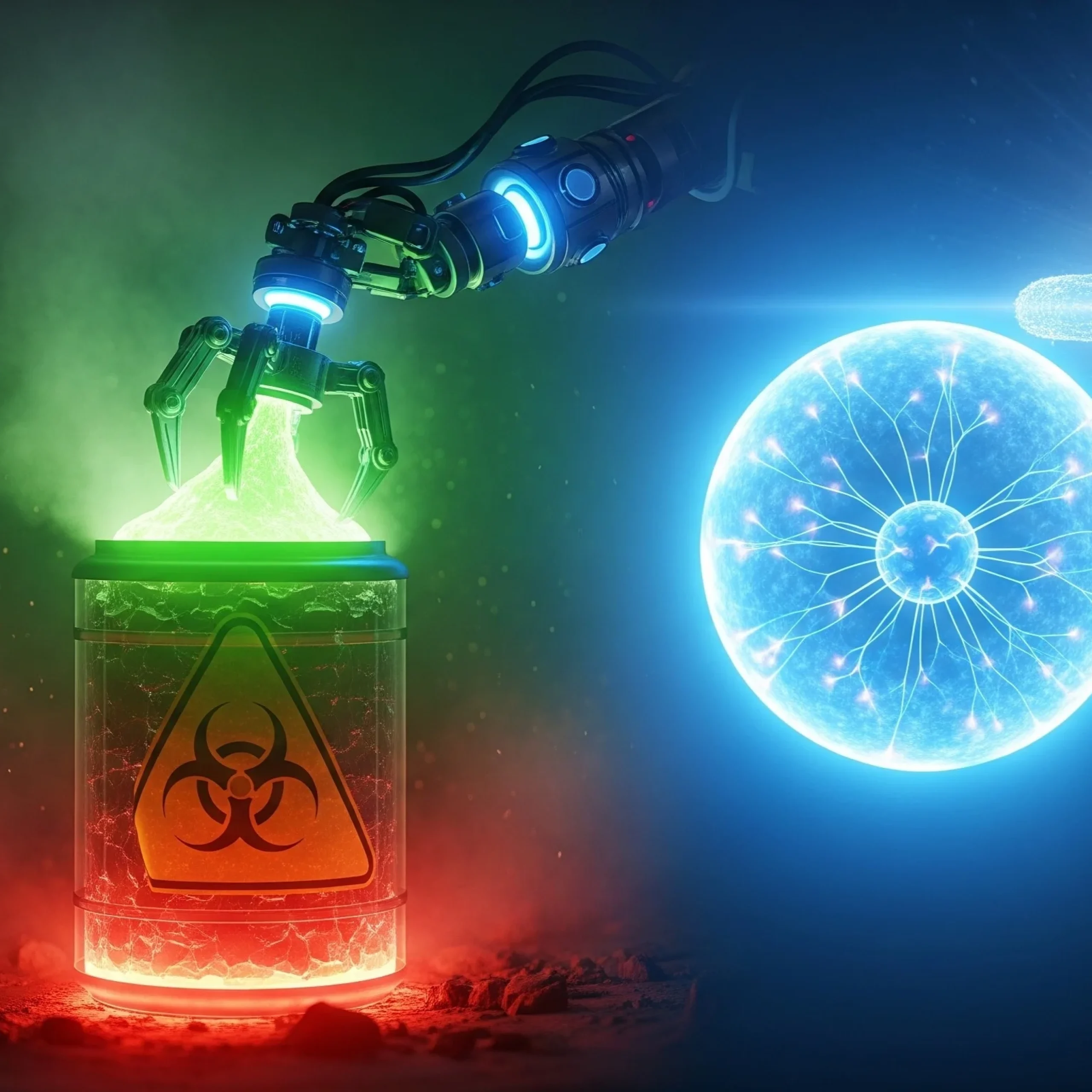
Modern nuclear energy faces two major challenges: nuclear waste disposal and the search for new, efficient energy sources. However, scientists at Los Alamos National Laboratory, led by physicist Terence Tarnowski, have proposed a solution that could change everything. They discovered that the isotope tritium, crucial for nuclear fusion, can be isolated from spent nuclear fuel. This research not only solves the tritium shortage but also transforms hazardous waste into a valuable resource, potentially marking a breakthrough toward a clean and sustainable energy future.
Why is tritium so important?
Tritium is an isotope of hydrogen with two neutrons instead of one. This makes it an ideal fuel for nuclear fusion reactions. When tritium and deuterium nuclei collide at extremely high temperatures, they fuse, releasing colossal amounts of energy. This is the principle underlying today’s most ambitious projects, such as the ITER international fusion reactor, which aims to prove the commercial viability of fusion energy. However, tritium is rare in nature, has a half-life of only 12.3 years, and is extremely expensive to produce.
Currently, tritium is produced in very small quantities in specialized reactors, limiting the development of nuclear fusion. The shortage and high cost of tritium are among the main obstacles to the commercial implementation of fusion energy.
Waste becomes a resource: how does it work?
Research has found that tritium is formed as a byproduct during the separation of uranium-235 in nuclear reactors, but its concentration in spent nuclear fuel is very low. However, even these small amounts accumulate in large volumes of waste.
The proposed method utilizes complex chemical and physical processes to separate and purify tritium from waste. This not only provides a new stream of this valuable material but also solves the problem of long-term nuclear waste storage. By transforming it into a commercially valuable resource, this approach could transform the economic model of waste management and make nuclear energy more sustainable.
The path to clean fusion energy
If Terence Tarnowski and his team’s research is successful, it will have far-reaching consequences.
- Stable Fuel Supply: Access to a new source of tritium will accelerate fusion research and pave the way for commercial power plants.
- Environmental benefit: Extracting tritium from nuclear waste will reduce the volume of hazardous substances requiring long-term storage, making the entire industry more environmentally responsible.
- Cost Reduction Over time, as production technology improves, the cost of tritium could drop significantly, making fusion more economical.
This research is a shining example of how innovations in physics can not only solve current problems but also open up new avenues for global energy development.



0 Comments