
A New Milestone in Alternative Fuel Development
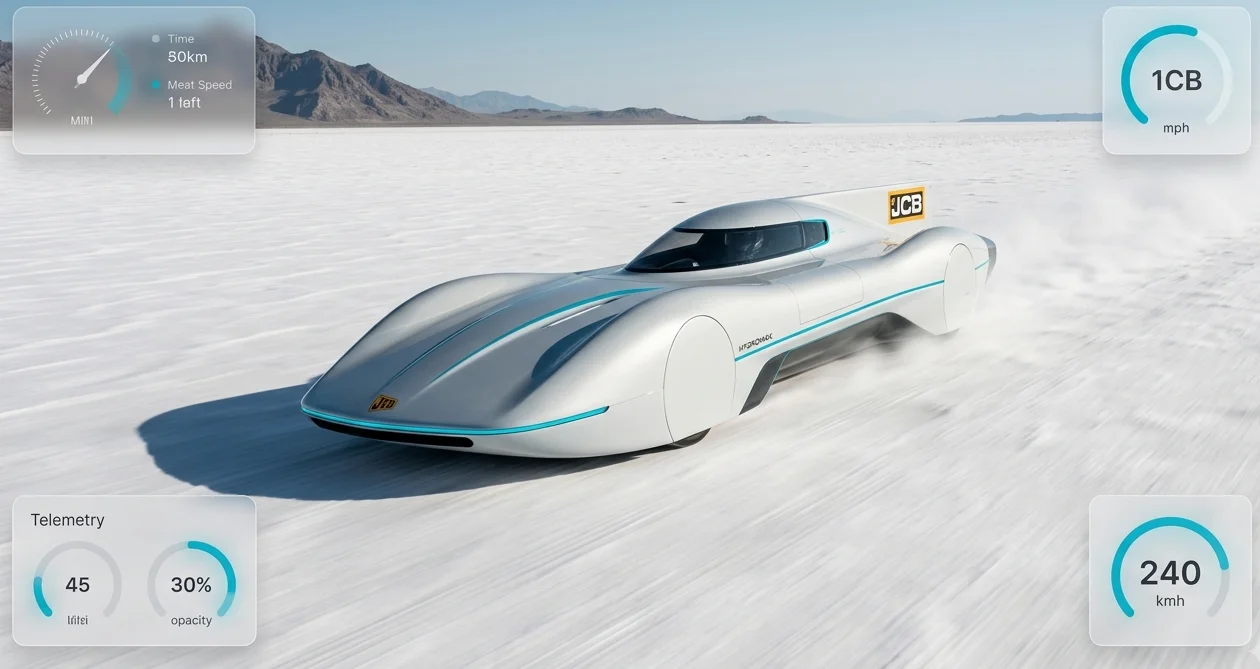
On the famous Bonneville Salt Flats in Utah, a new official land speed record for hydrogen-powered vehicles was established. British driver Andy Green, behind the wheel of the experimental JCB Hydromax streamliner, reached a top speed of 406.320 mph, equivalent to 653.908 km/h. The result was officially ratified by representatives of the International Automobile Federation (FIA) following two mandatory runs in opposite directions.
This event carries significant weight for the automotive industry as it more than doubles the previous record for vehicles powered by hydrogen internal combustion engines. The project was funded and engineered by heavy equipment giant JCB to demonstrate the capabilities of hydrogen technology in heavy machinery and transport applications. The engineering team proved that zero-emission fuel can deliver extreme power and reliability under critical operating conditions.
2>Engineering Details and JCB Hydromax Design
The JCB Hydromax vehicle differs fundamentally from conventional rocket or turbojet streamliners typically used for absolute land speed attempts. At the heart of its powertrain are two internal combustion engines based on production JCB Dieselmax units, heavily re-engineered to run on compressed hydrogen gas.
To achieve high power output without destructive pre-ignition, engineers developed a custom high-pressure direct gas injection system combined with forced induction. This setup resolved the detonation issues commonly associated with burning hydrogen in traditional cylinder layouts.
Technical Specifications of the Record Streamliner
The streamliner body underwent extensive testing in wind tunnels to achieve an ultra-low drag coefficient. Solid aluminum wheels without pneumatic tires were specifically manufactured to endure immense centrifugal forces operating at rotational speeds exceeding 6000 rpm.
The Bonneville Salt Flats Runs
According to FIA regulations, official record verification requires two runs performed in opposite directions within a one-hour window. The final recorded figure represents the average speed achieved across the measured one-mile distance.
During the first pass, Andy Green pushed the JCB Hydromax to 409.112 mph. Following rapid pit service, refueling, and thermal checks, the vehicle completed its return run at 403.528 mph. High ambient temperatures and reduced elevation air density presented challenges, but the thermal management systems operated within safe margins throughout the test.
Key Operational Steps During the Event
- Track Inspection: Surface analysis of the salt crust to identify micro-fissures and debris.
- Telemetry Verification: Calibration of fuel pressure sensors and exhaust gas temperature monitors.
- High-Pressure Refueling: Supplying chilled hydrogen into carbon-composite storage tanks.
- Engine Initialization: Pre-heating two power units using external auxiliary heating systems.
- Launch Procedure: Aerodynamic push-start to 50 mph to preserve clutch pack integrity.
Industry Impact and Future Prospects
While mainstream green initiatives heavily prioritize battery electric architectures, heavy machinery, long-haul freight, and aviation face strict energy density limits. The JCB Hydromax project confirms that hydrogen internal combustion engines serve as a viable carbon-neutral alternative without needing full battery conversion.
Utilizing hydrogen in combustion engines allows manufacturers to retain existing production lines and mechanical supply chains while reducing tailpipe emissions strictly to water vapor. The successful runs at Bonneville establish high-stress reliability data for future commercial applications.



0 Comments