
- Why is Gemini a revolution over Google Assistant?
- Gemini’s safety-enhancing features
- Quick and accurate summarization of information
- Voice control of complex routes
- Deep integration with the Google ecosystem
- Technological Foundation: AI Multimodality
- Future Prospects for AI in the Car
- Availability and terms of application
- Preparing for the Android Auto AI update
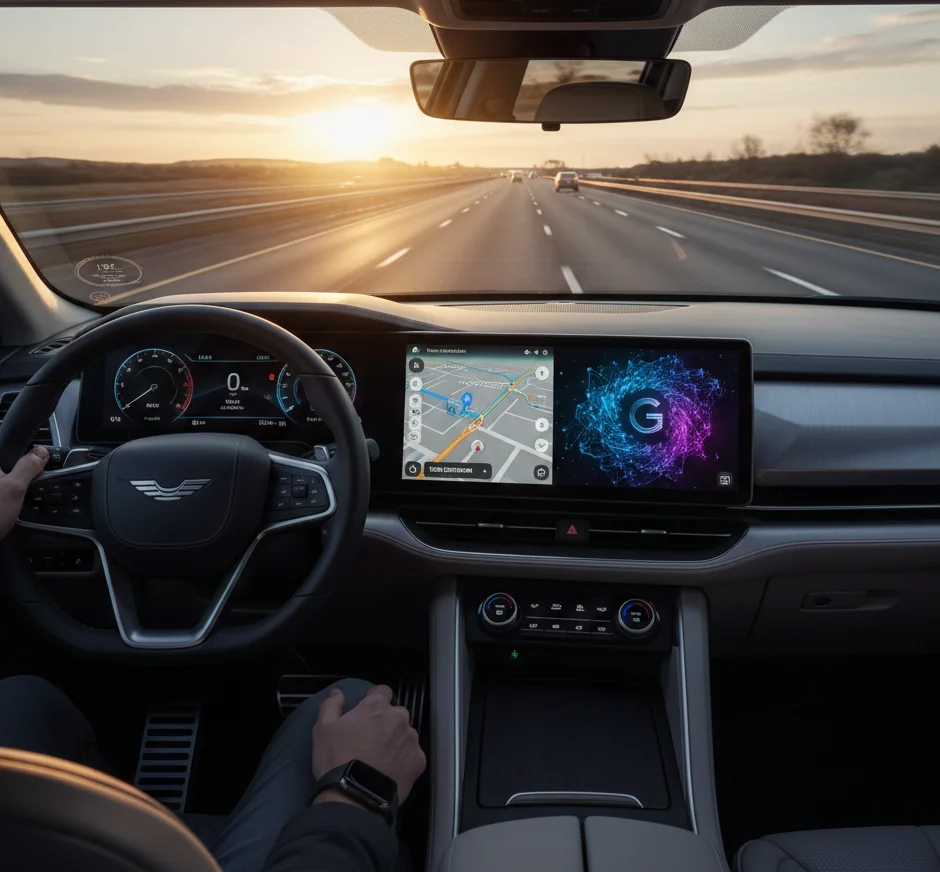
Google has officially announced a significant transformation of its in-car system. The classic Google Assistant, long the foundation of Android Auto interaction, is being replaced by Google Gemini. This change marks a shift from traditional voice control to deep integration of generative AI, opening up entirely new possibilities for drivers and passengers. This isn’t just an update; it’s a fundamental shift in the philosophy of interacting with in-car electronics.
Why is Gemini a revolution over Google Assistant?
The key difference lies in the architecture. While the previous assistant relied on predefined commands and scripts, Google Gemini is a large-scale multimodal model (LLM). This gives it the ability not only to execute instructions but also to understand context, maintain the flow of conversation, and perform multi-step tasks. Instead of verbalizing precise commands, the driver can communicate with the system in a more natural, human-like language.
- Contextual Memory: Gemini Android Auto remembers previous requests in the current session, allowing you to build more complex dialogs.
- Multitasking: The system can simultaneously manage navigation, media, and messaging, seamlessly switching between tasks.
- Natural Languages: AI better recognizes slang, intonation, and vague queries, minimizing the need for repetition.
Gemini’s safety-enhancing features
Safety is a top priority for any in-car technology. Gemini’s integration with Android Auto is designed to reduce driver cognitive load and minimize screen distraction. New AI features provide critical capabilities not available in the previous version.
Quick and accurate summarization of information
The greatest advantage of AI in the safety context is its ability to quickly process large volumes of text. Instead of listening to a long chain of work emails or a detailed text chat, Gemini instantly generates a concise and informative summary. Drivers hear only the key information, making decisions faster and without taking their eyes off the road. This applies not only to text messages but also to news or other information received.
Voice control of complex routes
With Android Auto’s AI update, planning complex trips becomes intuitive. Drivers can verbally request, “Find the nearest gas station with the lowest prices on my route to Boston, then add a coffee stop for no more than $5, as long as it doesn’t delay me more than 15 minutes.” Google Gemini will process this complex request, integrate it with Google Maps, and update navigation.
Deep integration with the Google ecosystem
Gemini’s Android Auto integration goes beyond simple commands. As a native Google product, the AI seamlessly interacts with other popular services, making the car part of the user’s unified digital ecosystem.
- Google Maps: Improved voice navigation, the ability to change the display mode or find alternative routes using natural language.
- Google Calendar: Quickly check when your next meeting starts or add a reminder by simply saying, “Add a reminder to call a client when I get to the office.”
- Media Players: Easily control playback, search for tracks, or even generate playlists based on your mood (“Play something energetic for a long drive”).
Technological Foundation: AI Multimodality
While Gemini’s initial focus is on voice interaction, its multimodal nature (the ability to process various types of data, including text, images, and audio) offers extraordinary potential. In the future, subject to technical feasibility and regulatory approval, AI will be able to utilize data from vehicle cameras.
Future Prospects for AI in the Car
This could include a voice query like, “What’s that passing by on the right?” followed by object identification and information. This would transform the in-car assistant into a true digital guide. The introduction of this technology strengthens Google’s position in the embedded systems market, challenging competitors using less advanced voice technologies or proprietary systems.
Availability and terms of application
The transition to Google Gemini will be gradual. Initially, the new features will be available to users in key regions with support for key languages, including English. Ukrainian Android Auto users can expect expanded AI functionality as Google scales language support and fully replaces the old assistant with Gemini. This requires updating both the Android Auto system itself and its accompanying mobile apps.
Preparing for the Android Auto AI update
Users don’t need to purchase new hardware, as the update is software-based. However, to ensure optimal performance of the in-car AI, it is recommended to update your smartphone’s operating system to the latest version of Android to ensure full compatibility with Google Gemini’s capabilities. This integration is expected to make the in-car voice assistant experience so seamless that drivers will never want to return to their previous method of interaction.
Gemini’s integration into Android Auto is a significant step forward, transforming a typical in-car voice assistant into an intelligent, contextually aware partner that truly helps you drive safer and more efficiently.



0 Comments