
First Success in Space-Based Tissue Engineering of Internal Organs
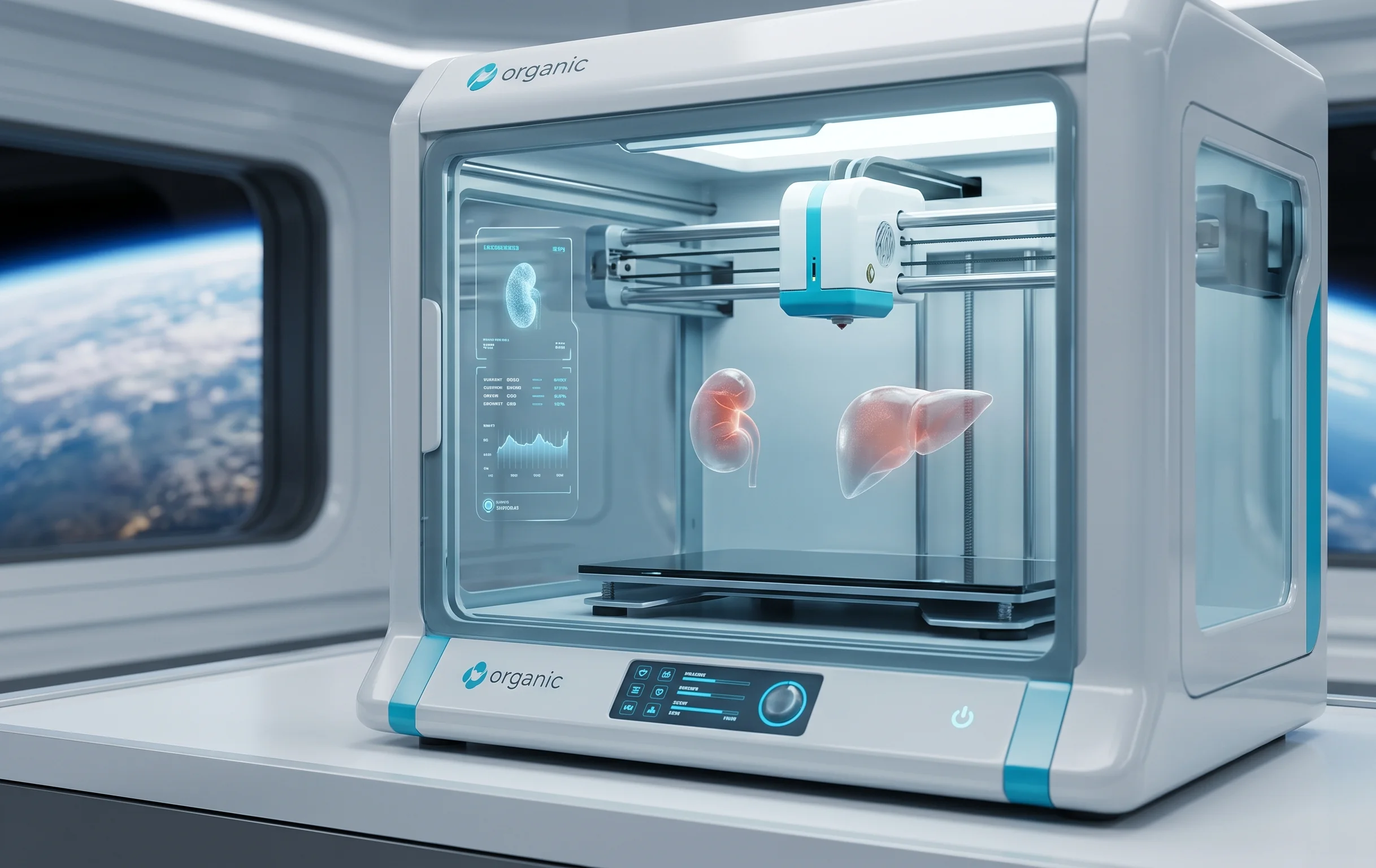
American startup Auxilium Biotechnologies has announced a historic achievement in space medicine and biotechnology. For the first time under microgravity conditions aboard the International Space Station (ISS), functional tissue samples of human kidney and liver have been successfully 3D-bioprinted. This experiment opens new horizons not only for future transplantology in space but, more immediately relevant, for creating fundamentally new methods of drug testing.
The experiment was conducted using the specialized AMP-1 orbital 3D-bioprinter, developed by Auxilium. The key advantage of bioprinting in space lies in the absence of gravity, which on Earth causes soft biological structures to sag and deform under their own weight before the tissue formation process is complete. In microgravity, cells can distribute uniformly and maintain a specified three-dimensional shape, enabling the creation of more complex and accurate tissue models.
Why Gravity Hinders Bioprinting on Earth
When creating three-dimensional biological structures on Earth, engineers and scientists face a serious challenge: soft living cells and the bioinks containing them lack sufficient structural rigidity. Under the influence of Earth’s gravity, printed tissue layers are prone to settling, which leads to distortions in geometry and internal structure of the organoids.
To counteract this effect on Earth, temporary supporting scaffolds made of gels or polymers are often used, which are later removed. Thickeners are also applied to bioinks. However, these methods have drawbacks: they can affect cell viability, complicate the process, or leave foreign traces in the finished tissue.
In space, under constant free-fall conditions, gravity is practically absent. This allows cells to float freely in the nutrient medium and settle precisely at designated points without undergoing deformation. As noted by Dr. Anthony Atala of the Wake Forest Institute for Regenerative Medicine, who collaborated with Auxilium, microgravity ensures an extremely uniform distribution of cells, which is critical for the functionality of future organs.
AMP-1 Orbital Bioprinter: A Multifunctional Platform
The AMP-1 device used in the experiment is not just a printer for a single type of tissue. During the same mission to the ISS, it demonstrated its versatility by printing not only kidney and liver tissues but also samples of cartilage tissue and 28 implants designed for nerve repair.
According to Auxilium Biotechnologies, this is the first instance where three different tissue types have been produced within a single spaceflight, and the first demonstration of a multi-profile manufacturing platform operating in orbit. This is an important step towards creating autonomous medical manufacturing complexes in space.
Return to Earth and Further Research
The samples of the printed tissues and nerve implants successfully returned to Earth last month aboard a SpaceX Dragon cargo capsule. They are currently undergoing detailed analysis in Auxilium’s laboratories and partner scientific institutes. Scientists are evaluating the structure, cell viability, and functional characteristics of the resulting organoids (tiny, simplified organ models).
Immediate Real-World Application: Drug Testing
It is important to understand that the kidney and liver tissues printed in space are small experimental samples, not full-fledged organs ready for human transplantation. Creating complex organs permeated with a network of blood vessels remains a challenging task, the solution to which will take many more years.
However, these space biomodels have immense potential for immediate application in the pharmaceutical industry. The resulting organoids can mimic the reactions of real human organs to new drug candidates. Pharmaceutical companies will be able to use them to test the efficacy and toxicity of compounds, which will significantly reduce, and in the future, possibly entirely eliminate, testing on animals.
This approach is highly relevant as the global community, including regulators such as the FDA in the US, is actively seeking alternatives to animal models. Obtaining accurate human organoids grown in space could accelerate new drug development and make the process safer.
Business Strategy and Future Outlook
Auxilium Biotechnologies’ successful experiment is part of a broader business strategy aimed at securing a niche in the space manufacturing market. The ISS is planned to be decommissioned around 2031, and commercial space stations are preparing to take its place.
Auxilium is already positioning its bioprinters as equipment for future commercial platforms, such as stations from Vast and Starlab. The company views space not as an exotic laboratory but as an effective location for manufacturing high-tech medical products, where microgravity conditions serve as a technological advantage that cannot be replicated on Earth.
This achievement confirms that space is becoming increasingly accessible not only for fundamental science and tourism but also for practical, commercially viable manufacturing that can bring real benefits to medicine on Earth.
Below is a comparison of printing parameters in space versus on Earth:


5 Comments
cool of course but I barely believe this will solve the transplantation queue problem in the next 10 years.. How much will one such organ grown in space cost?? it will be golden
and what stops from creating artificial microgravity on Earth for this? like in some centrifuges or magnetic fields?? why drive the printer all the way to the ISS, it is like hell expensive and inconvenient
Finally at least some real step to stop animal testing!! if this allows testing drugs faster then it is just a mega breakthrough. wonder how fast companies will actually switch to such organoids?
everyone is talking about ISS but it is retiring soon. do you seriously think private stations like Vast or Starlab will manage to deploy commercial production by 2031? looks way too optimistic
wait, how do cells even survive during the flight back to Earth in the dragon capsule? there are crazy G-forces upon atmospheric entry, don't they just deform again??