
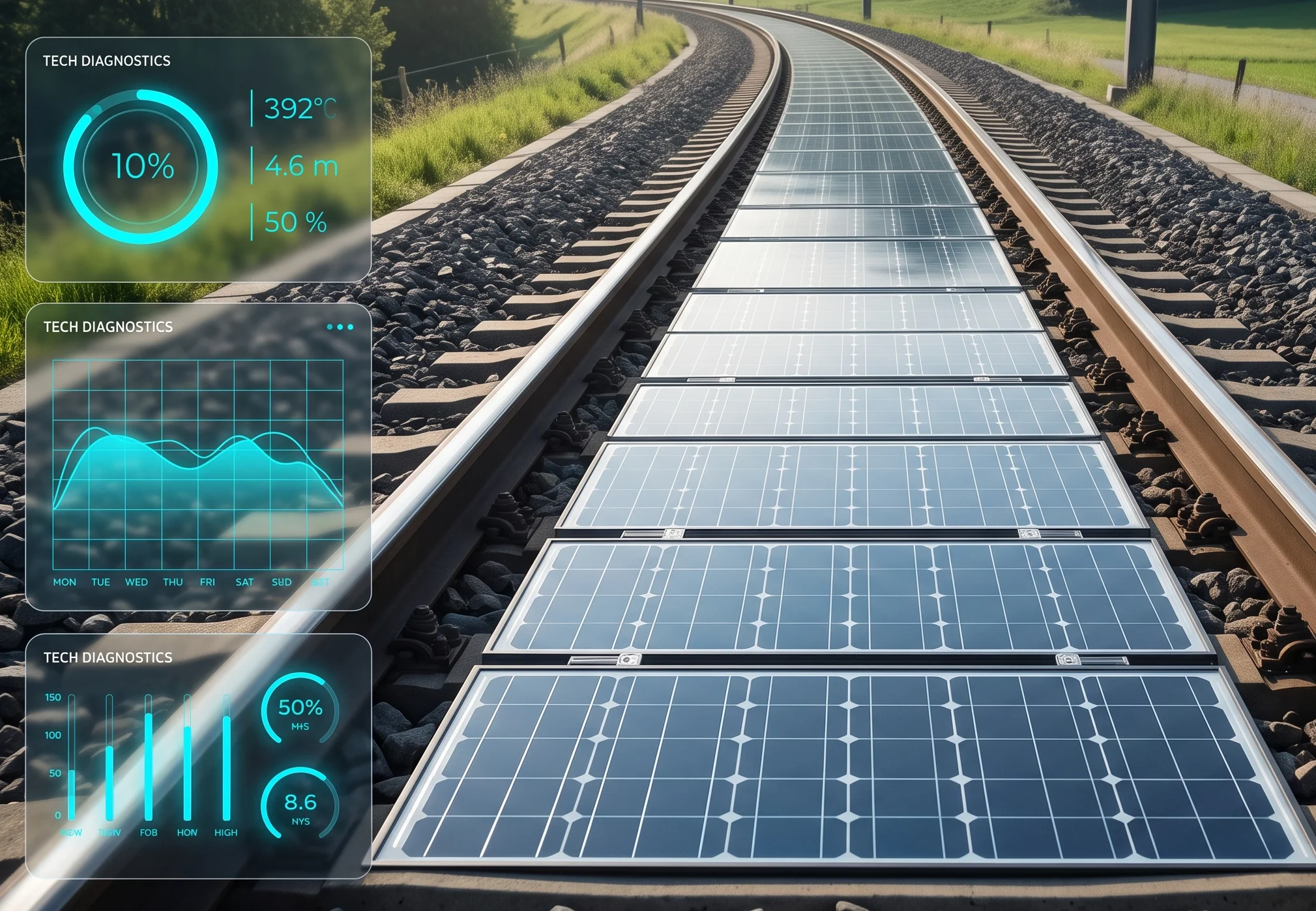
Integration of Photovoltaics into Railway Infrastructure
The search for alternative sites for renewable energy generation is forcing engineers to go beyond traditional rooftop or ground-mounted solutions. One of the most promising and yet challenging areas is the use of free space between railway tracks. The technology, which passed its first tests in Switzerland, is now being prepared for large-scale deployment in Italy. The main advantage of this approach is the use of existing infrastructure without the need to acquire new land plots, which is critical for densely populated European regions.
Italian railway network operator Rete Ferroviaria Italiana (RFI) has officially announced the launch of a pilot project to test removable solar systems. The partner of the initiative is the Swiss startup Sun-Ways, which has developed a unique patented mechanics for quick installation and removal of photovoltaic elements. The new approach allows turning ordinary sleepers into a source of clean energy without creating obstacles for regular maintenance of the railway track.
Technical Features and Fast Installation Mechanism
The key problem with previous attempts to integrate solar panels into railway infrastructure was the complexity of track maintenance. Railway tracks require regular ballast cleaning, rail grinding, and sleeper geometry control. The Sun-Ways design solves this problem with a special mechanical fastening system. The panels are delivered to the work site pre-assembled and laid between the rails using a special train equipped with a mechanized laying device.
The installation process resembles unrolling a carpet. A special railway car moves at a speed of up to 1 kilometer per hour, automatically fixing the solar modules to the sleepers using clamps. If routine track repair or snow removal is needed, the same train can dismantle the panels at a similar speed. This eliminates the need for long-term traffic blocking and the involvement of large manual labor crews.
Environmental Effect and Operational Challenges
According to preliminary expert estimates, covering at least 10% of Italy’s railway network with solar panels would generate energy volumes equivalent to the operation of several large thermal power plants. The resulting electricity can be fed directly into the overhead contact line to power locomotives or transmitted to the country’s general power grid to meet the needs of nearby settlements.
However, the operation of photovoltaics in such extreme conditions is associated with a number of technical challenges. First, it is a high level of pollution. Dust, small metal particles from brake pad and rail wear, and lubricants can significantly reduce the transparency of the protective glass. To solve this problem, Sun-Ways is developing a special anti-reflective and dirt-repellent coating. Second, strong vibrations generated during the movement of heavy freight trains require increased strength of silicon wafers and reliability of electrical connections.
Prospects for Technology Scaling in Europe
The Italian project is seen as an important step towards standardizing the technology at the pan-European level. Since the railway tracks of most European countries have a standard gauge of 1435 millimeters, the Swiss development is universal. Interest in conducting similar tests has already been expressed by the French national operator SNCF, which indicates the formation of a new trend in European renewable energy.
In addition to the purely energetic effect, installing panels on sleepers performs an additional protective function. The elements partially protect the railway ballast from excessive overheating under direct sunlight in summer. This reduces the risk of rail bucking due to thermal expansion, which is a serious problem for the southern regions of Italy in the context of global climate change.




0 Comments