
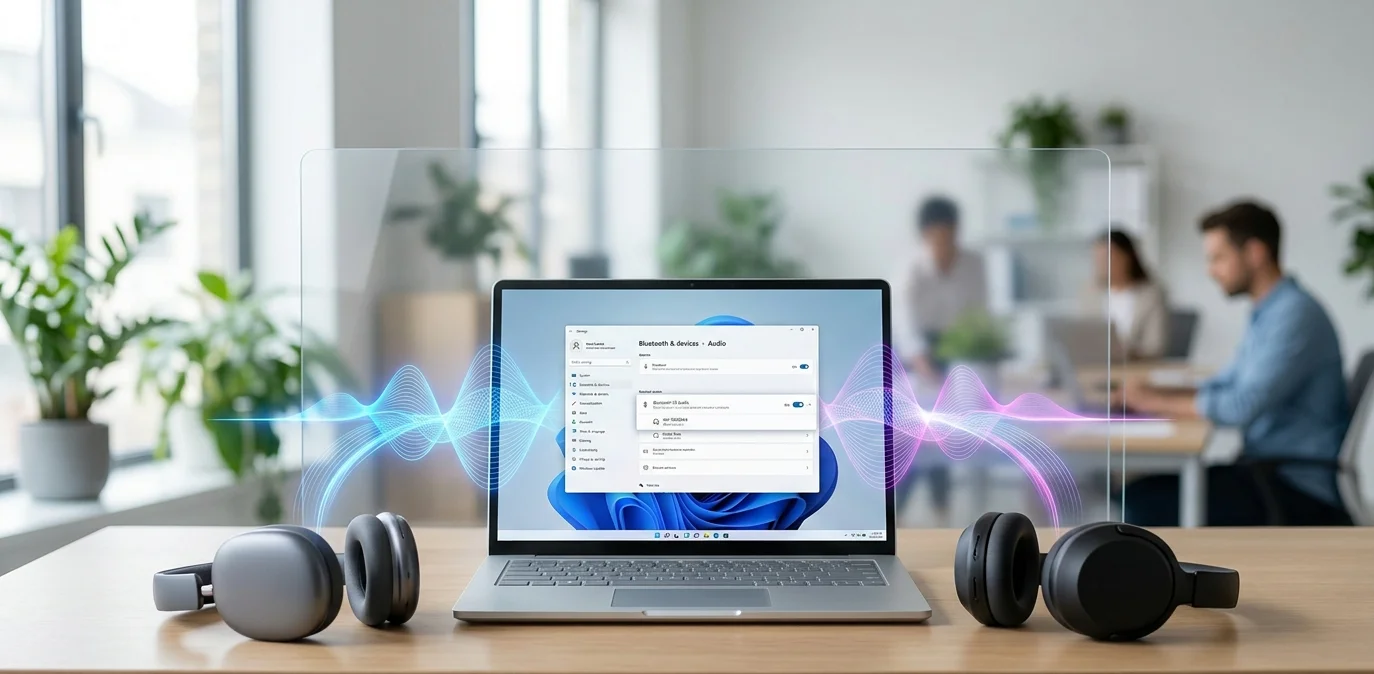
A Major Shift in Microsoft Windows Audio Subsystem Architecture
Simultaneous audio output to multiple wireless devices has historically been a significant architectural limitation of the Windows operating system. Users were forced to rely on third-party hardware splitters or complex audio virtualization software utilities. With the latest Windows 11 update, Microsoft has integrated native support for a feature that enables parallel audio broadcasting to two pairs of Bluetooth headphones or compatible speakers without compromising quality or sync synchronization.
The integration of this functionality was achieved through a deep modernization of the wireless communication stack and a transition to state-of-the-art data transmission standards. This update is specifically designed for scenarios such as watching movies together, listening to podcasts, or delivering presentations where two users share a single computer screen.
Technical Framework – Bluetooth LE Audio and Auracast
The foundation of this new Windows 11 capability is the Bluetooth Low Energy (LE) Audio architecture, introduced by the Bluetooth SIG to replace the legacy Bluetooth Classic Audio standard. The core element of this framework is the Auracast broadcast audio specification, which transitions from the traditional point-to-point connection topology to a wide-area broadcasting model.
In contrast to the outdated SBC codec, the new standard utilizes the highly efficient LC3 (Low Complexity Communication Codec). This codec ensures high-density audio transmission at a significantly reduced bitrate. The following technical comparison table details the differences between these audio transmission standards.
Reducing the bitrate without reducing the frequency response characteristics freed up radio frequency bandwidth, allowing the operating system to allocate enough data throughput to broadcast a second independent audio channel to adjacent headphones.
Hardware and System Requirements
To operate wireless broadcasting to two pairs of headphones simultaneously, updating the Windows 11 software layer is necessary but not sufficient. The technology requires specific hardware specifications from both the host computer and peripheral audio devices:
- Bluetooth Adapter: The built-in or external Bluetooth module must support Bluetooth version 5.3, 5.4, or higher, and feature hardware-level support for LE Audio.
- Audio Devices: Both pairs of wireless headphones must be certified for LC3 codec operation and support Auracast broadcast signal reception.
- OS Version: A current build of Windows 11 with the latest servicing updates for the Core Audio subsystem is required.
If either of the connected audio devices only supports the legacy Bluetooth Classic standard, the operating system will fall back to compatibility mode, disabling dual audio broadcasting capabilities.
Configuration Interface and Stream Management
The wireless broadcast control interface is integrated into the native Windows 11 Quick Settings panel, accessible from the right side of the taskbar. Users can open the audio output selection menu, where a new broadcast icon will appear next to the main volume slider.
- Enable the Bluetooth wireless module within the Windows system settings.
- Pair both sets of headphones sequentially using the standard device addition assistant.
- Navigate to the advanced volume mixer panel and select the option to broadcast to multiple targets.
- Initiate the Auracast session, enabling both peripheral devices to receive an identical audio signal.
A notable feature of Microsoft’s implementation is the ability to adjust volume levels independently for each pair of connected headphones directly within the system volume mixer. This allows users to adapt the sound intensity to their personal preference.
Latency Analysis and Power Efficiency
A major flaw in early dual-audio prototypes was audio-to-video desynchronization and channel drift between the two separate playback devices. Thanks to deterministic time-synchronization mechanisms built into the LE Audio architecture, hardware latency has been restricted to a range of 20-50 ms. This duration is imperceptible to human senses and provides an optimal media viewing experience.
Energy efficiency represents another significant advantage. By optimizing the compression algorithms of the LC3 codec, power consumption on both the headphone batteries and the laptop wireless controller is reduced by roughly 30-40% compared to legacy SBC audio streaming at equivalent perceived sound quality levels.


0 Comments