
The Scaling Barrier in Avian De-Extinction
De-extinction projects targeting long-lost species have consistently faced a severe technological barrier: the inability to replicate embryonic development conditions outside a living organism or a natural nest. While mammalian resurrection efforts can rely on surrogate mothers from closely related species, this pathway is closed for giant egg-laying creatures. The moa, a flightless bird that went extinct approximately 600 years ago in New Zealand, left behind genetic material, but finding a natural surrogate is impossible due to the unique physical parameters of its eggs.
The closest living relatives of the moa, such as the kiwi or the emu, lay eggs that differ significantly in volume, shell thickness, and gas exchange rates. Attempting to place an engineered embryo of a giant bird into the egg of a smaller species inevitably leads to embryonic death due to oxygen deprivation or moisture imbalance. Consequently, Colossal Biosciences has focused its efforts on building a completely controlled artificial environment capable of replacing the natural eggshell of large avian species.
Technological Framework of the Artificial Egg
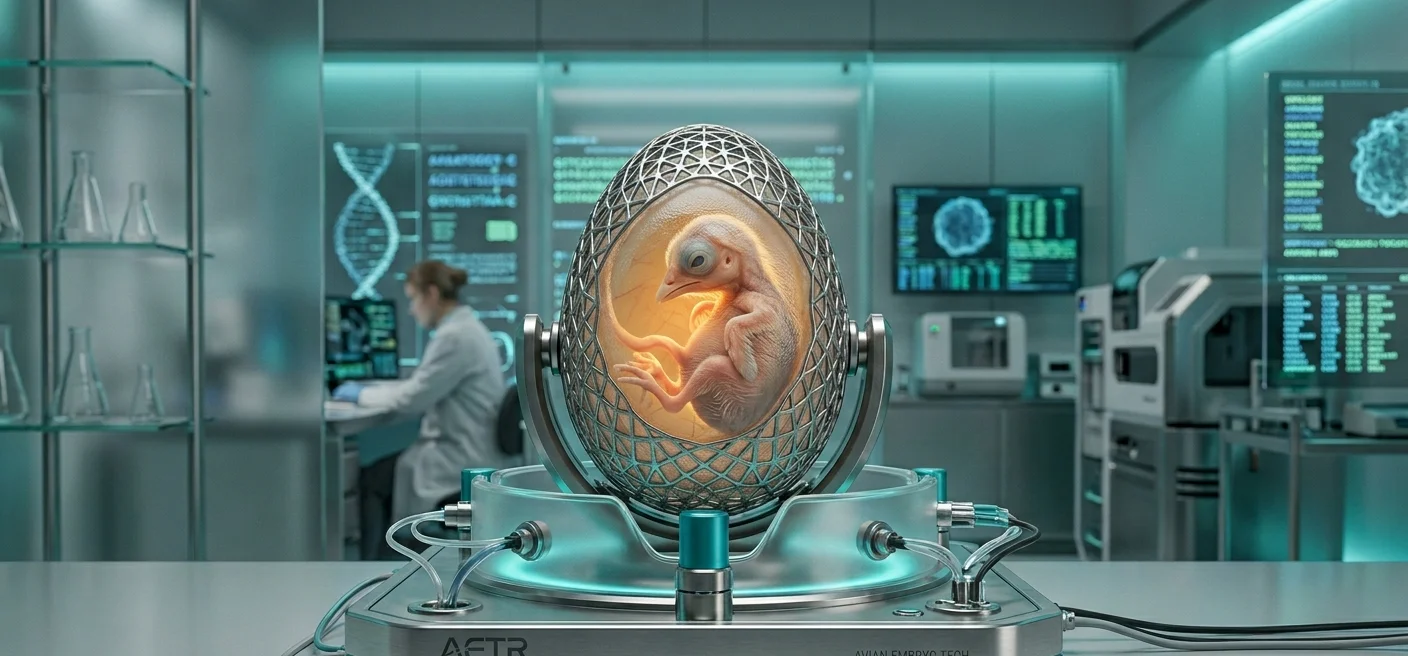
Engineers have designed a hybrid system that visually and functionally replicates the structure of an avian egg while allowing absolute control over every stage of incubation. The core of the design consists of a rigid, 3D-printed titanium alloy framework. This lattice structure provides the mechanical stability necessary to support the substantial weight of the developing embryo and its nutrient medium.
The critical biological component of the system is a specialized, semi-permeable silicone membrane. It mimics natural eggshell function by regulating gas diffusion and moisture evaporation. The internal chamber of the artificial egg is linked to a closed-loop microfluidic system that continuously refreshes the nutrient solution, clears metabolic waste, and maintains stable osmotic pressure. To validate this bioengineered platform, scientists conducted an extensive study using model organisms.
Testing the Platform on Model Species
Before advancing to work with reconstructed moa genetic material, researchers validated the shell-less incubation technology on avian models. During the study, scientists successfully hatched 26 live chicks that underwent their entire developmental cycle inside the artificial devices. This confirmed that the engineered environment does not induce developmental abnormalities and fully meets the physiological needs of the embryo across all growth stages.
Throughout the incubation process, computer arrays continuously monitored oxygen consumption, carbon dioxide emission, and temperature fluctuations. The artificial shell allowed researchers to dynamically adapt the thickness and permeability of the membrane as the embryo grew, an intervention impossible within a natural eggshell. This milestone clear the path for scaling the apparatus to match the physical dimensions of giant moa eggs, which could weigh several kilograms.
Future Application in De-Extinction Initiatives
The development of a scalable artificial incubation system addresses one of the primary constraints in resurrecting giant extinct birds. The next step for researchers involves optimizing the platform to handle larger volumes of biomaterial. Given that the largest moa species reached heights exceeding 3 meters and masses of up to 250 kilograms, their eggs require precise pressure distribution within the incubator to prevent damage to the delicate embryonic vascular network during early development phases.
Beyond the scientific pursuit of restoring New Zealand’s lost megafauna, this technology holds immediate value for contemporary ornithology. It can be deployed to safeguard endangered bird species threatened by habitat destruction or avian pathogens. The ability to incubate embryos from damaged or unviable eggs within an artificial titanium-silicone shell will substantially boost chick survival rates in conservation programs and research facilities globally.



0 Comments