
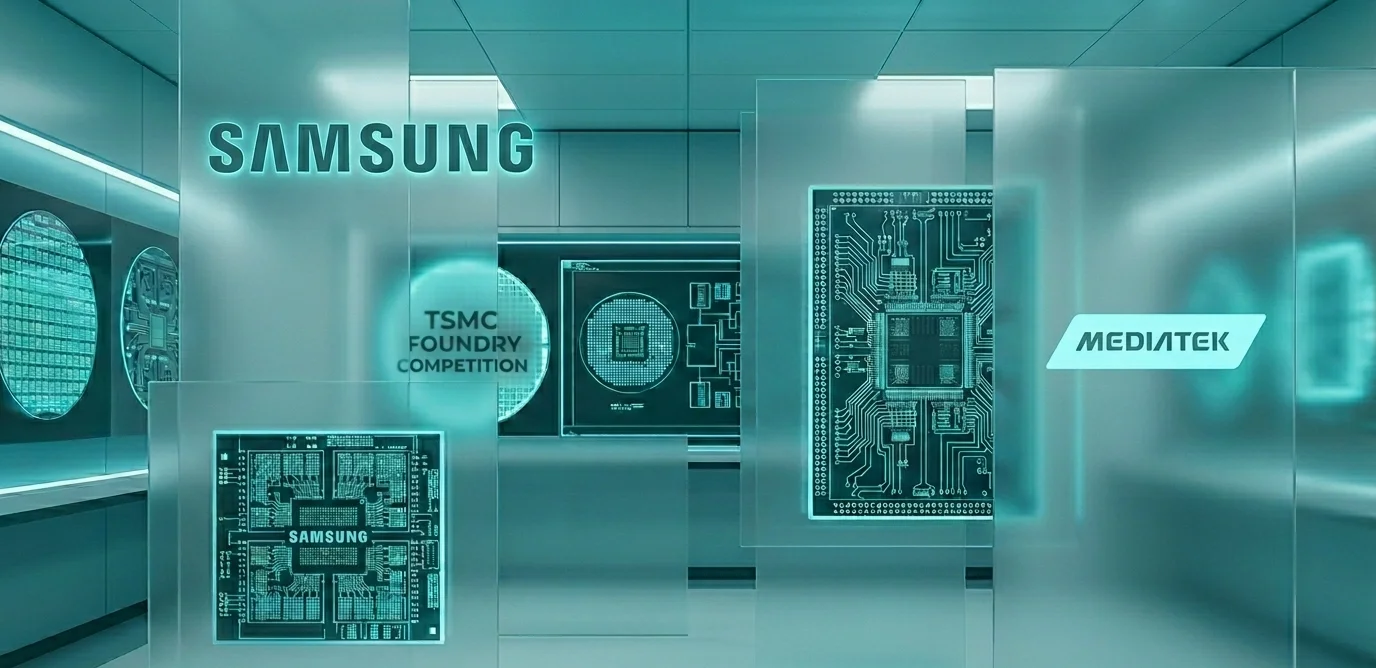
Secret Meetings in Taipei Highlight Intensifying Foundry Rivalry
Market observers have reported an unofficial visit by Lee Yoon-tae, the head of Samsung Electronics’ semiconductor division, to Taiwan. The primary objective of this unannounced trip, which remains unconfirmed by official corporate channels, is to hold direct high-level talks with MediaTek executives. The South Korean tech giant is reportedly moving to secure the major mobile processor designer as a client for its contract manufacturing arm, Samsung Foundry. Currently, MediaTek relies almost exclusively on Taiwan Semiconductor Manufacturing Company (TSMC) for its chip production, solidifying TSMC’s dominance over more than half of the global foundry market.
Industry analysts view Samsung’s latest initiative as an aggressive countermeasure to address prolonged challenges within its semiconductor business. In recent years, the company has struggled with low production yields on its advanced nodes, prompting prominent clients like Qualcomm and Nvidia to shift the bulk of their orders to TSMC. Securing a manufacturing partnership with MediaTek could mark a major turning point for Samsung, potentially restoring global industry confidence in its manufacturing capabilities.
Technical Dynamics and Advanced Lithography Node Competition
The core focus of the ongoing discussions centers on next-generation lithography nodes. MediaTek is actively designing high-performance mobile chipsets for its premium Dimensity lineup, requiring the most advanced transistor architectures available. Samsung Foundry is attempting to attract the chip designer with its second-generation 3-nanometer process node (SF3), which utilizes Gate-All-Around (GAA) transistor technology. South Korean engineers maintain that the GAA architecture offers superior power efficiency and higher transistor density compared to the traditional FinFET structure that TSMC continues to deploy for its 3nm N3-series nodes.
However, migrating production to Samsung’s facilities poses notable technical and supply chain risks for MediaTek. Adapting an existing integrated circuit design for a different foundry’s specific process rules requires substantial capital investment and months of engineering work. Unless Samsung can guarantee stable production yields reaching at least 60 to 70 percent, MediaTek risks disrupting its shipping schedules to major smartphone manufacturers.
MediaTek’s Financial Incentives and Supply Chain Diversification
For MediaTek, a potential partnership with Samsung could serve as a valuable tool to mitigate financial pressure exerted by TSMC. Given its dominant market position, TSMC has consistently raised its silicon wafer pricing over recent quarters. Each successive manufacturing milestone introduces higher production costs, directly squeezing MediaTek’s profit margins and driving up retail prices for smartphones. Securing Samsung as a secondary supplier would provide MediaTek with significant leverage during future price negotiations with TSMC.
Furthermore, heightened geopolitical considerations surrounding Taiwan are encouraging fabless semiconductor firms to aggressively pursue geographical diversification strategies. Samsung operates extensive manufacturing operations in South Korea and is rapidly expanding its production capacity in Texas, USA. This established footprint positions Samsung as a stable long-term partner, despite its near-term challenges in optimizing state-of-the-art lithography equipment yields.
Future Outlook for the Global Semiconductor Ecosystem
Industry experts emphasize that even if preliminary agreements are finalized, the first commercial MediaTek processors manufactured via Samsung’s foundries would not reach the market for another 18 to 24 months. This timeframe is essential for engineers to fully adapt complex processor topologies to meet the South Korean manufacturer’s specific design guidelines. While TSMC remains the primary beneficiary of current mobile market dynamics, Samsung’s proactive engagements in Taiwan signal the early stages of a broader realignment within global technology supply networks.



0 Comments