
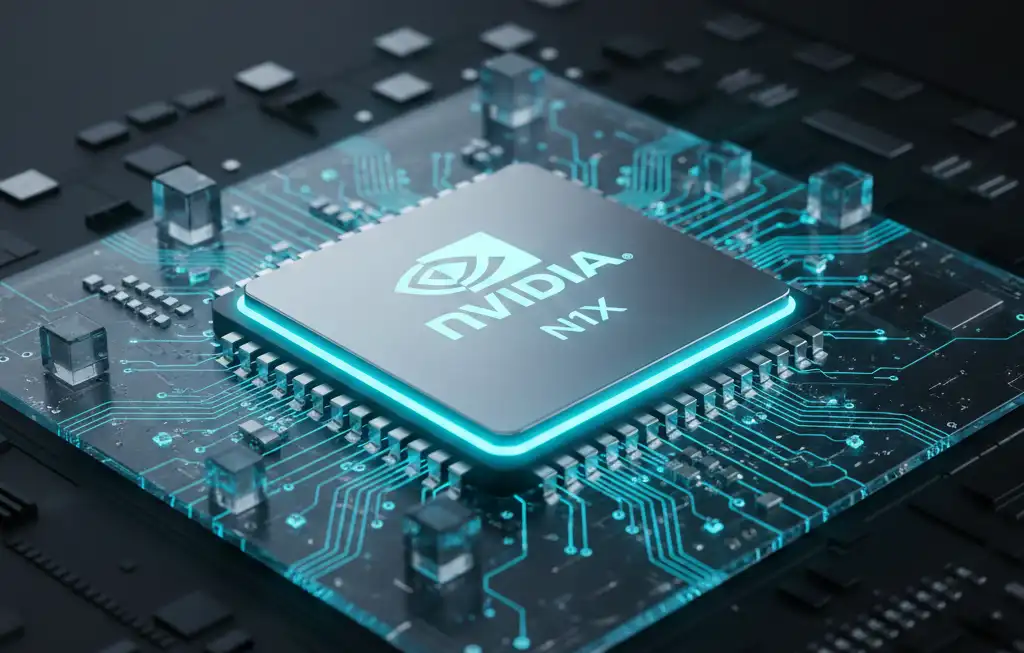
Tech giant NVIDIA is on the verge of a historic move that could change the landscape of personal computing forever. According to the latest data, the company is completing the development of its own ARM-based central processors, which will become the basis for a new generation of laptops in 2026. This is not just another attempt to enter the CPU market, but an ambitious plan to create the most powerful integrated platform capable of competing with Apple Silicon and solutions from Qualcomm.
The project is being implemented in close collaboration with MediaTek, which allows combining NVIDIA’s vast experience in graphics technologies and AI with MediaTek’s expertise in creating energy-efficient mobile systems on a chip (SoC). The new line has been codenamed N1 and N1X, and the first test results are already forcing market leaders to reconsider their development strategies for the coming years.
Characteristics of the N1 and N1X chips
The processor series will be divided into two segments: the energy-efficient N1 for ultrabooks and the flagship N1X for professional gaming workstations. Both chips are based on TSMC’s advanced 3nm process technology, which enables incredible transistor density and low power consumption.
- The N1X processor will receive 20 computing cores, including the flagship Cortex-X925 cores, providing record single-threaded performance in a Windows environment.
- The graphics subsystem is based on the Blackwell architecture, which is used in the latest 50-series desktop cards.
- The power of the integrated GPU in the N1X model is estimated to be equivalent to a discrete RTX 5070 graphics card, which is an unprecedented figure for an SoC.
- The built-in NPU for AI tasks delivers performance of over 100 TOPS, far exceeding the requirements of the Copilot+ PC standard.
The use of LPDDR6 memory with a bandwidth of over 500 GB/s allows the GPU to operate without the bottlenecks typically found in integrated solutions. This means that users will be able to play modern AAA games with ray tracing without the need to install a separate bulky graphics card, which will allow laptops to be significantly thinner and lighter.
Partnership with MediaTek and the role of AI
MediaTek’s role in this project is difficult to overestimate. The company took on the development of memory controllers, I/O blocks and integration of 5G modems. However, the “heart” of the chip remains NVIDIA technologies. Special attention is paid to AI blocks, as the modern market requires local processing of complex neural network models. Thanks to the new generation tensor cores, N1X-based laptops will become ideal tools for developers, designers and Data Science specialists.
Support for DLSS 4.0 (Deep Learning Super Sampling) is expected to allow upscaling of in-game images to 4K resolution at high frame rates using only the resources of the integrated chip. This makes the NVIDIA ARM platform a direct competitor not only to Intel Core Ultra, but also to next-generation game consoles.
First devices from Lenovo and Dell
Laptop manufacturers are already actively testing engineering samples of new processors. The most active position is taken by Lenovo. Leaks from the certification database confirm that the Yoga line in 2026 will receive modifications based on the NVIDIA N1. These devices are positioned as premium solutions for content creators, where autonomy (up to 25 hours of operation) and high speed of processing media files are important.
- Lenovo Legion 7 ARM Edition: a gaming laptop without discrete graphics, but with performance on par with last year’s top systems.
- Dell XPS 13 “Emerald”: an ultrabook on the N1 chip with fully passive cooling and support for Windows 11 AI tools.
The base models with the N1 processor will start at $1,100, while the top-of-the-line N1X models can cost over $2,500 depending on the screen and memory configuration. This puts them in direct competition with the MacBook Pro, while offering a much broader gaming library thanks to the NVIDIA ecosystem and driver optimizations.
Windows 11 software optimization
One of the main problems with ARM platforms has been software compatibility. Microsoft and NVIDIA are working on a new level of emulation, Prism, that will allow you to run x86 applications with virtually no performance loss. Windows 11 (26H1) will introduce specific drivers for the Blackwell GPU, providing direct access to hardware acceleration for most professional applications from Adobe and Autodesk.
Energy efficiency and the future of the market
The move to ARM allows NVIDIA to radically reduce the thermal design power (TDP). While modern gaming laptops require 240-330W power supplies, N1X-based systems can deliver similar performance while consuming only 80-100W. This means less fan noise, lower case temperatures, and the ability to use compact USB-C chargers.
The market expects that the emergence of NVIDIA N1/N1X will force Intel and AMD to accelerate the development of their own energy-efficient architectures. However, the presence of a huge user base accustomed to the GeForce brand gives NVIDIA a huge marketing advantage. 2026 will be the starting point when the concept of “gaming laptop” will no longer be associated with a heavy and hot machine.



0 Comments