
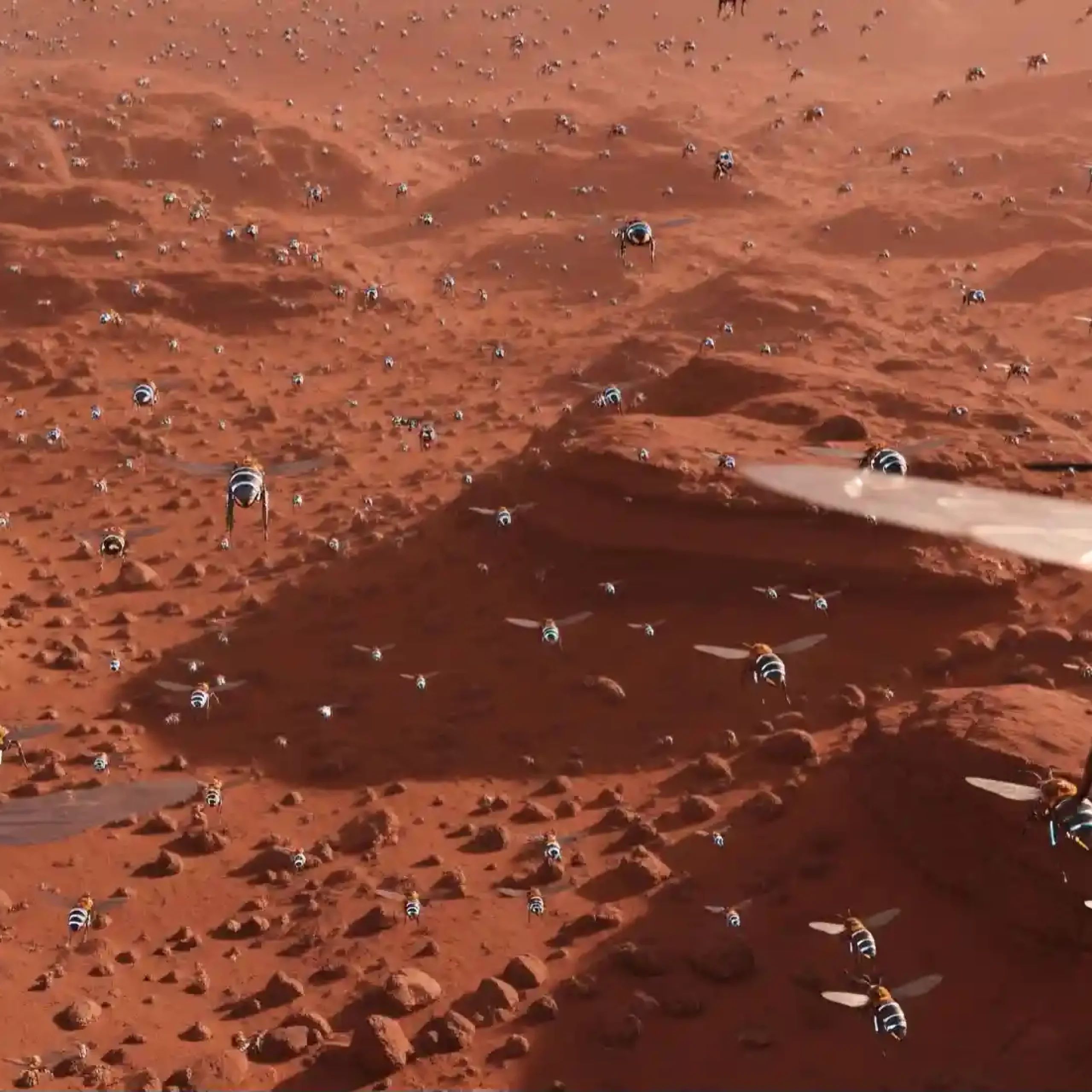
The exploration of Mars has always been one of humanity’s most ambitious goals. We’ve relied on large, reliable rovers like Curiosity and Perseverance to explore the Red Planet’s surface. However, these giants are limited by their speed and ability to traverse challenging terrain, such as steep slopes or deep craters. Now scientists face a new challenge: how to explore every corner of the planet without risking expensive equipment? The answer has been found in an unexpected place-the world of insects. Engineers from NASA and American universities have developed a concept that could change the future of space missions: NASA’s Marsbee project.
From Mars Rovers to Flying Robots: The Evolution of Exploration
Rovers have undoubtedly accomplished a tremendous amount, providing us with invaluable data on the geology, atmosphere, and potential life on Mars. However, their mobility is limited. They cannot fly over canyons, penetrate caves, or reach high mountain peaks. This led to the idea of creating a small flying robot that could act as a scout. The use of miniature vehicles has made it possible to explore areas that rovers cannot reach. Their small size makes them less expensive to manufacture and deliver to the planet.
Technological challenges of the thin atmosphere
The main technical challenge for beekeeping is the extremely thin atmosphere of Mars, which is only about 1% of Earth’s atmospheric pressure. This means traditional methods for generating lift are unsuitable. Engineers solved this problem by developing a wing design that mimics the motion of insect wings. This system is capable of generating lift through high-frequency flapping, allowing the beekeepers to remain aloft. It is this innovative approach that gives the project its name, Marsbee. This American development is the result of a collaboration between the University of Alabama in Huntsville and George Washington University, underscoring its scientific validity.
Collective Intelligence: The Power of Robot Swarms
Instead of deploying a single robot, scientists are proposing swarm technology. Deploying dozens or even hundreds of small robots offers several advantages. First, if one robot fails, the mission won’t be disrupted, as the others will continue their work. Second, a swarm can perform distributed tasks, such as creating 3D maps of the terrain simultaneously. Robots can fly as a group, transmitting data to each other, ensuring greater reliability. This also allows for covering larger areas in less time.
Each swarm of robots will be equipped with cameras, microphones, and small sensors to collect information. Thanks to a collective intelligence system, they will be able to automatically coordinate their actions, make decisions, and avoid obstacles without direct control from Earth, which is critical for a space mission. This approach is completely new in space exploration and could become standard practice for future missions to other planets and moons.
Future space exploration from Marsbee
The Marsbee project is more than just a concept; it’s a significant step in the development of space technology. Successful development of this robotic bee could pave the way for exploration we could only dream of before. Compact flying vehicles will be able to study the atmosphere and search for water or signs of life in remote regions where larger craft would be unable to maneuver. This will allow us to gain a much more complete picture of Mars and other celestial bodies.
Beyond Mars, similar technologies could be used to explore space in places like the moons of Saturn or Jupiter, which have thick atmospheres. The potential for developing this technology is enormous. The success of Marsbee will demonstrate that the future of planetary exploration lies in small, autonomous, and collaborative spacecraft. This is further proof that human inventive genius can overcome any challenge the universe presents. The Marsbee project is more than just a robotic bee; it is a symbol of a new era in exploring the unknown.
Key Benefits of Marsbee
- High mobility: The rover can fly over complex terrain, reaching areas inaccessible to rovers.
- Mission Resilience: If one robot fails, the others continue to carry out the mission.
- Teamwork: Swarm can perform complex tasks that require simultaneous data collection from multiple locations.
- Cost reduction: Small spacecraft are significantly cheaper to manufacture and launch than large rovers.
- Efficiency: Ability to cover a larger area in less time.



0 Comments