
- Kakedzan: A City Philosophy Where Innovations Intertwine
- Three Paths: Future Mobility Infrastructure
- Energy and Sustainability: Hydrogen and Zero Footprint
- Practical Testing: Homework and AI Health Monitoring
- Who are the “Weavers” and the “Inventor”?
- Inventors
- Weavers (Woven)
- Prospects and timeframes for implementation
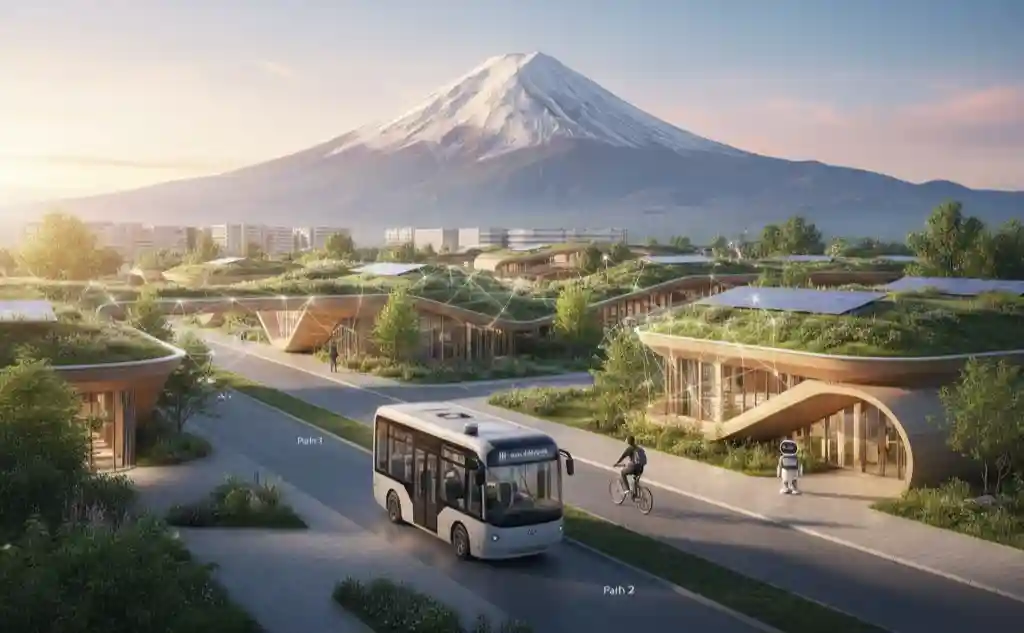
Toyota has launched a unique and ambitious project that reimagines the very concept of urban living. At the foot of Japan’s sacred Mount Fuji, on the site of a former automobile factory in Susono, the company has invested approximately $10 billion to create Woven City – the world’s first prototype of a fully integrated, connected smart city. This initiative is more than just a residential complex; it’s a “living laboratory” designed to test and refine technologies that will become the foundation of everyday life by 2050.
Kakedzan: A City Philosophy Where Innovations Intertwine
The name “Woven City” reflects the project’s core philosophy, based on the Japanese concept of “Kakezan” (multiplication). The idea is synergistic: combining Toyota’s advanced manufacturing and infrastructure expertise with the software solutions of its subsidiary, Woven by Toyota, and the ideas of partners, startups, and research institutions. The goal is to create an environment where innovation intertwines in real-world settings, enabling the rapid development and adaptation of new solutions.
Three Paths: Future Mobility Infrastructure
Woven City was designed by renowned Danish innovative architect Bärke Ingels. The key planning element is a unique street grid consisting of three parallel paths that form the logistics and transportation system of the future:
- Path 1: Designed exclusively for high-speed, fully autonomous transport, such as the Toyota e-Palette self-driving electric buses. These vehicles provide efficient logistics and passenger transportation without human intervention.
- Path 2: Medium-speed streets designed for individual micromobility, such as electric scooters, bicycles and specialized delivery vehicles.
- Path 3: Wide pedestrian areas are completely free of traffic. They are integrated with parks and squares, providing a safe and comfortable environment for social life.
Additionally, the city’s underground infrastructure includes a hidden network for automated goods delivery and waste collection. This reduces traffic congestion and visual pollution above ground, improving quality of life.
Energy and Sustainability: Hydrogen and Zero Footprint
Woven City embodies sustainable energy principles. The city was designed with a zero-carbon footprint and environmental responsibility in mind.
- Green Building: Most buildings, including smart homes, are constructed from sustainable wood and use traditional Japanese building techniques.
- Hydrogen Energy: The city’s primary power source is a combination of solar panels and hydrogen fuel cells, which produce clean, emission-free energy. This is part of Toyota’s strategy to develop hydrogen technology.
Practical Testing: Homework and AI Health Monitoring
Woven City functions as a giant testing ground for advanced technologies. All smart homes are equipped with sensors and connected to the city’s central operating system, which is powered by AI.
- Robotics: Residents interact with home assistants that help with routine tasks. Robotic couriers and assistants for the elderly are also being tested.
- Healthcare Systems: A unique network of AI sensors and systems can continuously monitor residents’ health indicators and needs, predicting potential problems and improving overall safety.
- AI optimization: Artificial intelligence manages all key processes – from energy distribution and drone traffic optimization to waste management.
Who are the “Weavers” and the “Inventor”?
Woven City’s residents are divided into two key categories, each of which plays a critical role in the development of innovation.
Inventors
This group includes employees from Toyota, its subsidiaries (such as Denso and Aisin), as well as external startups and research institutions. Their mission is to develop, implement, and test new technologies directly in the urban environment.
Weavers (Woven)
These first residents are Toyota employees and their families. They are the direct users of the innovations. Their key task is to provide feedback on the operation of systems, robots, and mobility, helping the “inventors” improve their products and services. Initially, the city is designed to accommodate approximately 300 people.
Prospects and timeframes for implementation
Construction of Woven City began in 2021. The first “Weavers” began moving in in the fall of 2025. This marks the transition from construction to the active testing phase. The city is planned to gradually expand to 2,000 residents, with its opening to the wider public scheduled for 2026. The success of this project will allow Toyota to export proven mobility solutions and technologies to major cities around the world, influencing how we will live in 2050.
Woven City is a shining example of how a private corporation can take the lead in addressing global social and environmental challenges, using innovation as a fundamental tool for building a sustainable future.

0 Comments