
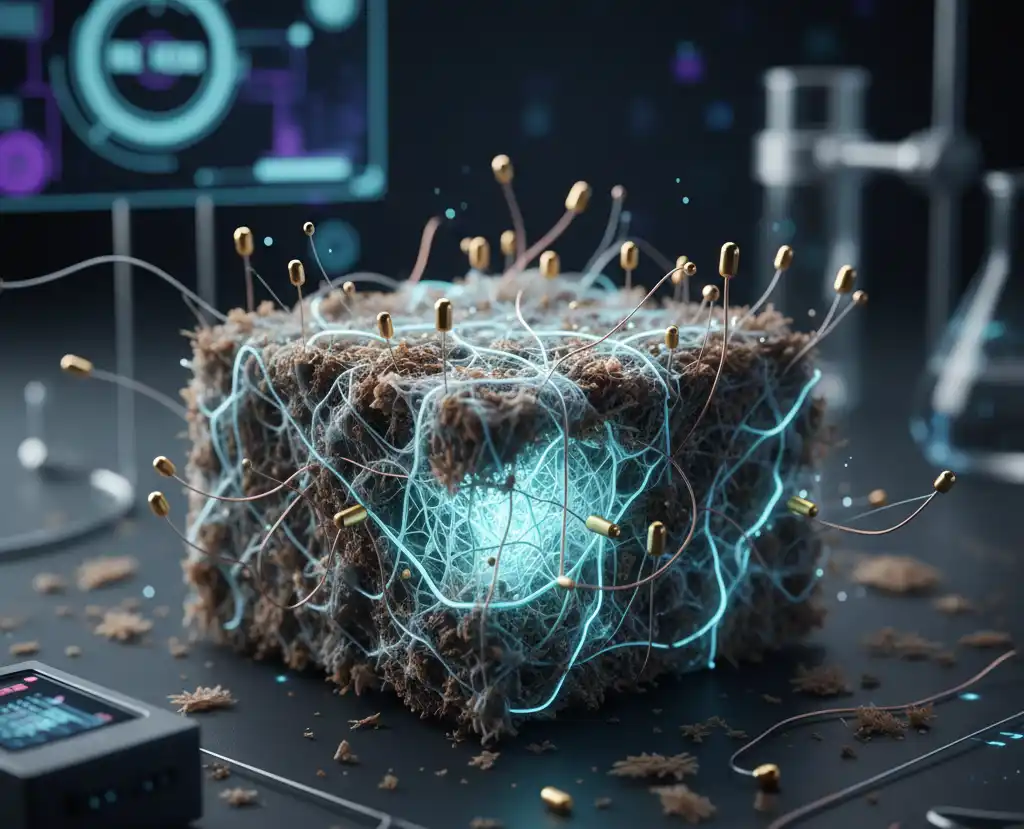
The scientific world is on the brink of one of the most unexpected technological revolutions-the creation of a mushroom computer. This idea, once the stuff of science fiction, is now a tangible subject of research. Scientists have successfully demonstrated how living mushroom mycelium, a branched network of thread-like cells (hyphae), can be used as a computing platform. This approach, known as biocomputing, offers a fundamentally new paradigm for creating electronic devices that are more resilient, self-healing, and significantly energy-efficient than traditional silicon chips.
How a Mushroom Computer Works: From Electrical Solder to Logic Gate
Fungal computing is based on a unique property of mycelium: its ability to generate and transmit electrical signals similar to those in the brain’s neural networks. The network of hyphae functions as a complex natural switch, with connection and branching points that can mimic logic gates (e.g., AND, OR, NOT), the fundamental building blocks of any computer.
- Information transmission Information is encoded as a series of electrical “spikes” or potential fluctuations that are propagated by the mycelium as if it were a biological conductor.
- Data Processing: The structure of the constantly changing and adapting mycelium allows the system to independently process incoming data and make “decisions” by changing conduction pathways.
- The role of fungal species: For these purposes, species such as Ganoderma lucidum or Pleurotus ostreatus are most often used, as they have a well-developed and dense mycelial network, which is critical for the formation of complex computational circuits.
Research shows that by stimulating mycelium with chemical or thermal stimuli, changes in its electrical activity can be observed. This allows for the development of interfaces that can convert digital data into biological stimuli for the fungus and read its response as a processed electrical signal.
Incredible Benefits: Energy Efficiency, Self-Healing and Eco-Friendly
The transition to mycelial computing systems should solve critical problems of modern electronics, namely their significant energy consumption and inability to self-regenerate.
- Energy efficiency: Because the mushroom computer operates on biological processes, it consumes minimal energy-millions of times less than traditional chips. This opens the way to the creation of ultra-low-power computing devices.
- Self-healing and adaptability: Unlike a static silicon circuit, mycelium is living matter. If a hyphae is damaged, the fungal network can self-regenerate and reroute computational pathways, ensuring high system resilience.
- Eco-Friendly and Biodegradable: The use of mushroom material means that the devices will be biodegradable, which is a solution to the problem of electronic waste, which is one of the biggest threats to the environment.
Mycelium’s ability to change structure in response to external conditions (humidity, temperature, chemical composition) makes it an ideal candidate for creating intelligent sensors and adaptive building materials.
The Potential for AI and the Future of Bio-computing Technology
Bio-computing technology holds great promise in the fields of artificial intelligence (AI) and neuromorphic computing. The neural network-like structure of mycelium makes it a natural foundation for developing new AI architectures with an innate ability to learn and process information in a nonlinear manner.
- Neuromorphic Computing: Mushroom networks can naturally mimic the functions of synapses and neurons, enabling the creation of more effective models for machine learning and pattern recognition.
- Bio-robotics: Integrating fungal computing elements into soft robotic systems could lead to the creation of organic robots capable of self-repair and interaction with the biological environment.
Challenges on the path to commercial success
Despite its remarkable potential, the implementation of the mushroom computer into mass production faces a number of significant challenges that require additional investment and research.
- Computing speed: Currently, the processing speed of mushroom systems is significantly lower than that of modern processors. This makes them unsuitable for high-speed tasks, but ideal for slow but constant sensor systems.
- Stability and Nutrition: As living organisms, these systems require constant conditions (temperature, humidity, nutrients). Ensuring their stable operation and longevity is a key engineering challenge.
- Interface: Creating a reliable and efficient interface between living matter (fungus) and electronics (digital devices) remains the most challenging engineering problem.
In summary, the mushroom computer is not just a scientific curiosity, but a promising direction in the development of electronics. While it is unlikely to replace traditional PCs in the near future, its potential for energy-efficient computing, environmental sensors, and self-healing adaptive systems is enormous. These organic computers could become a vital component of green technologies and the sustainable development of our planet.


0 Comments