
- A new look at car impact absorption
- What are metamaterials for protection?
- How the “twisting” mechanism works
- The Role of 3D Printing Technology in the Automotive Industry
- Potential applications and improvement of vehicle safety
- Economic benefits and future of Metamaterial instead of traditional steel
- Conclusion
A new look at car impact absorption
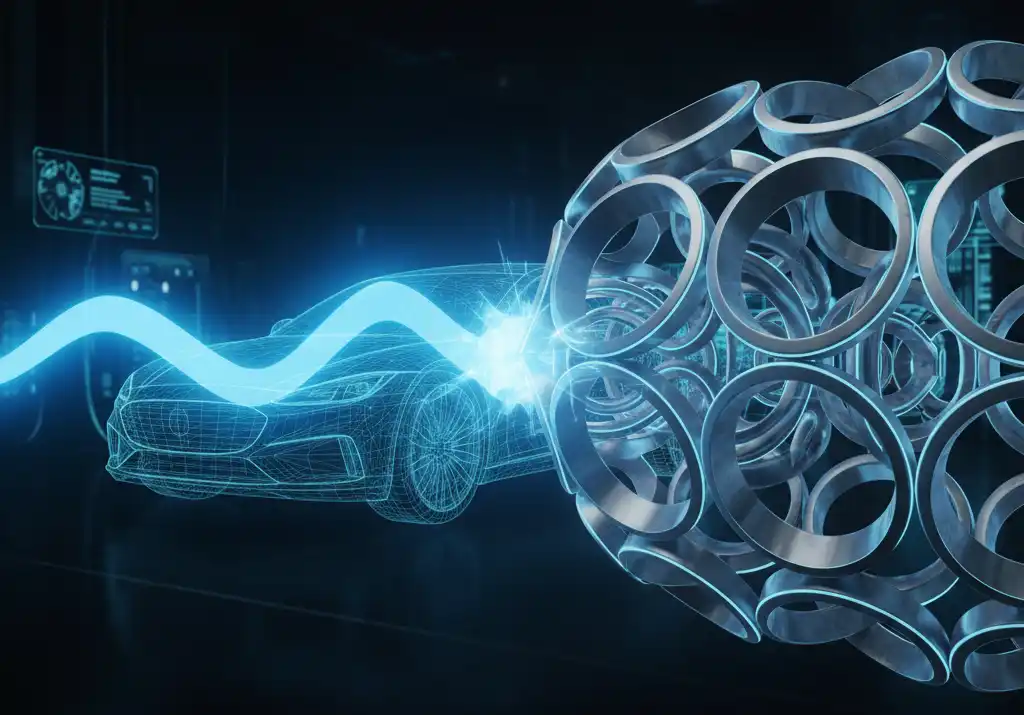
The automotive industry is constantly searching for innovative materials for cars that can improve safety without adding weight. A recent development by scientists offers a real breakthrough: a 3D-printed metamaterial that functions as adaptive, intelligent armor. This technology could revolutionize the design of protective elements, from bumpers to interior body structures.
What are metamaterials for protection?
Unlike conventional materials, the properties of metamaterials are determined not by their chemical composition, but by their artificially created structure. These are engineered composites composed of repeating elements, giving them unusual properties not found in nature. In the context of defense, they allow the creation of energy-absorbing structures with incredible efficiency.
The most striking feature of this particular metamaterial is its chiral structure. Chirality refers to the absence of mirror-image symmetry, allowing the material to twist or curl under the influence of an external force. This phenomenon is radically different from the compression or deformation of traditional materials, providing much better shock absorption.
How the “twisting” mechanism works
Upon impact, instead of breaking or simply collapsing, the cells of the 3D-printed metamaterial convert the kinetic energy of the impact into rotational and internal frictional energy. The twisting occurs at the microscopic level, effectively dissipating the energy throughout the structure.
- Efficiency: Research shows that the torsional metamaterial can absorb energy per unit mass significantly more efficiently than composites or high-strength alloys.
- Adaptability: Unlike regular armor, which has a fixed rigidity, intelligent armor adapts to the direction and force of impact.
- Lightweight: This lightweight vehicle armor helps reduce the overall weight of the vehicle, which directly impacts fuel economy and maneuverability.
The Role of 3D Printing Technology in the Automotive Industry
Creating such a complex chiral structure would have been nearly impossible using traditional manufacturing methods. 3D printing of energy-absorbing components (specifically, powder metal fusion technology) has become a key enabler. It allows the internal geometry of matter to be constructed layer by layer with high precision.
The use of 3D printing allows engineers to quickly prototype and customize protective elements for a specific vehicle model. This significantly accelerates the implementation of new technologies and makes it possible to move to mass production of this armor.
Potential applications and improvement of vehicle safety
The primary focus of the development is improving vehicle safety. The metamaterial can be used in:
- Body elements: To protect the passenger compartment from severe side or frontal impacts.
- Bumpers and crumple zones: Provide controlled and maximum impact absorption at the initial stage of a collision.
- Battery Protection: This is critical for electric vehicles, where battery damage can have catastrophic consequences.
However, the potential of this innovative material extends far beyond automobiles. Energy-absorbing structures could also find application in:
- Aerospace: Protection of satellites from micrometeorites.
- Sports Equipment: Creating more effective helmets that better disperse impact energy.
- Construction: Earthquake-resistant structures that can dampen vibrations.
Economic benefits and future of Metamaterial instead of traditional steel
While the exact production cost depends on scale and the material chosen (e.g., polymer or high-strength titanium), the long-term outlook is positive. Thanks to the reduced amount of material required and the reduced weight of the final product, overall vehicle operating costs will be lower.
If this 3D-printed metamaterial proves significantly more effective, it could replace expensive and heavy traditional solutions. The advantages of 3D-printed armor and its potential for creating lightweight vehicle armor pave the way for cars that not only better protect passengers but are also more fuel-efficient and environmentally friendly.
The development of such a twisting metamaterial is a striking example of how engineering combined with advanced technologies such as 3D printing can solve today’s most complex problems, marking a technological breakthrough.
Conclusion
The innovation of 3D-printed metamaterials is one of the most promising developments in improving vehicle safety. The use of these structures allows for unprecedented levels of impact absorption, making our vehicles smarter and more reliable on the road.


0 Comments