
- The Phenomenon of Iterative Evolution: What is it?
- The History of Aldabra Atoll: A Stage for an Evolutionary Drama
- The Way from Madagascar: The Role of the White-throated Rail
- Loss of the ability to fly as a survival strategy
- Scientists’ Evidence: What Fossils Reveal
- The significance of the discovery for modern science
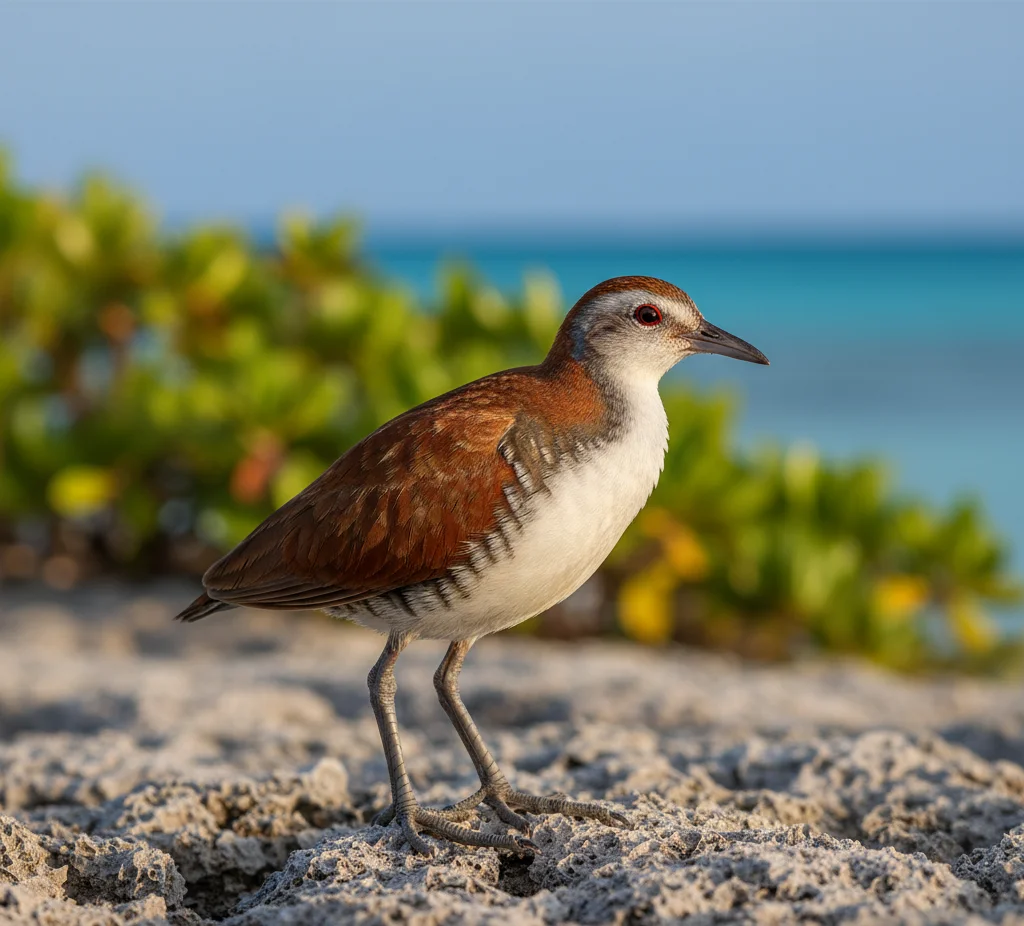
Nature never ceases to amaze humanity with its mysteries, and sometimes it presents scenarios that seem impossible even to experienced biologists. A true sensation has occurred in the world of science: a bird species thought to have gone extinct over a hundred thousand years ago has reappeared in the same place. This isn’t the plot of a science fiction movie, but a real scientific fact, recorded by researchers on a remote atoll in the Indian Ocean. The story of Cuvier’s rail is striking proof that evolution can replicate its masterpieces if the right conditions exist.
The Phenomenon of Iterative Evolution: What is it?
To understand how a dead species can be “resurrected,” we need to delve deeper into the term “iterative evolution.” This extremely rare phenomenon in biology involves the development of identical or very similar species from the same ancestor, but over different timeframes. The process essentially involves the same original species encountering similar environmental conditions thousands or millions of years apart. Under the influence of the same selection pressures, it undergoes an identical path of change, acquiring the same morphological traits.
This is precisely the case with the birds of Aldabra Atoll. This is the first and most significant example of iterative evolution among rails and one of the few proven cases among vertebrates. Scientists have a unique opportunity to observe how nature literally restarted the program of species creation, restoring it after its complete extinction.
The History of Aldabra Atoll: A Stage for an Evolutionary Drama
Aldabra Atoll, located in the Indian Ocean north of Madagascar, is a unique nature reserve. Its isolation has created ideal conditions for studying evolutionary processes. However, the site’s dramatic geological history has been a key factor in the extinction and emergence of birds. Research shows that the island experienced catastrophic sea level changes, which directly impacted its fauna.
-
- The first colonization took place more than 136,000 years ago, when sea levels were lower and birds were able to reach land.
-
- The complete catastrophe occurred due to global warming of that period: about 136 thousand years ago, the world’s ocean level rose so much that the atoll was completely submerged.
-
- The destruction of life was total-all flora and fauna, including the first population of flightless rails, perished, leaving no descendants.
-
- The land was revived about 100,000 years ago when the Ice Age began and the water level dropped, exposing the atoll again.
It was this geological “reset” that created a clean slate for nature’s second attempt. The island became habitable again, but it remained empty, awaiting new settlers who might arrive from neighboring territories.
The Way from Madagascar: The Role of the White-throated Rail
The main character of this story is the white-throated rail (Dryolimnas cuvieri), a chicken-sized bird native to Madagascar. This species is known for its ability to fly, though it’s not the best. Populations of these birds have a tendency to migrate and colonize new territories. When their numbers in Madagascar grow, groups of birds set out across the ocean in search of new homes.
This is how they arrived on Aldabra twice: once before the atoll’s flooding, and again tens of thousands of years after the waters receded. It’s important to understand that in both cases, the same ancestral species arrived on the island. This is a fundamental condition for iterative evolution: the original genetic material remained unchanged, allowing for a parallel developmental process.
Loss of the ability to fly as a survival strategy
Why did birds that could fly suddenly abandon this ability? The answer lies in energy efficiency and the absence of threats. Flight is an extremely energy-intensive mode of locomotion. It requires developed muscles (including the pectoral muscles) and a strong keel, which consumes a lot of the body’s resources.
-
- Environmental Safety: Aldabra Atoll had no land-based predators to threaten the birds. They didn’t need to take off immediately to escape attack.
-
- Resource conservation: There was plenty of food on earth that could be obtained on foot. Evolution always strives for optimization, so the organism began to conserve energy by reducing its wings.
-
- Rapid adaptation: After just a few generations, the wing muscles atrophied, and the legs became stronger for fast running.
This process occurred identically in both time periods. Both the first (pre-flood) and the second (modern) populations lost their ability to fly, becoming land dwellers. This transformation made them prisoners of the island, but also its rightful masters.
Scientists’ Evidence: What Fossils Reveal
Claims of the species’ revival are based not on speculation, but on a thorough analysis of paleontological findings. Scientists from the University of Portsmouth conducted a detailed comparison of skeletal remains. They examined fossils dating to the period before the atoll’s submergence and compared them with the bones of modern birds, as well as with remains from the period immediately after the reappearance of land.
The key piece of evidence was the structure of the wing and ankle bones. Analysis revealed that the fossilized wings were significantly smaller and less developed than those of the Madagascar ancestor, while the leg bones were more massive. This suggests that the birds were losing their ability to fly. Most strikingly, the anatomical changes in both groups (the one living 136,000 years ago and the one living today) are almost mirror images. This confirms that evolution followed the same path twice.
The significance of the discovery for modern science
The case of the Aldabra Atoll rail is of great importance for understanding the mechanisms of evolution. It demonstrates that evolution is not a chaotic set of chance occurrences, but a deterministic process that produces identical results under identical conditions. Given “initial data” in the form of a specific species and environment, nature is highly likely to reach the same endpoint.
Today, Cuvier’s rail remains the last flightless bird in the Indian Ocean. Other similar species, such as the famous dodo of Mauritius, have disappeared forever due to human intervention. Conserving the population on Aldabra is crucial, as this bird is living proof of the incredible resilience of life and its ability to recover even after global catastrophes.




0 Comments