
- The Beginning of the Journey: From ATI Imageon to the First Mobile Accelerators
- The Birth of Adreno: An Anagram Hiding Radeon’s Roots
- The 2008 crisis and a pittance in the sale
- Qualcomm monopoly and the disappearance of competitors.
- Revenge Attempt: AMD Returns via Samsung
- Why RDNA 2 Couldn’t Beat Adreno
- Conclusions: A $100 Billion Lesson
The story of how Radeon technologies became the foundation of Qualcomm’s dominance. Why AMD sold its mobile division to Imageon, and whether it can return to the market through Samsung.
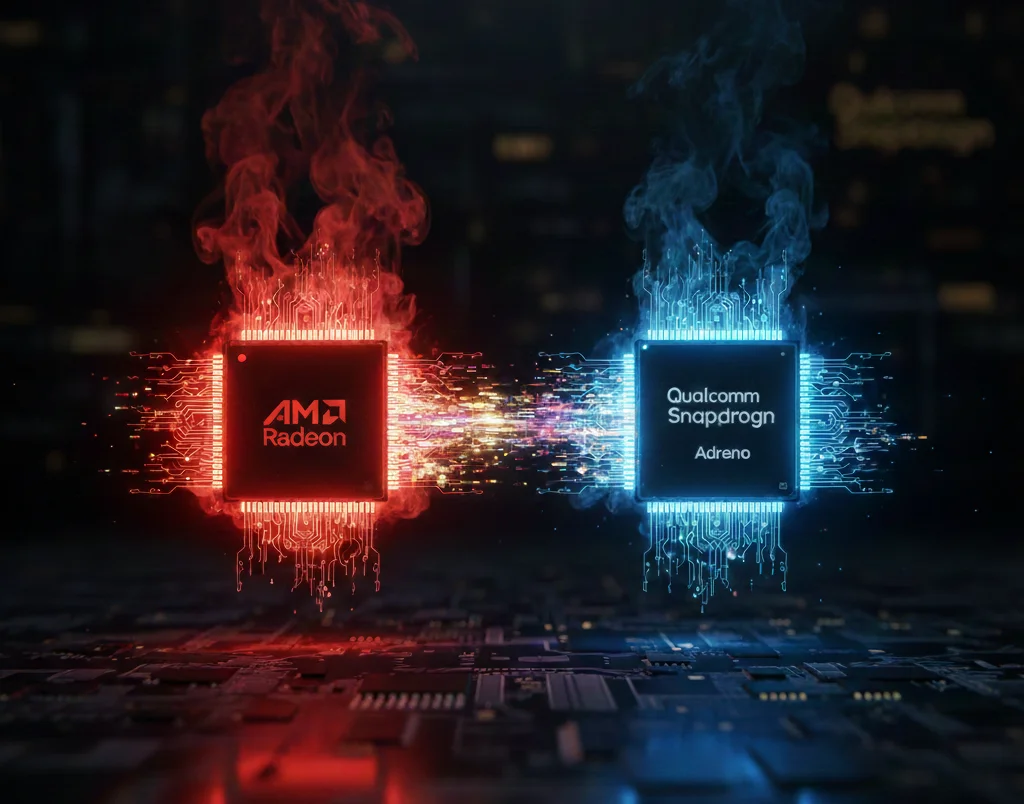
How AMD Single-Handedly Created Qualcomm’s Dominance: The History of Adreno Graphics
The history of the IT industry is replete with examples of failed deals, but the sale of AMD’s mobile division to Qualcomm in 2009 stands out. It’s a tale of how the leader in desktop graphics cards, while in the throes of a financial crisis, handed over the keys to the future of the mobile market for a mere $65 million. Today, when Qualcomm’s market capitalization is measured in hundreds of billions, that sum seems like the price of a mid-size yacht, not an entire world-changing technology trend. This strategic mistake changed the landscape of the mobile industry for the next decade, creating a monopoly that all smartphone manufacturers now have to reckon with.
The Beginning of the Journey: From ATI Imageon to the First Mobile Accelerators
It all began in 2006, when AMD acquired Canadian graphics card maker ATI for $5.4 billion. It was one of the most high-profile deals of the time. Along with the legendary Radeon brand, the company inherited the Imageon division. At the time, the smartphone world was just emerging; the iPhone hadn’t yet been introduced, but Imageon was already the king of push-button devices. Their chips powered 2D and 3D graphics in iconic devices like the LG Prada, Motorola RAZR V3i, and Sony Ericsson K790. Users at the time had no idea that the same engineers creating graphics for powerful gaming PCs were responsible for the smooth interface and the first mobile games.
- Imageon 2300 is the first full-fledged 3D accelerator for the revolutionary mobile phones.
- ATI technologies were used in the first HTC communicators in Windows Mobile, setting industry standards.
- AMD planned to combine ATI’s expertise with its processors, creating a unified ecosystem for all types of devices.
The Birth of Adreno: An Anagram Hiding Radeon’s Roots
In the early 2000s, Qualcomm was known primarily for its communications patents and modems. However, they had an ambitious plan: to create their own processor (System on Chip) that would unite everything. Realizing that developing their own graphics from scratch would take 5-7 years and billions of dollars, they approached AMD for a license. Thus, the Adreno brand was born. If you look closely at the name Adreno, you’ll see that it’s a direct anagram of Radeon. Qualcomm simply rearranged the letters, but the architectural foundation remained unchanged.
The world’s first Android smartphone, the HTC Dream (T-Mobile G1), was powered by a Snapdragon processor with Adreno 200 graphics, a modified AMD Z430 architecture. At the time, Qualcomm paid AMD royalties for every device sold. It was a perfect arrangement: AMD earned money without spending money on marketing, and Qualcomm had the best graphics on the market. However, the economic storm of 2008 forced AMD’s management to change its priorities, with disastrous consequences.
The 2008 crisis and a pittance in the sale
Why did AMD decide to sell a profitable division? In 2008, the company found itself in a critical situation. First, the global financial crisis hit demand. Second, the $5.4 billion debt from the ATI acquisition became unsustainable. But the most important factor was Intel. The release of Core 2 Duo processors made AMD’s then-current Phenom solutions uncompetitive. The company literally had no money to pay salaries. The decision was made to cut non-core assets.
AMD’s management, blinded by the battle in the PC market, considered smartphones a passing fad. Qualcomm, on the other hand, saw the iPhone as the beginning of a new era. In 2009, the same deal took place: Qualcomm acquired the Imageon division, all its patents, and lured AMD’s top engineers for just $65 million. By comparison, developing a single generation of graphics core today costs tens of times more. AMD effectively handed its competitor the foundation for a future monopoly by focusing on a market that soon began to stagnate.
Qualcomm monopoly and the disappearance of competitors.
Having acquired AMD’s technology, Qualcomm became an aggressive leader. They integrated Adreno graphics into their Snapdragon chips so tightly that no other manufacturer could offer a comparable balance of performance and power efficiency. They played a tough game: if you want our best 4G modems, buy the entire processor. This forced many players out of the market.
- Texas Instruments discontinued its OMAP line, even though its processors were considered some of the best for multimedia.
- NVIDIA tried to compete with the Tegra line, but the lack of an integrated modem and the loss in graphics optimization forced them to go into niche products.
- Qualcomm has become a de facto monopoly, dictating terms to smartphone makers such as Samsung, LG, and Xiaomi.
Revenge Attempt: AMD Returns via Samsung
More than a decade passed before AMD attempted to correct this mistake. Under Lisa Su’s leadership, the company regained its leadership in the PC and server markets and once again turned its attention to smartphones. Realizing that creating its own smartphone chip from scratch was too expensive, they opted for a partnership. Samsung, whose own Mali graphics solutions were inferior to Qualcomm’s, readily agreed to the collaboration.
In 2022, the Exynos 2200 chipset with Xclipse graphics based on the RDNA 2 architecture was released. This is the same architecture used in the PlayStation 5 consoles and the portable Steam Deck. Marketers promised a revolution-real-time ray tracing on a smartphone screen. However, the first attempt proved a bummer: Qualcomm’s extensive experience in mobile power efficiency proved stronger than AMD’s raw power.
Why RDNA 2 Couldn’t Beat Adreno
The main problem was adaptation. The RDNA architecture was designed for systems with active cooling or ample space for heat dissipation. In the cramped smartphone case, it ran into critical issues. During intensive loading, the phone would become so hot that it was uncomfortable to hold, and after 15-20 minutes, the frame rate would drop sharply (throttling). Furthermore, game developers were slow to implement support for AMD’s new features, as the vast majority of the market still relied on Adreno.
- Overheating: After 10 minutes of gaming, performance dropped below the levels of standard Mali solutions.
- Power consumption: Ray Tracing features proved to be too heavy for modern mobile batteries.
- Software and drivers: AMD had to learn to write stable software for Android practically from scratch.
Conclusions: A 0 Billion Lesson
Today, AMD and Samsung’s collaboration continues, and new generations of Exynos chips are becoming more stable. However, the story of Adreno will forever remain in business textbooks as an example of a colossal mistake. By selling the division for $65 million, AMD lost potential billions in revenue and allowed Qualcomm to become the architect of the mobile world. This is a reminder to all market leaders: in the world of technology, there are no “minor” industries, and what seems like a toy today may become the backbone of the global economy tomorrow.



0 Comments