
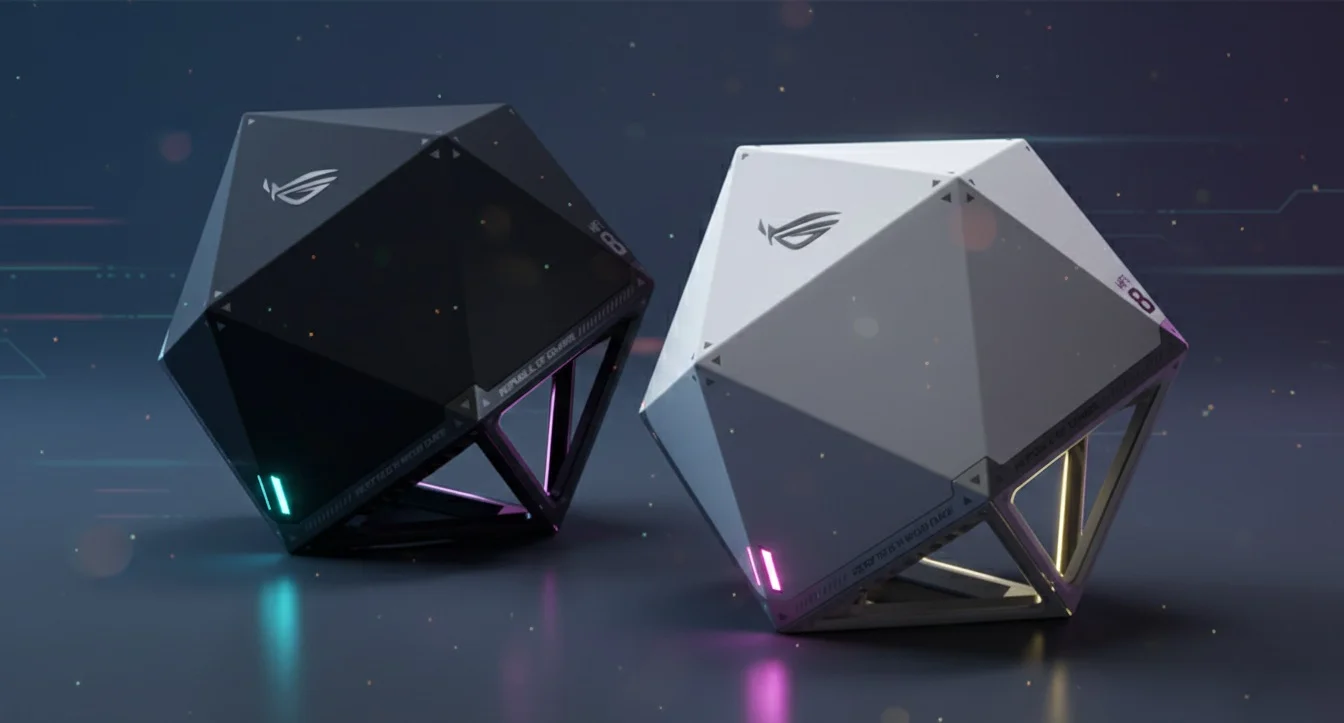
Asus has unveiled the revolutionary ROG NeoCore router with support for the Wi-Fi 8 (IEEE 802.11bn) standard. Learn about new stability technologies and the benefits of AI in the networks of the future.
Wi-Fi 8 becomes a reality: Asus showcases the future of wireless networking at CES 2026
The world of technology has just crossed the threshold of a new era of wireless communication. At the annual CES 2026 exhibition, Asus once again confirmed its status as an innovation leader by demonstrating the world’s first functional prototype of a router based on the Wi-Fi 8 standard. The novelty, called ROG NeoCore, radically changes the approach to how we perceive Internet connections. If previous generations competed for maximum speed figures, then Wi-Fi 8 focuses on what is really important for the modern user – on absolute stability and reliability under any conditions.
How Wi-Fi 8 differs from previous standards
The IEEE 802.11bn standard, better known as Wi-Fi 8, doesn’t try to impress us with cosmic speeds of hundreds of gigabits. In fact, the theoretical throughput threshold remains at the level of Wi-Fi 7 and is about 46 Gbps. However, the key change lies in the Ultra-High Reliability (UHR) philosophy. This is a technology that ensures uninterrupted network operation even when there are dozens of other access points around you that create interference. Asus has integrated these capabilities into its ROG NeoCore so that users can forget about “ping” in games and sudden disconnections during video calls.
- Improved efficiency of spectrum usage in the 2.4, 5, and 6 GHz bands.
- New data flow management architecture to minimize latency.
- Intelligent resource distribution between client devices in real time.
Technological innovations in Asus ROG NeoCore
The main star of the Asus stand was the ROG NeoCore router. Its futuristic design with the use of translucent elements and branded backlighting hides a super-powerful hardware filling. The device uses revolutionary UEQM (Unequal Modulation) technology. Traditional routers are forced to reduce the signal quality for all devices if one of them is too far away. Wi-Fi 8 allows ROG NeoCore to apply different modulation for each connection separately. This means that your gaming PC will receive maximum resources, even if the smartphone in the next room has a weak signal level.
In addition, Asus has implemented a Multi-AP coordination system. In large buildings where Mesh systems operate, network nodes now do not just transmit data, but “communicate” with each other. They agree on the use of channels so as not to overlap each other. This avoids interference, which was previously the main enemy of stable Wi-Fi in apartment buildings.
The role of AI and network automation
Asus ROG NeoCore is not just a signal transmitter, but a real intelligent node. Thanks to built-in AI algorithms, the router is able to predict traffic spikes. For example, if you start streaming or playing an online game, AI automatically prioritizes these data packets, limiting background downloads. This happens instantly and does not require manual configuration in the admin panel. AI also optimizes the power consumption of connected gadgets, “waking up” their network module only when information is being transmitted, which significantly extends the battery life of smartphones and smart home sensors.
The future of the smart home with Wi-Fi 8
For owners of a large number of IoT devices, Wi-Fi 8 will be a real salvation. The new standard allows you to connect hundreds of devices without losing response speed. Thanks to the optimization of signals at low frequencies, the coverage for smart lamps, security cameras and thermostats is almost doubled. Asus claims that one ROG NeoCore router is able to provide stable coverage even in large two-story houses without the use of additional repeaters, although support for the company’s AiMesh technology has not disappeared and has become even more effective.
Cost and availability of new technologies
Although the device demonstrated at CES 2026 is a pre-production model, experts are already predicting prices for the first commercial models. The top-of-the-line ROG NeoCore gaming router is expected to cost around $599 at launch. For those looking for more budget-friendly solutions, Asus is preparing the RT series, the price of which may start at $299. It is important to understand that to fully utilize the benefits of Wi-Fi 8, you will also need appropriate client devices - smartphones and laptops with IEEE 802.11bn support, which will begin to appear on the market in large numbers towards the end of 2026.
Conclusions about the Asus presentation
Asus ROG NeoCore is a bold look into the future. The company has once again proven that the development of networking technologies is not only about increasing the numbers in the specifications, but also about creating a comfortable and seamless user experience. Wi-Fi 8 solves the fundamental problems of loaded broadcasts, making wireless Internet as reliable as a wired connection. If you are planning to upgrade your home network in the near future, you should closely follow the announcements of Asus, because the future is already here, and it works without delays.



0 Comments