
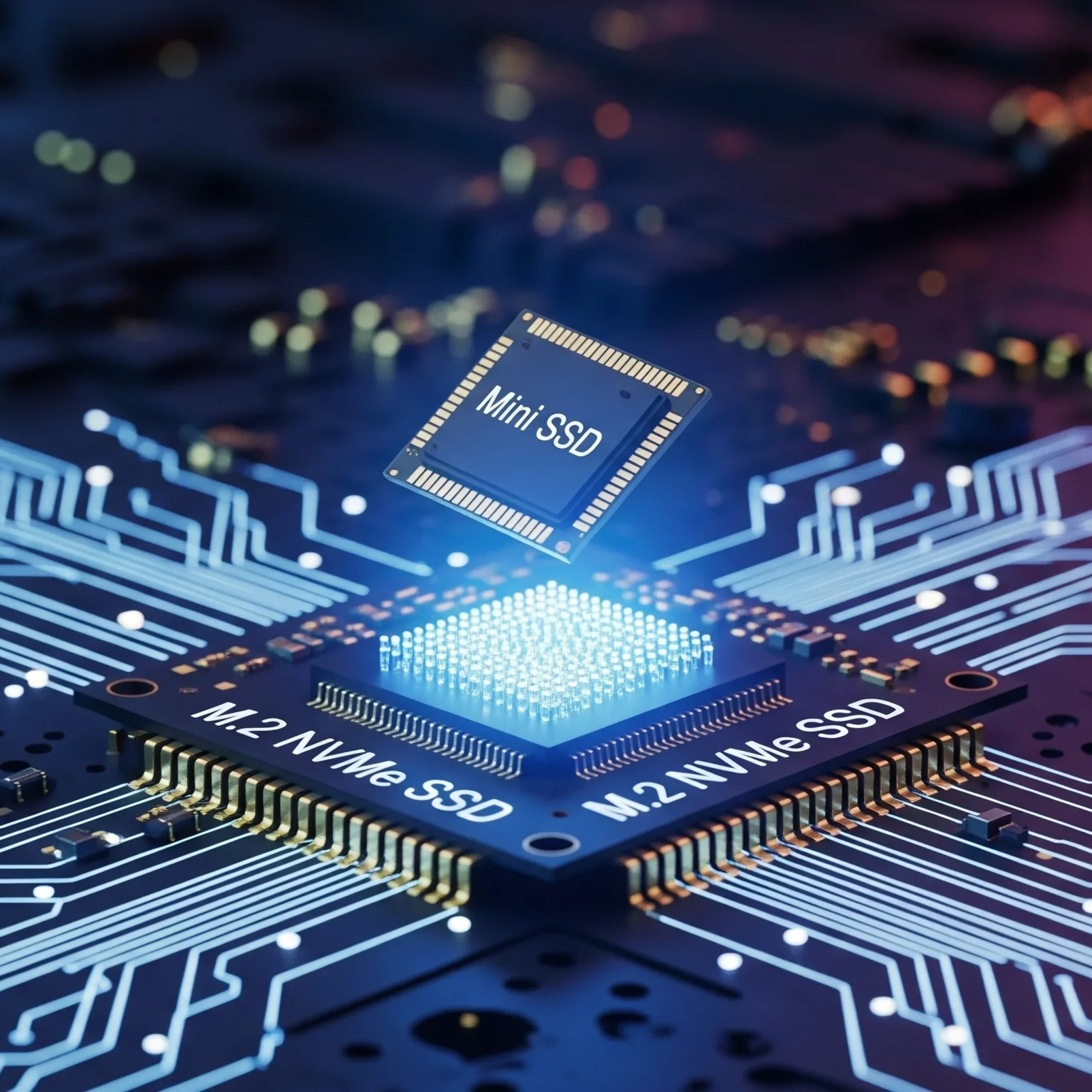
Computer technology is constantly striving for miniaturization. Every year, devices become thinner, lighter, and more portable, necessitating the development of new, more compact components. Data storage devices are no exception. Following the dominance of standard SSDs, NVMe M.2 drives entered the market, becoming the industry standard for high-speed solutions. However, China is taking another step forward, introducing a new, even more compact format: the Mini SSD. This development promises to change the way we think about the internal layout of ultra-thin laptops, gaming consoles, and other miniature gadgets.
Why has Mini SSD become necessary?
Traditional M.2 drives, despite their compact size, have standard dimensions, such as 2280 mm, which still takes up significant space inside the device. Ultrabooks, gaming consoles like the Steam Deck, and slim tablets require every available millimeter to accommodate more powerful processors, larger batteries, or more efficient cooling systems. This is where the Mini SSD format comes in. Although developed in China, it has the potential to become a new global standard.
It uses the same high-speed PCIe Gen4 x4 interface, but its physical dimensions are significantly smaller, making it ideal for the most compact devices. This isn’t just a scaled-down M.2, but an entirely new, optimized format designed specifically to address the space constraints of modern electronics.
The main advantages of the new format
- Incredibly compact: The Mini SSD’s main advantage is its size. Typical dimensions are only 2230 or 2242 mm, which is much smaller than the most common M.2 drives. This allows electronics manufacturers to produce devices with even smaller thickness and weight, which is especially important for mobile solutions.
- High performance: Despite its compact size, the Mini SSD is just as fast. Using the PCIe Gen4 x4 interface, it delivers data transfer rates just as high as its larger counterparts. This allows users to quickly load the operating system, programs, and large games without any noticeable slowdowns.
- Energy efficiency: A smaller board size and optimized component structure contribute to reduced power consumption. This is especially valuable for battery-powered devices, as it helps extend battery life.
The development of this format demonstrates that technological progress can be achieved not only through increased power but also through efficient use of space and resources. This opens up new opportunities for engineers to rethink device designs, abandoning large storage devices in favor of more compact and energy-efficient solutions.
Applications and potential
Mini SSDs find their ideal place where every cubic millimeter is worth its weight in gold. Among the most likely applications:
- Ultrabooks and thin laptops: Due to their thin casing, these devices often have limited space. Mini SSDs will allow manufacturers to create thinner models while still delivering high performance.
- Portable gaming consoles like the Steam Deck require not only compactness but also fast game loading speeds. A Mini SSD delivers on these requirements.
- Mini PCs and Embedded Systems: For industrial use or home mini PCs where size is a priority, the Mini SSD is the ideal solution.
- Tablets and smartphones Although the storage in these devices is even smaller, Mini SSDs could become the basis for a new generation of high-performance mobile gadgets.
The developer positions the Mini SSD as a future standard that could displace M.2 drives from the compact solutions market. This is an ambitious goal, achievable thanks to the ever-growing demand for portable devices.
Competition and market prospects
Although Mini SSD is a new player on the market, it faces strong competition. For example, some manufacturers are already using M.2 2230 or 2242 drives in devices like the Microsoft Surface. These solutions are also compact, but Mini SSD is striving to create its own unified standard. The manufacturer claims its technology is more optimized, and its drives are not simply a smaller version, but a separate, specially designed format.
Furthermore, the market is full of competitors offering M.2 drives in various configurations. However, the emergence of Mini SSDs signals an important trend: the industry is moving toward even greater miniaturization, and companies that offer the most efficient and compact solutions will be able to take the lead. Analysts predict that if Mini SSDs are priced comparable to M.2 drives (e.g., around $100-$200 for a 1TB model), they have a good chance of success.
Mini SSDs aren’t just another new product, but the potential beginning of a new era for compact electronics. Their arrival demonstrates that continuous technological improvement is key to market growth, and we may soon see this format in many of our favorite devices.




0 Comments