
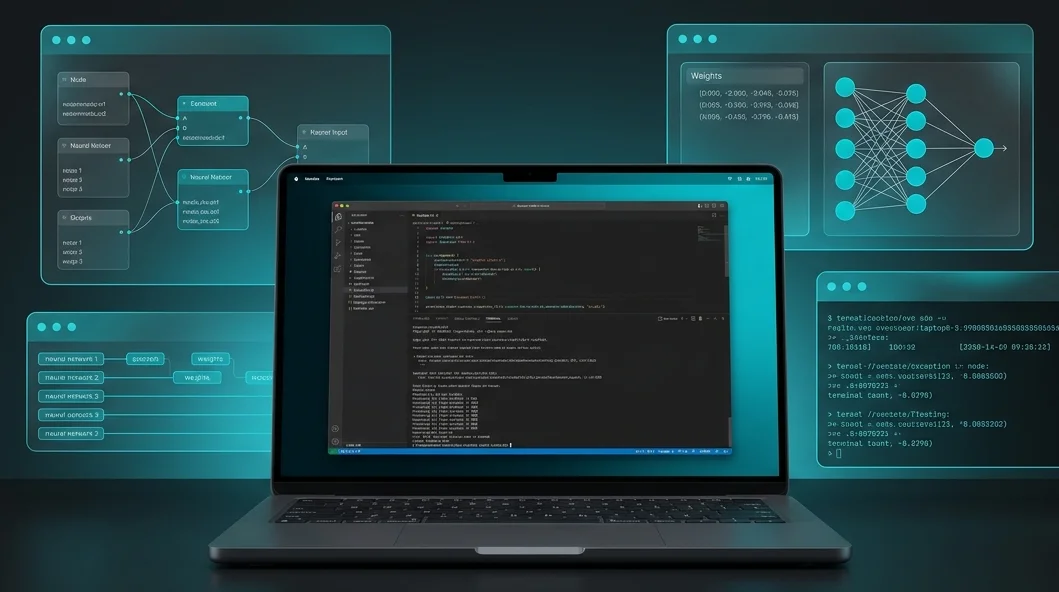
Next Generation Local AI and PC Autonomy
The evolution of generative artificial intelligence has relied heavily on cloud infrastructure and massive data centers for years. Users sent API requests or worked through web interfaces, handing over processing tasks to big tech compute clusters. However, the release of Meta’s Muse Glimmer marks a clear pivot toward local compute. The company has published an open-weight 30-billion parameter neural network designed specifically for on-device execution using consumer hardware.
The primary engineering goal was maintaining complex reasoning capabilities while drastically lowering memory footprints. The model targets fully offline operations, private document processing, and multi-step agentic tasks without sending packets over the internet.
Technical Specifications and Architecture
Muse Glimmer utilizes a modified transformer architecture featuring Grouped-Query Attention (GQA). This design minimizes the memory overhead of the context cache when processing long documents or codebase structures. Distributed under the permissive Apache 2.0 license, the model allows both personal experimentation and commercial deployment.
To achieve seamless operation on consumer GPUs, Meta implemented advanced 4-bit quantization (AWQ / GPTQ). In its raw FP16 uncompressed state, a 30B parameter model requires nearly 60 GB of VRAM just to load weights. Through loss-less quantization techniques, the footprint has been reduced to manageable consumer levels.
Hardware Requirements for PC Deployment
Running Muse Glimmer locally requires a clear understanding of system resource allocation between dedicated VRAM and system RAM. Because the model is optimized to fit inside a 20 GB VRAM boundary, the range of compatible hardware is far broader than previous LLM generations.
Recommended System Specifications
- Graphics Processing Unit (GPU): NVIDIA GeForce RTX 3090, RTX 4080 (16 GB VRAM with partial CPU offloading), or RTX 4090 (24 GB VRAM for native fit).
- Central Processing Unit (CPU): 8-core processor such as AMD Ryzen 7 7700X or Intel Core i7-13700K and above.
- System Memory (RAM): Minimum 32 GB DDR4/DDR5 (64 GB recommended if offloading layers).
- Storage: NVMe SSD with at least 30 GB of free space (read speeds above 3500 MB/s for fast model loading).
Apple Silicon users (M2/M3/M4 chips) can run Muse Glimmer effectively thanks to Unified Memory architecture. Configurations equipped with 36 GB or 48 GB of RAM can execute the entire model natively through frameworks like MLX or Ollama.
Practical Local AI Use Cases
Moving computations directly to local desktop hardware eliminates two major obstacles: data privacy risks and recurring subscription or API token costs. Muse Glimmer performs reliably in environments where sending sensitive data off-site is prohibited.
Key Operational Scenarios
- Private Code Analysis: Developing and auditing software inside an air-gapped corporate environment with zero IP exposure risks.
- Sensitive Data Processing: Analyzing legal contracts, financial spreadsheets, and medical records locally.
- Autonomous AI Agents: Executing multi-step desktop workflows, writing automation scripts, and indexing local files without network dependencies.
- Field Work and Travel: Maintaining access to a high-tier intelligence assistant without internet access.
Installation and Setup Guide
Deploying Muse Glimmer does not demand deep software engineering experience. Modern local AI tooling streamlines deployment into simple single-command setups.
Running via Ollama
The most straightforward method is utilizing Ollama, which handles quantization weights download and manages CPU/GPU layer offloading automatically.
Run the following command in your terminal to initialize the model:
ollama run meta/muse-glimmer:30b-q4
Once initialized, users can interact via terminal or attach graphical interfaces like Open WebUI or LM Studio using the local REST API endpoint on port 11434.
Comparative Analysis with Cloud AI
When measuring Muse Glimmer against established cloud-hosted models, total cost of ownership and latency become key decision factors. In benchmarks measuring logic reasoning and code generation, Meta’s open-weight model matches entry-tier cloud endpoints while delivering zero network latency and complete privacy guarantees.
The absence of per-token API billing makes Muse Glimmer highly cost-effective for continuous background processing and high-volume automated tasks.


0 Comments