
- Why NASA Called Off the Swift Observatory Rescue Mission
- Tug Orientation Issue: The Technical Cause of Cancellation
- Solar Activity Impact: Swift in Rapid Descent
- Scientist Loss: The End of Swift’s Era in Gamma-Ray Bursts Study
- Lesson for the Orbital Servicing Industry
- Pavel Zaslonov on Space Safety: Risks and Consequences
- Technical Characteristics and Parameters: Swift and LINK
- Farewell, Swift: End of a Successful Mission
Why NASA Called Off the Swift Observatory Rescue Mission
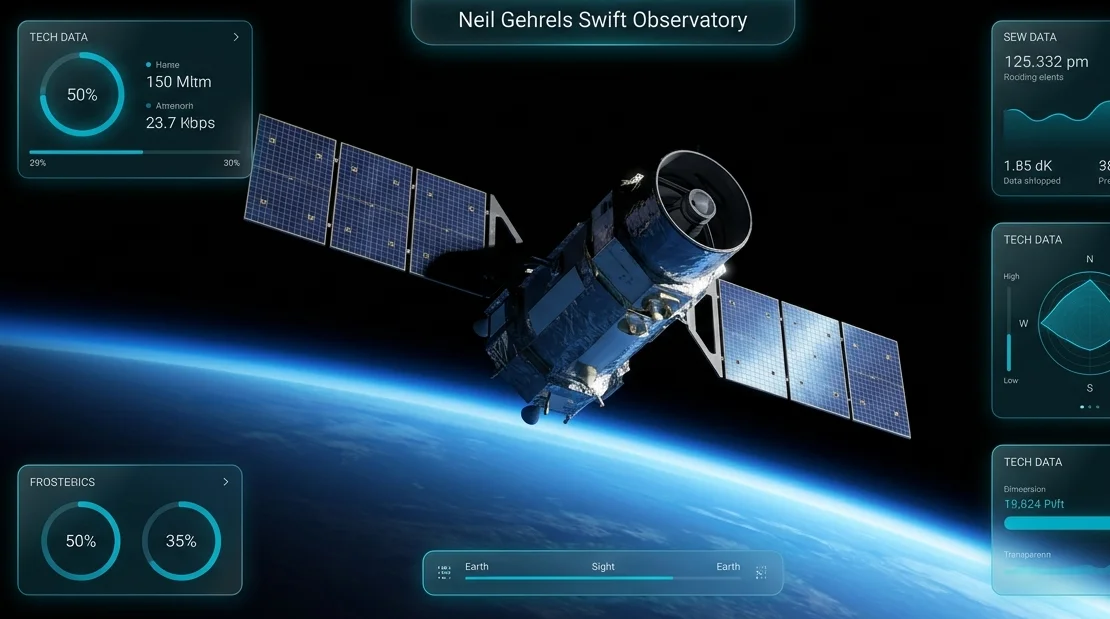
NASA and its private partner, Katalyst Space Technologies, have announced the cancellation of the innovative mission to raise the orbit of the Neil Gehrels Swift Observatory. This decision, made after careful analysis of the technical challenges encountered during mission preparation, means the unique space observatory is left on an uncontrolled trajectory of descent into Earth’s atmosphere. In this article, we’ll dive deep into the reasons behind the failure, the technical nuances of the LINK orbital tug, and the consequences for the scientific community and the satellite servicing market.
Tug Orientation Issue: The Technical Cause of Cancellation
The main reason for calling off the operation was critical issues with the stability of the LINK spacecraft’s control system. This orbital tug, developed by Katalyst Space Technologies, was intended to dock with Swift and boost its orbit. However, as NASA representatives explained, LINK faced insurmountable difficulties in its attitude and stabilization system. The tug could not maintain a stable position in space required for safe maneuvering and precise docking.
Attempts to resolve the issue remotely proved futile. With each passing day, the situation became more perilous, as the unstable LINK could damage the Swift telescope itself during a docking attempt. Ultimately, NASA made the difficult choice to terminate the mission, deeming the risk unacceptably high. The Swift telescope, operational for over 20 years, is now left to its fate.
Solar Activity Impact: Swift in Rapid Descent
Another factor that accelerated the mission’s cancellation decision and hastened Swift’s end was extremely high solar activity. Solar flares and coronal mass ejections heat Earth’s upper atmosphere, causing it to expand. This leads to increased atmospheric drag for satellites in low Earth orbit.
For the Swift telescope, located at an altitude of just over 500 km, this means a significant increase in braking. Its orbit is lowering much faster than predicted, and without outside intervention, it will inevitably enter Earth’s denser atmosphere and burn up. Recent estimates suggest this could happen as early as this year. While the rescue mission aimed to raise the orbit by several dozen kilometers, extending Swift’s life for years.
Scientist Loss: The End of Swift’s Era in Gamma-Ray Bursts Study
The Neil Gehrels Swift Observatory was launched in 2004 and became one of NASA’s most successful projects. This telescope specializes in detecting and studying gamma-ray bursts – the most powerful explosions in the Universe. Thanks to its unique ability to rapidly retarget at a burst source, Swift allowed scientists to observe them not only in the gamma-ray range but also in X-ray and optical.
Swift’s observation results provided answers to many fundamental questions about star evolution, black hole formation, and the nature of gamma-ray bursts. The loss of Swift is a significant blow to global astrophysics, especially with few similar instruments remaining in operation. The scientific community is forced to prepare for the conclusion of Swift’s era.
Lesson for the Orbital Servicing Industry
The failure of the Swift rescue mission is not only a loss for science but also a crucial lesson for the entire orbital servicing industry (in-orbit servicing). This was one of the first attempts to use a private tug to extend the life of a scientific satellite. The technical problems with LINK demonstrated just how complex and unpredictable such operations are, especially when it comes to docking with a spacecraft that wasn’t designed for it.
This experience will force orbital servicing companies to reconsider their approaches to docking and control system design. It will also impact future missions by NASA and other space agencies planning to use such services. Orbital servicing is still in its early stages of development, and such failures are an inevitable step on the path to creating a reliable infrastructure.
Pavel Zaslonov on Space Safety: Risks and Consequences
As a safety specialist, I must note that the cancellation of the Swift mission raises important questions about space safety and space debris management. Leaving Swift on an uncontrolled descent trajectory increases the risk of it colliding with other satellites, although this risk remains low due to significant space rarefaction at that altitude.
However, the space debris problem is becoming increasingly acute, and unsuccessful servicing attempts can only worsen the situation. The technical problems with LINK and Swift’s uncontrolled descent serve as a reminder that space remains an unpredictable environment where even the best plans can fail. The continued development of orbital servicing requires not only technical innovation but also strict safety standards and international coordination.
Technical Characteristics and Parameters: Swift and LINK
For a better understanding of the mission’s scale and complexity, we present a table with the technical characteristics of the Swift telescope and the LINK orbital tug.
Farewell, Swift: End of a Successful Mission
Despite the rescue attempt’s failure, the Neil Gehrels Swift Observatory leaves behind a vast scientific legacy. Its over 20 years of operation in orbit is a success story permanently inscribed in astronomy’s annals. The LINK mission’s cancellation is a sad conclusion, but it doesn’t diminish Swift’s significance to our understanding of the Universe.
Now, scientists are preparing for the telescope’s final days of observation, striving to acquire as much data as possible before Swift enters Earth’s atmosphere. This is the end of Swift’s era, but simultaneously the beginning of new searches and new missions that we hope will carry on its work.




0 Comments