
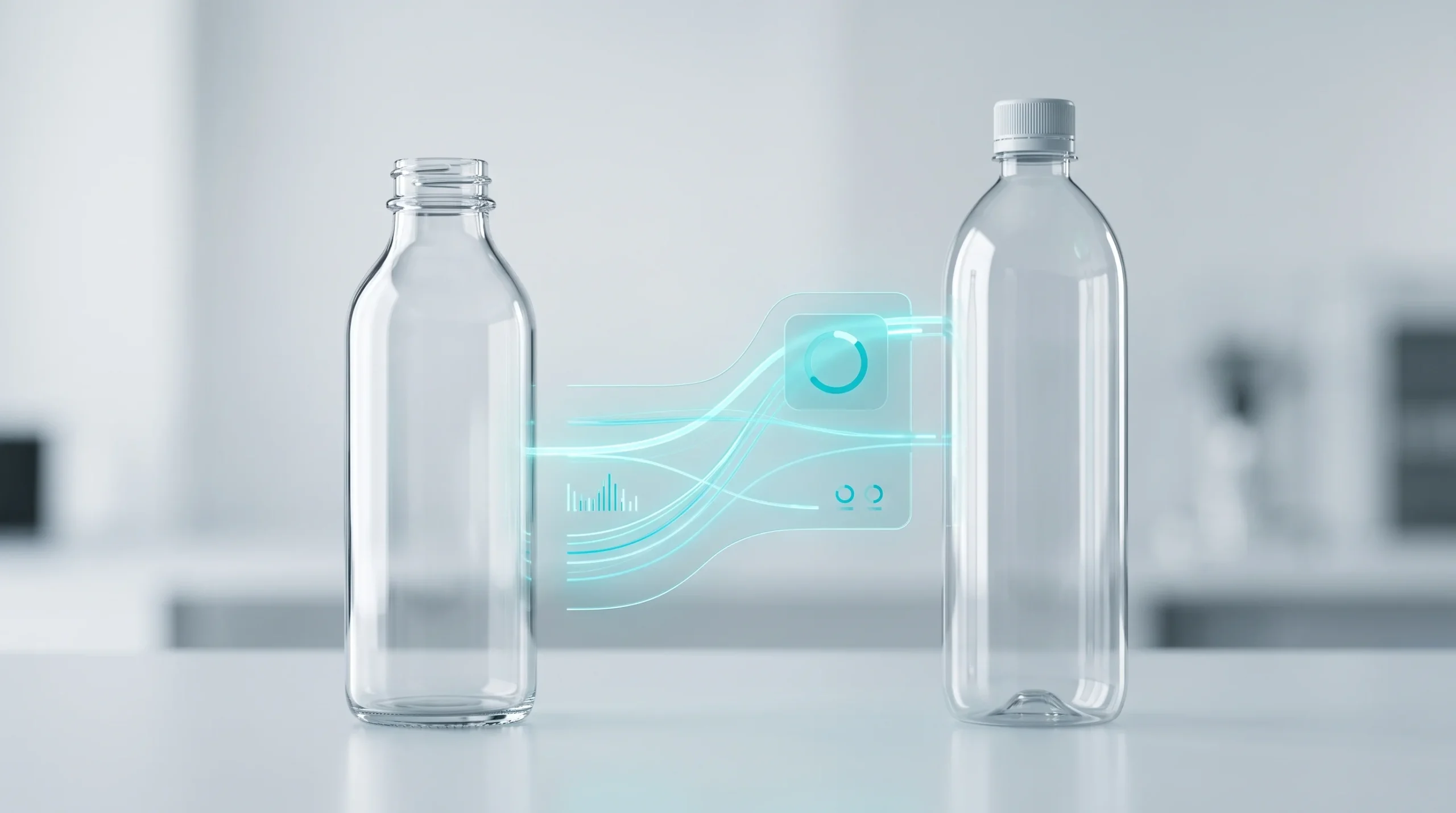
The Material Paradox and Real Carbon Footprints
Public perception has long held glass packaging as the undisputed gold standard of environmental friendliness, while plastic is universally viewed as an ecological hazard. However, evaluating the environmental impact of packaging cannot rely solely on degradation time in nature or visual aesthetics. Industrial ecology experts rely on Life Cycle Assessment (LCA), a methodology that examines the complete environmental footprint of a product from raw material extraction to manufacturing, logistics, and end-of-life disposal.
When assessing greenhouse gas emissions and global climate change factors, single-use glass bottles frequently show higher negative impacts than polyethylene terephthalate (PET) containers. The key factors behind this difference lie in the thermodynamic energy required for melting minerals, extreme production temperatures, and massive weight differences during commercial transportation.
Manufacturing Energy and Resource Extraction
The production of virgin glass requires extremely high temperatures. To melt raw materials such as silica sand, soda ash, and limestone into a homogenous liquid, industrial furnaces must maintain temperatures between 1400 °C and 1600 °C. These furnaces operate continuously, predominantly burning fossil fuels like natural gas or consuming massive amounts of grid electricity. Furthermore, the chemical reaction during raw material calcination directly releases additional carbon dioxide into the atmosphere.
In contrast, PET plastic melts and forms at significantly lower temperatures, around 250 °C to 260 °C. Lower processing temperatures directly translate to reduced specific energy consumption per manufactured unit. While PET is a synthetic product derived from petrochemicals, the total energy consumed to manufacture a standard 0.5-liter PET bottle is substantially lower than that required for a glass container of equivalent capacity.
The Transportation Burden and Logistics Emissions
Container weight plays a decisive role in determining the total carbon footprint across distribution chains. A standard 0.5-liter glass beverage bottle weighs between 300 and 450 grams, whereas a modern lightweight PET bottle of the same volume weighs approximately 20 to 30 grams. This represents a weight differential of up to 15 to 20 times.
When transporting beverages via road freight or rail networks, the dead weight of glass packaging accounts for a substantial percentage of total cargo mass. This disparity leads to higher fuel consumption, faster road wear, and substantially higher CO₂ emissions per ton-kilometer transported. Over long distribution routes exceeding several hundred kilometers, the logistical transport footprint completely offsets the inherent material inertness of glass.
Recycling Realities and Circular Economy Nuances
Glass is frequently praised for its ability to be recycled infinitely without losing its physical properties. While true from a material science standpoint, glass recycling remains energy-intensive. Remelting cullet still requires temperatures around 1000 °C to 1200 °C, yielding energy savings of only 20% to 30% compared to virgin production.
PET cannot undergo infinite mechanical recycling cycles without polymer degradation. However, advanced chemical recycling processes and the adoption of food-grade rPET (recycled PET) reduce the carbon footprint by up to 70% compared to virgin plastic. Crucially, the energy required to collect, shred, wash, and re-extrude rPET pellets is vastly lower than operating high-temperature glass melting furnaces.
Core Determinants of Packaging Sustainability
- Reuse Cycles. Refillable glass bottles that return to bottling facilities for 15 to 30 reuse cycles easily outperform single-use PET on almost all ecological metrics. Conversely, single-use glass is the most carbon-intensive packaging option on the market.
- Distribution Distance. For localized supply chains under 100 km, heavy refillable glass makes ecological sense. For long-distance logistics and global export, lightweight polymers minimize transport pollution.
- Collection Infrastructure. In regions lacking managed waste separation, plastic turns into persistent microplastic pollution and damages marine ecosystems. Glass remains chemically inert and non-toxic in natural habitats, despite taking millennia to degrade mechanically.
Strategic Conclusions for Packaging Assessment
Determining which packaging material is superior requires a clear definition of environmental priorities. If the primary objective is climate change mitigation, reducing global greenhouse gas emissions, and conserving thermal energy, optimized PET and rPET within robust recycling frameworks demonstrate superior outcomes over single-use glass. If the primary focus is preventing persistent plastic waste in marine ecosystems and avoiding synthetic chemical exposure, glass remains the preferred medium.
The modern packaging industry is increasingly moving toward standardized deposit return schemes (DRS), aggressive bottle lightweighting engineering, and higher blends of post-consumer rPET content to minimize aggregate lifecycle damage.




0 Comments