
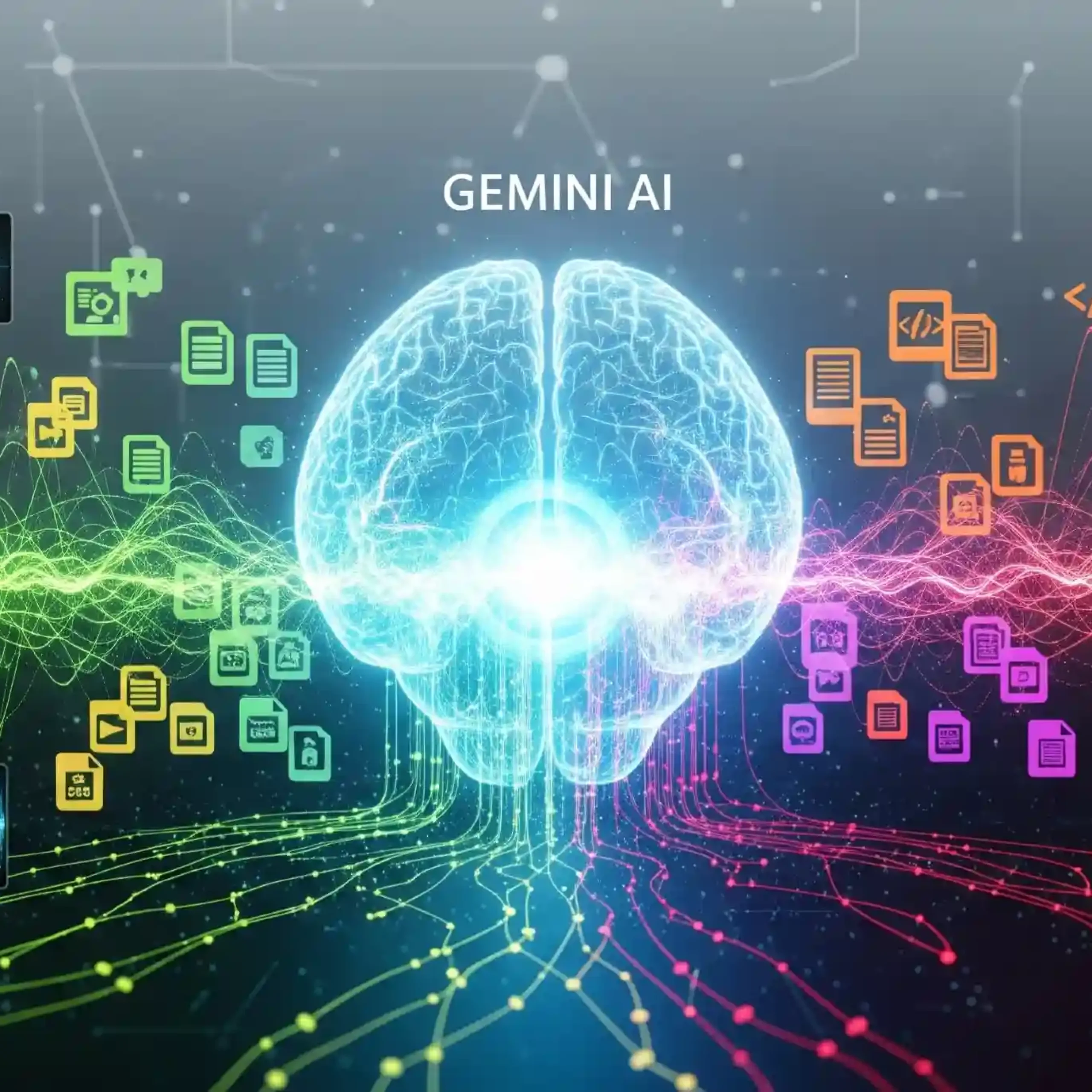
The world of artificial intelligence continues to evolve, and Google is once again demonstrating its leadership by responding to the needs of developers and users. A recent update significantly expanded the capabilities of Google Gemini models. They can now analyze not only text and images but also other types of data, including audio and documents. This is an important step toward creating truly multimodal and general-purpose AI that can interact with the world around us.
Listen and understand: a revolution in audio processing
One of the most anticipated new features was the audio processing feature. Until now, Gemini models worked primarily with visual and textual content. Now they can analyze audio recordings, transcribe them, and extract key information from them. This opens up a wealth of opportunities for developers. For example, you can download a recording of a long meeting, and Gemini 1.5 Pro will quickly prepare a summary, highlight key topics, and even identify different speakers.
This innovation isn’t just a convenient feature; it’s a true revolution in AI interaction. It allows language to be transformed into data that can be analyzed, sorted, and used. This will significantly speed up workflows and facilitate working with large volumes of information. This audio processing has applications in many fields, from journalism to medicine, where AI will help developers create new applications.
Analytics without borders: support for “any” files
In addition to audio, Google Gemini now supports loading files in various formats. While “any” is a bit of a generalization, in practice this means support for PDF documents, code files, tables, and many other text formats. This allows the model to process huge amounts of information stored in different files and work with them as a single entity.
For example, a developer can upload a large technical document in PDF format, and Gemini can help them quickly find the information they need, summarize it, or answer questions about its content. This feature is also useful for analyzing large codebases, where Gemini can help detect errors, suggest optimizations, or explain the program’s logic. This expands the API’s capabilities and makes multimodal AI much more useful for business and scientific research.
Practical application: why is this necessary?
Gemini’s new capabilities are already being applied in real-world projects. For example, a company can use this technology to automatically transcribe and analyze sales or customer support phone calls. This will allow for faster identification of problems and trends, and improved service quality.
In education, Gemini can be used to automatically generate lecture notes from audio recordings, significantly facilitating the learning process for students. In medicine, these new features can help summarize patient records, analyze research results, and maintain documentation. These capabilities open new horizons for innovation, where AI will enable developers to create previously unavailable solutions.
The Future of Artificial Intelligence: Where We’re Heading
Expanding Gemini’s capabilities is a major step toward creating universal artificial intelligence. With each update, the AI becomes more like the human brain, capable of perceiving information from various sources-text, images, video, and audio-and integrating it to solve complex problems. This will lead to AI evolving from a simple tool into a fully-fledged assistant capable of complex data processing.
This trend demonstrates that the future belongs to multimodal AI, capable of understanding the world in all its complexity. Google’s response to market demand with Gemini’s new features is proof that we are on the threshold of a new era where artificial intelligence will not simply answer questions but analyze complex relationships between different types of information.
Key innovations:
- Gemini Audio Support can analyze, transcribe, and summarize audio recordings.
- Multimodality: AI now works with different file formats, including PDF, code, and documents.
- API Flexibility: New features are available through the Gemini API to build innovative applications.
- Convenience: The model can simultaneously process large amounts of data from different sources.
- Wide application: New capabilities will be useful in business, education, medicine and other fields.




0 Comments