
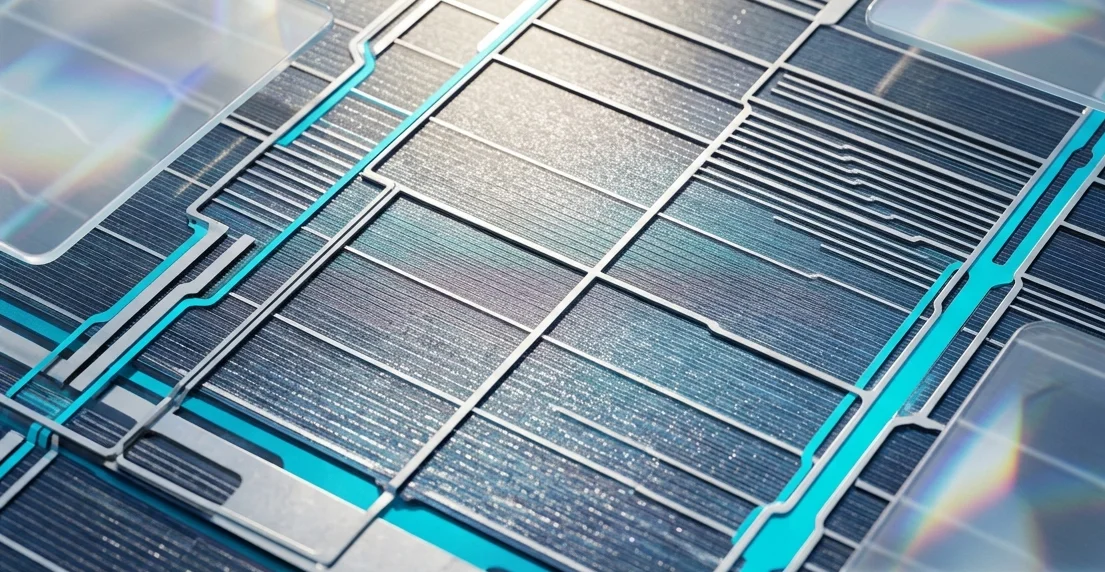
A New Milestone in Photovoltaics and Semiconductor Physics
Research groups from the Chinese Academy of Sciences have published test results for new-generation tandem solar cells. During laboratory testing, engineers registered an energy conversion efficiency of 26.4% and established a new record current density for perovskite-silicon heterostructures. These parameters open up clear pathways for optimizing commercial photovoltaic panels used in utility-scale solar farms and autonomous power supply systems.
A primary obstacle to the deployment of perovskite materials has long been degradation caused by external environmental factors such as humidity, ultraviolet radiation, and elevated operating temperatures. However, using advanced surface passivation technology and specialized molecular additives, Chinese researchers successfully minimized charge carrier losses at the layer interface. This modification enhanced electron extraction and stabilized the operating voltage of the cell.
Architectural Features and Technological Innovations
The device utilizes a tandem cascade architecture in which the top perovskite layer absorbs high-energy photons from the solar spectrum, while the bottom silicon layer captures longer wavelengths. This multi-junction configuration utilizes solar irradiance significantly more effectively than traditional single-junction silicon wafers.
To suppress charge recombination, the development team implemented several engineering strategies:
- Modification of the contact layer using organic compounds for accelerated hole transport.
- Optimization of surface micro-texturing to reduce parasitic light reflection.
- Application of an ultrathin protective coating that prevents moisture penetration into the active structure.
- Doping adjustments aimed at increasing the thermal resistance of the crystal lattice.
Through these measures, the cell demonstrated the ability to retain up to 90% of its initial efficiency after 1000 hours of continuous operation under full sun illumination and heating up to 60 degrees Celsius.
Comparative Technical Specifications of Photovoltaic Modules
To better understand the engineering progress, it is helpful to compare the parameters of this development with existing commercial solutions. The table below outlines key physical and operational characteristics across different solar cell technologies.
The compiled data indicates that the new cell design substantially outperforms existing analogs in efficiency metrics and generated current density. At the same time, operational longevity metrics require further refinement to reach standard industry warranty periods, which typically range from 20 to 25 years.
Prospects for Mass Production and Commercialization
Scaling up from laboratory samples measuring a few square centimeters to full-sized industrial modules remains a complex engineering task. The primary challenge involves depositing uniform, defect-free perovskite thin films over large surface areas without pinholes or micro-cracks. Any structural inconsistency leads to localized hot spots and accelerated degradation across the module.
Researchers note that adapting this process to existing silicon wafer manufacturing lines can avoid radical capital retooling at manufacturing facilities. This approach lowers implementation barriers and speeds up commercial availability. Initial market adoption is anticipated in specialized sectors such as portable electronics, unmanned aerial vehicles, and residential rooftop setups.
Economic Factors and Generation Costs
Increasing solar cell efficiency even by one percentage point reduces the total land footprint required for a solar installation of a given power capacity. This reduction directly impacts structural racking costs, electrical cabling overhead, land lease expenses, and installation labor. For utility-scale installations exceeding 100 MW, such optimization provides measurable economic advantages by lowering the levelized cost of energy (LCOE).
Engineers are continuing work to refine layer chemistry and substitute expensive rare elements with more abundant alternatives, aiming to maintain production costs competitive with current mass-produced silicon panels.




0 Comments