
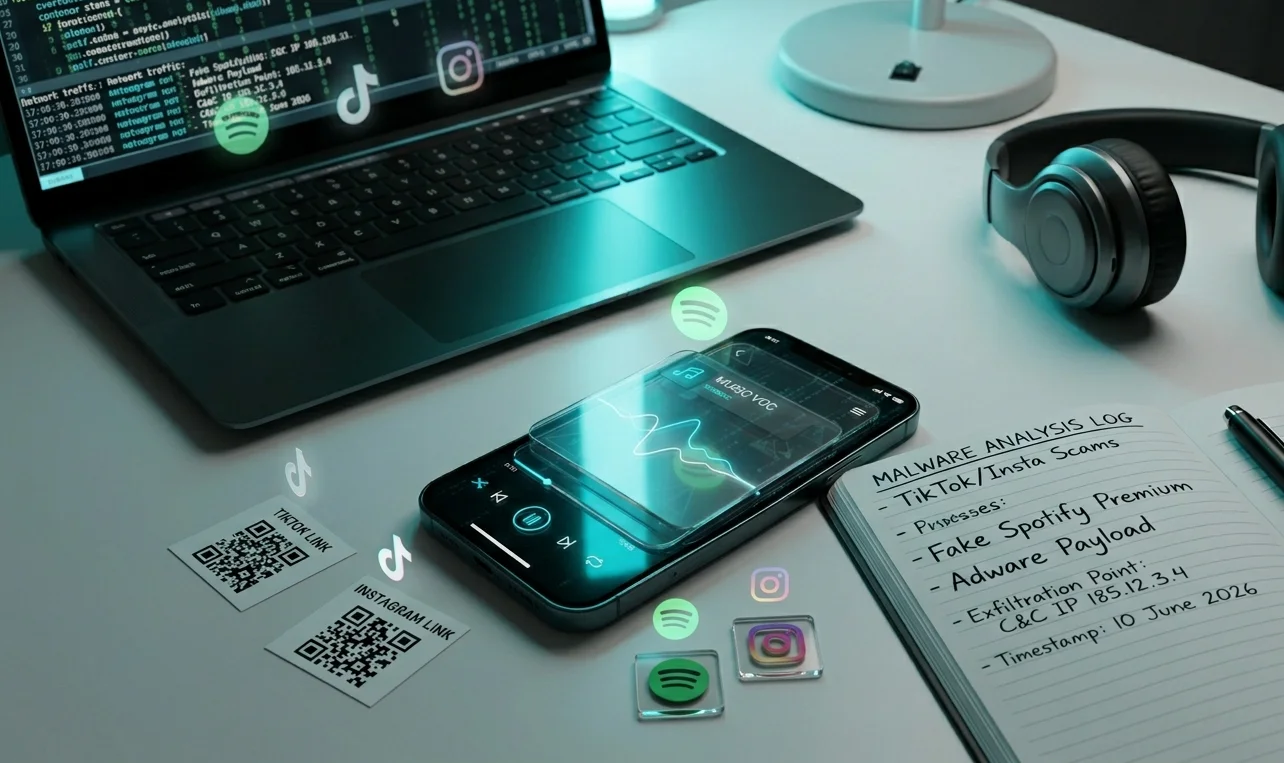
Anatomy of a New Cyber Threat in Popular Social Networks
Cybercriminals have launched a large-scale campaign on TikTok and Instagram, targeting users looking for free access to premium features of the Spotify streaming service. Attackers use short videos to demonstrate a supposedly working modified version of the app that allows listening to music without limits or ads. In reality, dangerous malware belonging to the class of infostealers (tools for stealing personal data) is distributed under the guise of the popular service.
This scheme is primarily aimed at mobile devices, but the threat is also relevant for desktop systems if the user follows links via a computer. The main danger is that the virus acts covertly, and the application itself can partially replicate the interface of the original program so as not to arouse suspicion in the victim during the first hours after installation.
How the Free Subscription Scam Works
The process of attracting a victim consists of several carefully planned stages based on social engineering methods and exploiting the desire to save money. Recommendation algorithms of TikTok and Instagram help attackers quickly reach a large audience without significant financial expenditure on advertising.
- Content Creation. Scammers publish short videos showing the Spotify Premium interface with all features active. The video claims that this account can be obtained absolutely free using a “secret method” or a new digital tool.
- Traffic Redirection. Links to third-party resources are placed in the profile bio or in the comments under the video. Most often, popular multi-link services like Linktree or URL shorteners are used. This allows bypassing standard social media security filters.
- Imitation of a Legitimate Site. By clicking the link, the user lands on a page that copies the design of the official Spotify website or a well-known mobile app catalog. There is a button to download a configuration file or an installation package.
After clicking the button, instead of the promised music player, malicious code is downloaded to the device. On Android devices, this is usually a modified APK file, while on iOS, scammers try to force the user to install a third-party management profile, which gives wider access to the system.
Technical Analysis of the Malware
Cybersecurity researchers have recorded that well-known families of Trojan stealers, including RedLine Stealer and its analogs, are most often distributed under the guise of a music service. These programs are designed to fully collect the user’s digital footprint for subsequent sale on dark web forums or for hacking financial accounts.
To understand the scale of the danger, it is worth considering the technical capabilities of infostealers integrated into fake installers. Below is a list of system components that attackers gain access to after activating the virus.
In addition to stealing information, some modifications of this software have backdoor functions. This means that after the initial infection, hackers can remotely upload other viruses to the device, such as ransomware or applications for secret cryptocurrency mining, which leads to rapid wear and tear of the smartphone hardware.
Psychological Triggers and Moderation Bypassing Methods
Why users continue to believe such schemes. Scammers actively use artificial scarcity and time limits. In the captions of the videos, they often indicate that the “promo is valid for 24 hours only” or “the number of free licenses is limited”. This forces a person to act emotionally and quickly, neglecting basic safety rules.
To bypass automatic moderation systems on TikTok and Instagram, attackers use veiled labels in videos, change the color scheme of famous brands, or use synthesized voices to read instructions. The comments under such publications are usually filled with bots that write positive reviews and confirm that the method allegedly works. This creates an illusion of safety for real visitors to the page.
How to Protect Your Device and Check the System for Viruses
The best way to protect against such threats is to maintain strict digital hygiene. Mobile operating systems have their own protection mechanisms, but they become useless if the user voluntarily grants the malicious program maximum administrator rights in the settings.
To minimize risks, it is recommended to follow these rules
- Install applications exclusively from the official Google Play and App Store, where all files undergo preliminary automatic and manual verification.
- Never download APK files or configuration profiles from links on social networks, no matter how attractive the offer looks.
- Pay attention to the permissions the app requests during installation. If a regular music player requires access to contacts, SMS, or system management, it must be removed immediately.
- Use licensed antivirus software for mobile platforms that can block transitions to phishing sites in real time.
If you have already followed similar links and downloaded files, you must take several emergency actions. First, completely remove the suspicious application through the system settings. After that, change passwords to all critical accounts (email, banking, social networks) from another, guaranteed clean device. Also, be sure to terminate all active sessions in the security settings of your accounts to invalidate any potentially stolen cookies.

0 Comments