
The Return of a Legendary Nameplate in the Hybrid Era
German automaker Audi has adjusted its strategy regarding a complete transition to electric vehicles after 2026. The direct outcome of this pivot is the unveiling of the new flagship supercar, the Audi Nuvolari, which features a high-performance plug-in hybrid powertrain. Named after the legendary Italian racing driver Tazio Nuvolari, this vehicle is designed to fill the void left by the discontinued R8 series. The company intends to release this model in a highly limited production run, making it an immediate target for automotive collectors and high-performance machinery enthusiasts worldwide.
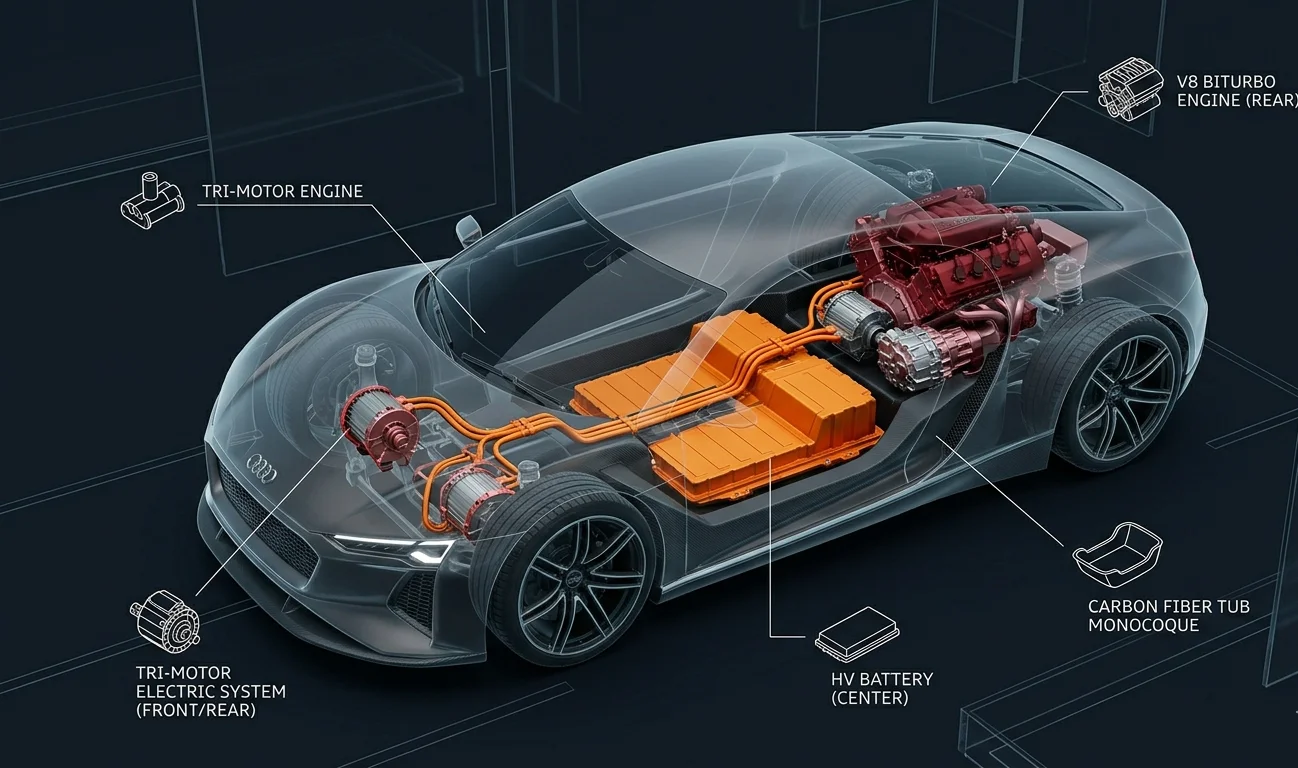
The new model is built upon a heavily revised space frame chassis that utilizes carbon fiber and advanced aluminum alloys. Designers shifted their focus away from pure battery electric vehicles (BEVs) toward ultra-powerful hybrids due to shifting market demands within the supercar segment. The Nuvolari demonstrates how classic internal combustion engineering can harmoniously interact with modern electric components to deliver peak dynamic behavior without the charging downtime drawbacks typically associated with EVs.
Powertrain Architecture and Technical Specifications
At the heart of the Audi Nuvolari lies a mid-mounted 4.0-liter twin-turbocharged V8 engine. This combustion unit is capable of screaming up to 10000 rpm, a benchmark performance figure usually reserved for dedicated motorsport applications. The V8 engine operates alongside three axial-flux electric motors, which offer superior power density and compact packaging compared to traditional radial-flux setups. Two electric motors reside on the front axle, providing full all-wheel-drive capabilities and individualized torque vectoring, while the third motor is embedded directly into the transmission housing to assist the rear axle wheels.
The total system output reaches an impressive 1001 horsepower, allowing the vehicle to deliver performance metrics that challenge modern hypercars. Thanks to the instantaneous torque provided by the electric components, the Nuvolari completely eliminates any hints of turbo lag. Audi engineers implemented an advanced thermal management setup, as high-rpm operation requires heavy heat dissipation from both the engine block and the compact liquid-cooled battery pack situated behind the passenger cabin for optimized weight distribution.
Track Performance and Driving Dynamics
The efficiency of transferring this immense power to the tarmac is handled by a proprietary all-wheel-drive system known as quattro predictive ride. This chassis control suite monitors road surface conditions every few milliseconds, preemptively adjusting damper stiffness and shifting torque delivery between the front and rear axles. Acceleration from 0 to 100 km/h takes less than 2.5 seconds, while the top speed is electronically limited to 350 km/h to preserve tire structural integrity under extreme thermal loads.
For decelerating duties, the supercar relies on a carbon-ceramic braking layout with fixed multipiston calipers. The vehicle aerodynamic envelope incorporates active functional elements, such as an adaptive rear wing and variable flaps within the front bumper structure. These elements optimize downforce based on real-time vehicle speed, allowing the driver to tackle high-speed sweeping corners with increased lateral acceleration. Utilizing lightweight composite structures for external body panels allowed engineers to maintain a reasonable curb weight despite carrying heavy hybrid batteries.
Pricing Structure and Market Availability
The Audi Nuvolari will not be a mass-market offering, with production strictly limited to 499 units globally. Assembly will take place exclusively at the specialized Böllinger Höfe manufacturing facility, the historic production site of the R8 and the electric e-tron GT models. This ensures a high degree of quality control and extensive interior customization options tailored to the specific desires of individual buyers. The cabin architecture emphasizes sustainable design, utilizing recycled carbon composites and premium microfiber upholstery while minimizing standard leather applications.
Base pricing for the premium hybrid supercar starts at 450000 USD within the United States market. When equipped with optional track-focused performance packages or bespoke paint schemes, transaction prices can easily eclipse 520000 USD. This pricing strategy positions the German supercar squarely against established high-end alternatives from manufacturers like Ferrari, McLaren, and Aston Martin. Customer deliveries are scheduled to commence next year, with the order books currently open for brand loyalists through selected dealer networks.



0 Comments