
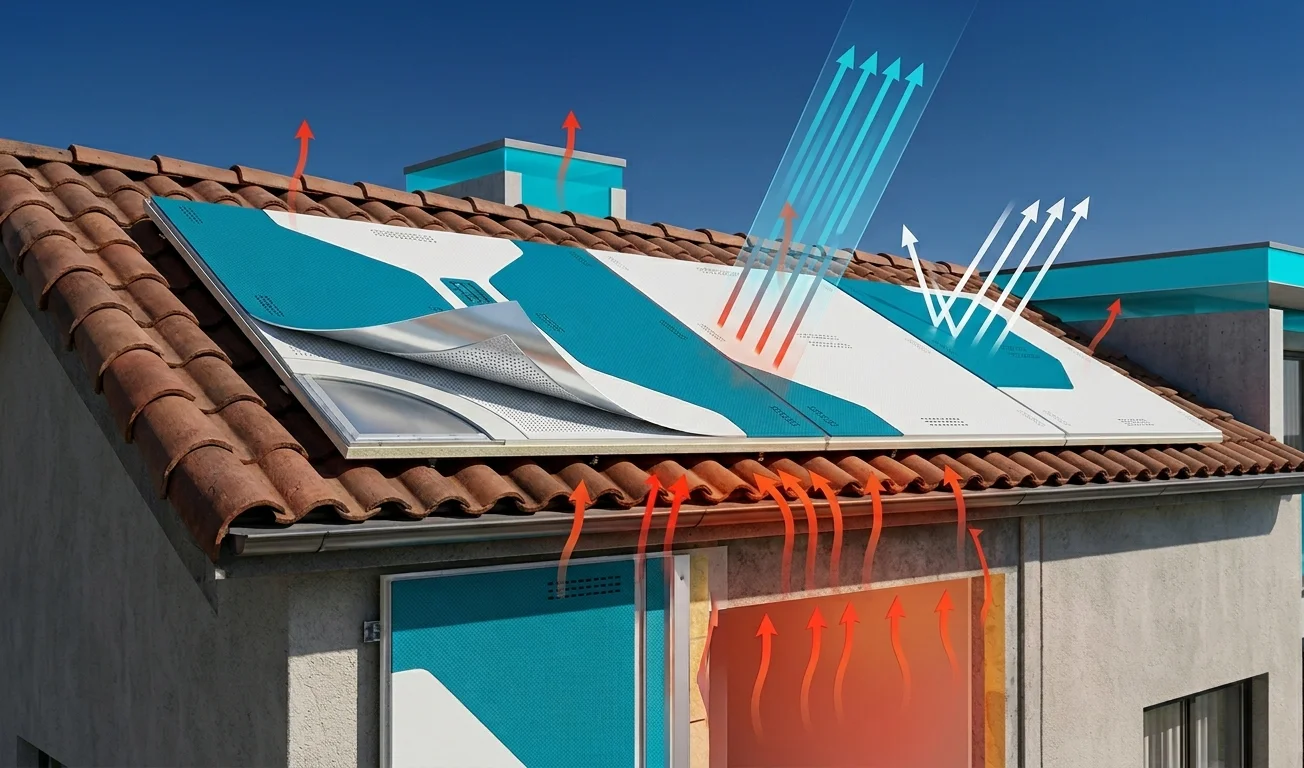
Principles of Wireless Cooling Without Using Electricity
Conventional cooling systems consume a significant portion of global electricity, creating critical pressure on power grids during summer peaks. Passive Daytime Radiative Cooling (PDRC) technology offers an alternative approach based on fundamental laws of thermodynamics. This system is capable of lowering the temperature of objects below the ambient level without using a single watt of electric current.
The system operates based on two simultaneous processes. First, the surface of the material reflects nearly 95-98% of solar radiation across ultraviolet, visible, and near-infrared spectrums. This prevents the building from heating up under direct sunlight. Second, the material is engineered to actively emit its own thermal energy within a specific range of wavelengths.
To address safety concerns regarding this process, it is worth noting that the term radiative cooling originates from the Latin word radiatio, meaning emission. It has no connection to radioactivity or harmful nuclear radiation. It refers to standard thermal infrared radiation emitted by any heated body, including human beings. The optical trick lies in emitting energy within the wavelength range of 8 to 13 micrometers. In this specific spectrum, Earth’s atmosphere is completely transparent. Physicists refer to this effect as the atmospheric transparency window. Thanks to this, heat does not warm up the surrounding air but passes unhindered through the planet’s atmospheric shell, dissipating directly into deep space, where temperatures are close to absolute zero at minus 273 degrees Celsius.
Materials and Engineering Solutions for Technology Deployment
To produce high-performance PDRC surfaces, scientists utilize complex nanostructured materials and metamaterials. The foundation for such coatings typically consists of polymers embedded with nanoparticles of silicon dioxide or aluminum oxide. These particles have precise sizes proportional to the wavelength of thermal radiation, which optimizes the processes of energy reflection and emission.
Modern developments are shifting toward flexible films that can be applied to existing windows, building roofs, or vehicle bodies. Laboratory and field tests indicate that utilizing such films allows reducing temperatures inside a space by 5-10 degrees Celsius compared to identical objects without the protective coating. This significantly reduces the reliance on classical climate control systems, lowering summer cooling expenses by 30-40%.
Special attention is drawn to hybrid systems combining passive panels with hydrogels or fluid loops. Water circulating beneath the panels cools down due to the radiative effect and is subsequently fed into the internal climate control system of the building. Such engineering designs ensure a stable temperature regime not only during daytime under direct sunlight but also at night, when the efficiency of heat dissipation into space remains high.
Integration Prospects and Economic Viability
Large-scale implementation of energy-free cooling systems is capable of transforming urban planning and architectural practices. Coating the roofs of large logistics hubs, supermarkets, and residential complexes with specialized radiative paints or panels will partially resolve the urban heat island effect in megacities, where asphalt and concrete accumulate solar energy and raise ambient urban temperatures.
From a financial standpoint, the technology demonstrates rapid payback due to the complete lack of operating expenses. The production cost per square meter of commercial film based on metamaterials is steadily decreasing due to advancements in roll-to-roll printing techniques. Implementing these solutions in hot climate regions will save billions of USD in energy sector subsidies and shrink the carbon footprint of residential and industrial sectors.
Despite obvious advantages, the technology has certain constraints that research groups are actively working to resolve. The primary challenge is its dependence on weather conditions: high humidity and dense cloud cover absorb part of the infrared radiation, lowering the efficiency of heat dissipation into space. Nevertheless, even under such conditions, integrated systems demonstrate high viability, acting as an exceptional barrier against solar overheating.




0 Comments