
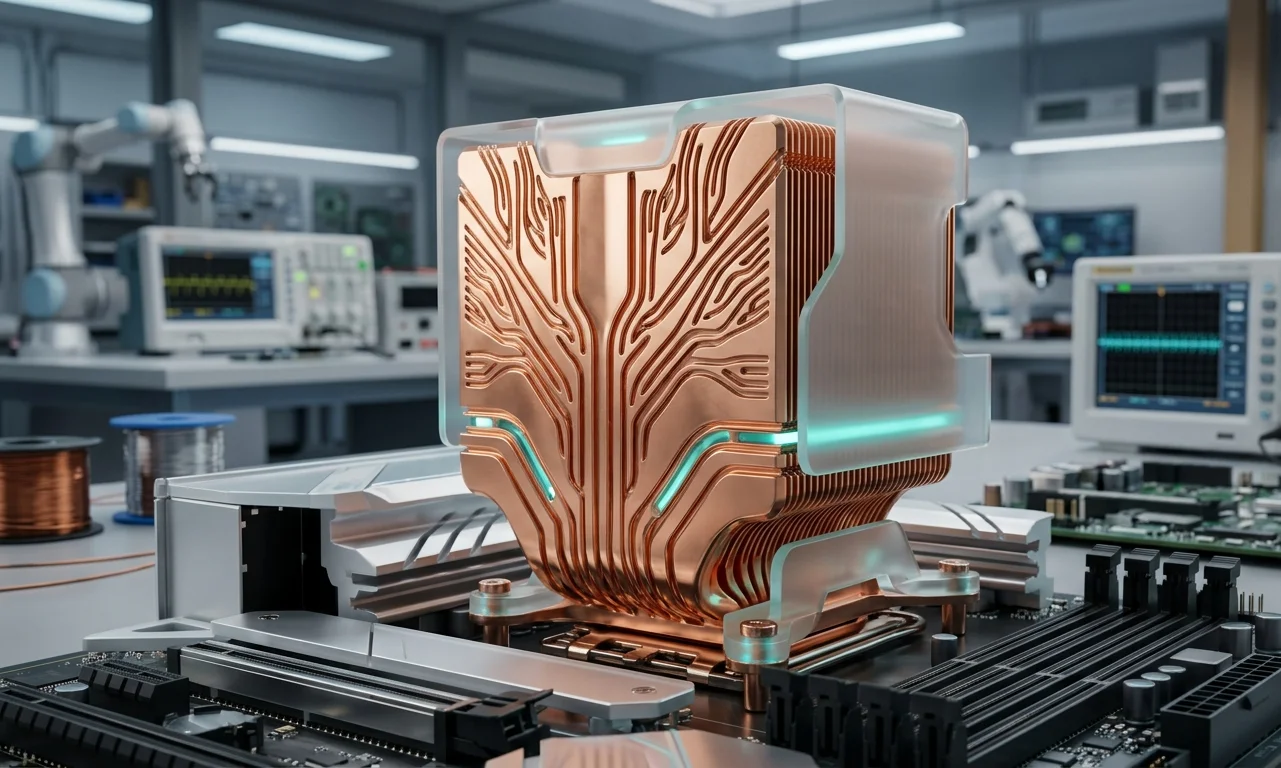
The Evolution of Copper Materials in Thermal Management
Copper remains the gold standard in the production of cooling systems due to its physical properties. The thermal conductivity of this metal is approximately 401 W/(m·K), which significantly exceeds that of aluminum. However, modern technologies require more than just the use of expensive metal; they demand the optimization of its internal structure. Scientists have focused on developing porous copper structures that allow for an increase in heat dissipation area without a critical increase in the overall dimensions of the radiator itself.
The main issue with classic copper blocks lies in their weight and cost. Research indicates that using additive manufacturing methods allows for the creation of complex geometric shapes that cannot be obtained through traditional milling or casting. This opens the way for creating hybrid systems where copper is used only in zones of maximum heat flux.
Micro-channel Structuring Technology
One of the most promising directions is the creation of micro-channels directly in the copper base that contacts the processor’s heat spreader. This allows the capillary effect to work in favor of cooling, especially in liquid systems. New approaches allow for the reduction of thermal resistance at the phase interface.
Impact of Microstructure on Convection
Laboratory tests confirm that surface roughness of copper fins created at the nanoscale promotes air flow turbulence. This prevents the formation of a laminar air layer, which usually acts as an insulator. As a result, heat transfer efficiency increases by 15-20% at the same fan speed. This is critically important for server solutions where component density is constantly increasing.
Practical Application and Economic Feasibility
Despite the advantages, copper radiators require protection against oxidation. Copper oxide has a much lower thermal conductivity, so manufacturers use nickel plating. Modern research suggests replacing nickel with thin layers of graphene or special ceramic coatings that do not hinder energy transfer but completely block oxygen access to the metal.
For the consumer market, this means the appearance of more compact coolers capable of servicing processors with a TDP exceeding 250 W. Currently, the cost of such solutions may range between 80-150 USD, depending on the complexity of the structure. However, as metal 3D printing technology develops, the price will gradually decrease.
Integration Perspectives in Mobile Devices
An interesting aspect is the implementation of thin copper vapor chambers in smartphones and laptops. Instead of bulky tubes, scientists propose using multi-layered copper meshes filled with refrigerant. This allows for uniform heat distribution across the device’s entire area, avoiding local overheating near the chipset. Using such structures allows maintaining peak processor frequency 30% longer than when using standard graphite stickers.
- Reduction of radiator thickness without loss of performance.
- Use of recycled copper to reduce environmental footprint.
- Improvement of acoustic comfort due to less need for intensive airflow.
Industry Outlook
Rethinking copper as a dynamic material rather than just a static piece of metal is the key to overcoming the thermal barrier in computing. Engineers continue to experiment with geometry, approaching bionic forms that mimic the circulatory system or leaf structures, which are the most efficient natural radiators.




0 Comments