
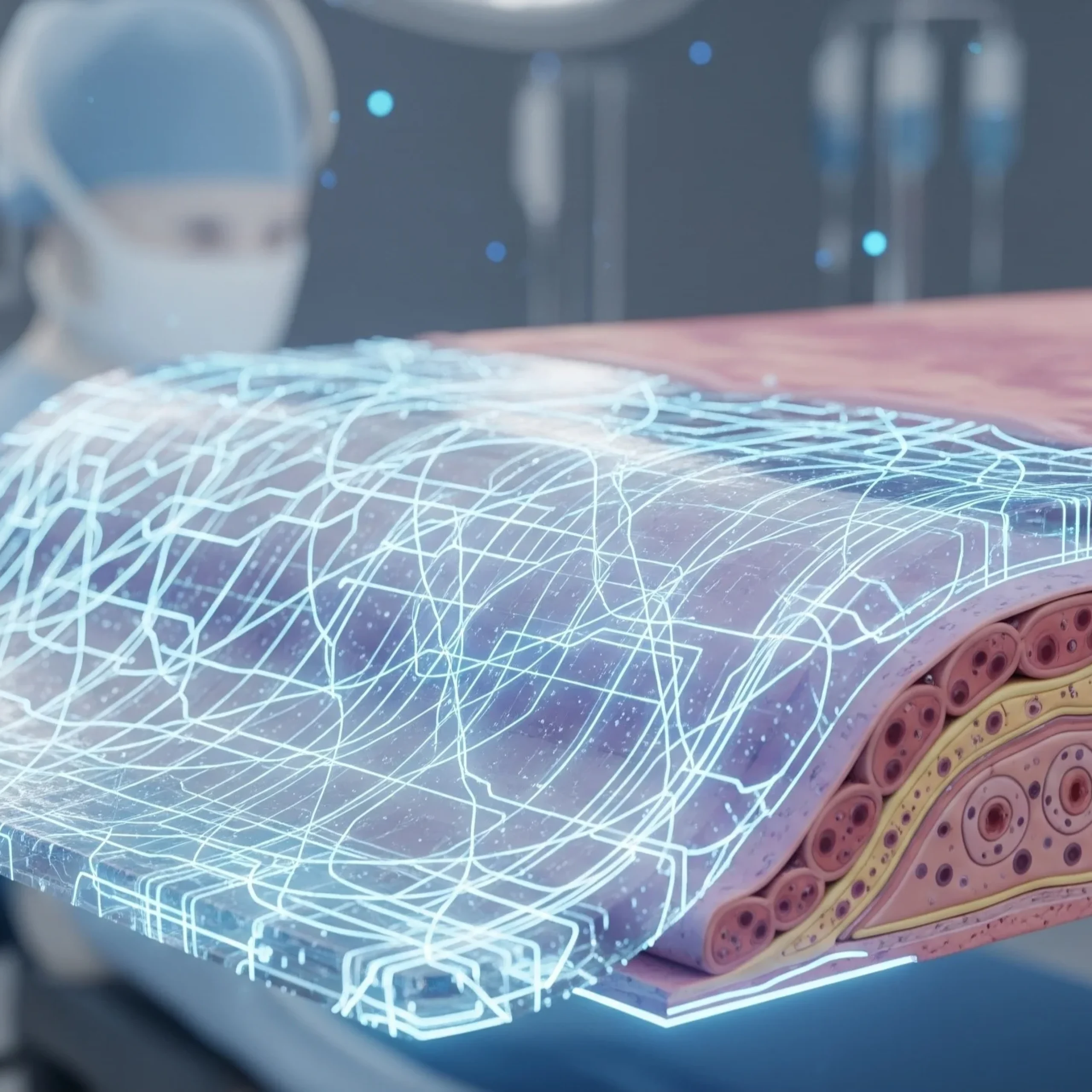
Regenerative medicine is constantly evolving, offering increasingly innovative solutions. One of the most promising advances is the development of biocompatible polymers capable of replacing traditional surgical sutures. These materials open new horizons for minimizing trauma, accelerating healing, and reducing the risk of complications during surgery. Unlike conventional methods that require mechanical damage to connect tissues, biocompatible polymers provide strong and hermetic adhesions, which is especially important for delicate and complex structures such as nerve fibers or blood vessels.
How does next-generation surgical glue work?
New surgical adhesives don’t simply hold wound edges together; they actively interact with biological tissue at the molecular level. Most of these bioadhesives are based on natural or synthetic polymers that mimic the properties of natural proteins. For example, some developments are based on chemical compounds activated by light, allowing the surgeon to control the polymerization process. This ensures precision and speed of application, as bonding occurs in just a few seconds. This medical adhesive is becoming an indispensable tool in surgeons’ arsenal, providing reliable fixation and facilitating the natural healing process.
Advantages of bioadhesives over traditional sutures
- Minimal tissue trauma. Unlike needles and threads, bioadhesives do not puncture tissue, preventing further damage and scarring.
- Speed and efficiency. The bonding process takes much less time than suturing, reducing the duration of the procedure.
- Sealing. Tissue bonding adhesive creates a perfectly sealed connection, which is especially important in vascular and cardiac surgery, where even the slightest leak can have serious consequences.
- Biological compatibility. Modern polymers completely degrade in the body over time, causing no inflammation and requiring no further intervention for removal.
- Reduced risk of infection. Puncture-free wound closure minimizes entry points for infection, significantly improving patient safety.
Expanding capabilities: from cosmetic surgery to complex trauma treatment
The use of biocompatible polymers is not limited to general surgery. This new biopolymer has already found its place in neurosurgery, plastic surgery, and even ophthalmology. For example, light-activated wound adhesives are successfully used to seal corneal incisions, and in traumatology, to fix fractures. Another promising area is tissue regeneration and the creation of three-dimensional structures for 3D bioprinting. Degradable polymers are used as temporary scaffolds for growing new tissue, which are subsequently replaced with natural biomaterial.
Types of biocompatible polymers
There are several key types of bioadhesives, each with its own unique properties. Natural polymers, such as fibrin or collagen, provide high biocompatibility but may have limited strength. Synthetic polymers, particularly those based on cyanoacrylates or polylactides, offer greater strength, but their biocompatibility requires careful study. Current research is focused on creating hybrid materials that combine the best properties of both types. An example is a light-activated bioadhesive developed at the Massachusetts Institute of Technology (MIT), which can bond wet tissue in just 30 seconds. These developments pave the way for the creation of “programmable” polymers that can alter their mechanical properties and degradation rates based on the body’s needs.
The Future of Biomedical Technologies
The development of biocompatible polymers is a key area in modern biomedical engineering. This technology has the potential to completely transform the approach to surgical intervention. Instead of “suturing” the body, doctors will be able to “glue” it together, significantly accelerating the healing process and improving treatment outcomes. This is especially relevant in conditions where surgical procedures are becoming increasingly complex and require maximum precision. Research is also focused on adding drugs (such as antibiotics or anti-inflammatory agents) to polymers, which would be released directly into the wound, enhancing healing and preventing complications. The cost of such medical adhesives can currently range from a few dollars to thousands of dollars, depending on the type and volume. As demand grows and technology advances, the price is expected to decrease, making them more accessible.
So, an alternative to surgical sutures is no longer science fiction. It’s a reality, actively being implemented into medical practice. This breakthrough will not only make surgeons’ work easier but will significantly improve patients’ lives, ensuring fast, safe, and effective recovery from injuries and surgeries.




0 Comments