
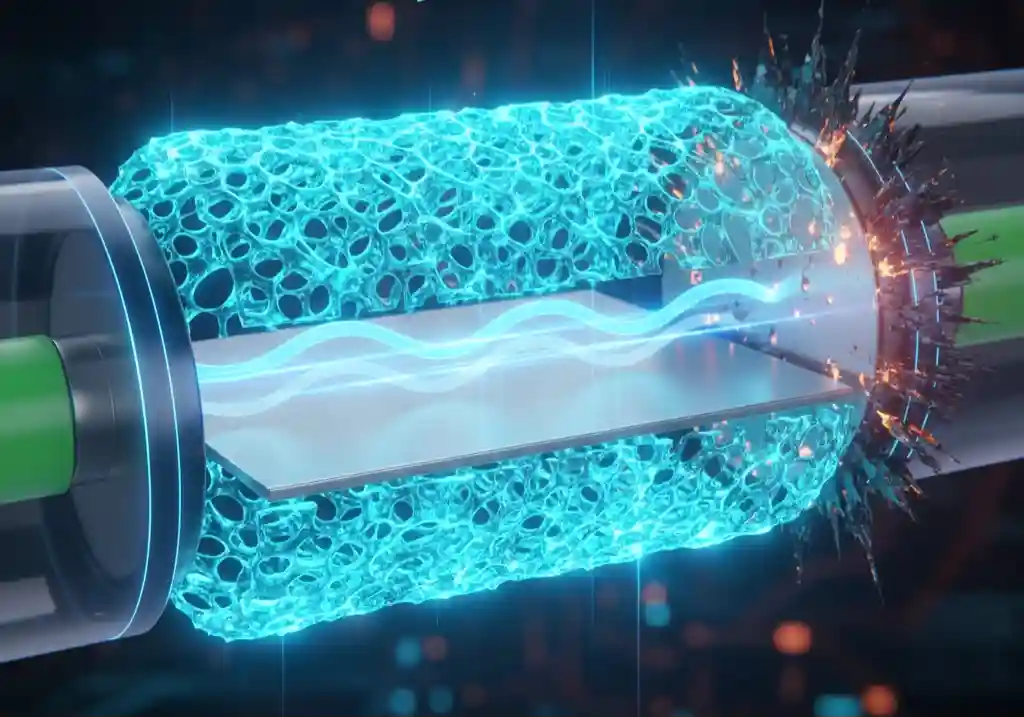
The field of energy storage has received a significant boost: an international team of scientists from Sweden and China announced the development of a porous, innovative material. This substance, used as an electrolyte, has the potential to extend the lifespan of lithium-metal batteries not by a fraction of a percent, but several times over. The success of this project, which combines high energy density and cyclic stability, is critical for the next generation of electric vehicles and portable electronics.
The problem that the cellular electrolyte solves: Dendrites and degradation
Why was lithium metal unstable?
Lithium metal batteries (LMA) have always been considered the “holy grail” of energy storage, as they can store significantly more energy than modern lithium-ion batteries. However, their widespread use has been hampered by two main factors: rapid degradation and safety risks.
During charge/discharge cycles, needle-like structures known as dendrites form on the surface of the lithium anode. These dendrites not only consume active lithium, reducing capacity, but can also puncture the battery separator. This leads to short circuits, overheating, and, ultimately, thermal runaway (fire). Furthermore, highly reactive lithium undergoes side reactions with the liquid electrolyte, forming an unstable SEI (Solid Electrolyte Interphase) layer, which causes rapid capacity loss.
Innovation: How the new cellular material works
Researchers from Chalmers University of Technology (Sweden) and the Dalian Institute of Chemical Physics (China) have developed and tested a new type of electrolyte based on a cellular material. This material has a unique microstructure with a very large yet uniform surface area and a controlled pore distribution.
The key function of this cellular material is to stabilize the flow of lithium ions. The material’s structure effectively controls lithium deposition on the anode. Instead of growing unevenly and forming dangerous dendrites, lithium ions are deposited evenly and densely. This prevents both dendrite formation and degradation of the SEI interface. The result is an anode that remains smooth and functional for a much longer period of time.
Extraordinary advantages and application prospects
Cyclical stability and security
Thanks to this innovation, the cyclic stability of LMA batteries increases exponentially. Under laboratory conditions, the new batteries have demonstrated the ability to withstand thousands of charge-discharge cycles without capacity loss, whereas traditional LMA batteries rapidly degrade after several hundred cycles. This directly translates into a significantly longer battery life for the end user. Furthermore, the absence of dendrites almost completely eliminates the risk of internal short circuits, improving battery safety.
The future of electric vehicles
Maintaining high energy density and increasing durability makes the technology ideal for electric vehicles. Cars equipped with such batteries will be able to travel much longer distances on a single charge, which is the main barrier to the widespread adoption of electric vehicles. This also opens up new possibilities for portable electronics, where battery life will increase.
Conclusions
The development of a new porous electrolyte is more than just a laboratory success; it paves the way for the commercialization of lithium-metal batteries. Combining high energy density with unprecedented safety and durability, this material has the potential to accelerate the energy transition and make future devices more efficient and reliable.

0 Comments