
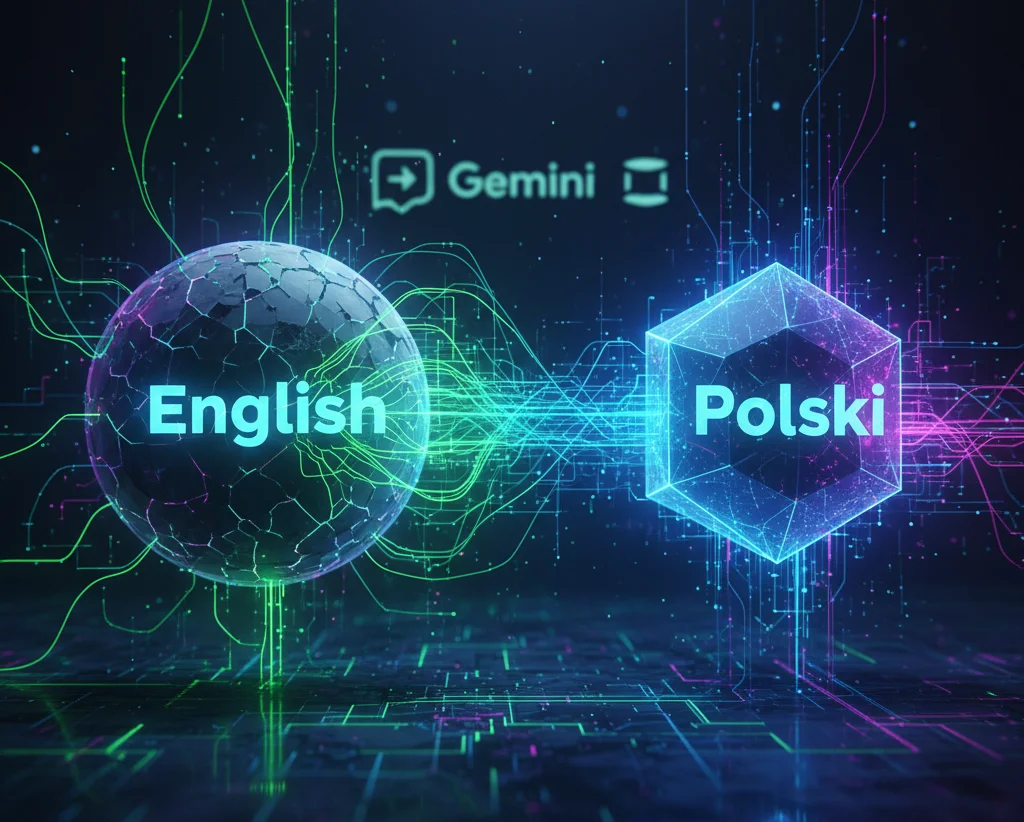
- The Nature of AI Learning: Have Billions Really Been Wasted?
- The Phenomenon of “Emergent Abilities” and Generalization
- Why did Polish become the litmus test for the LLM?
- Complexity leading to depth
- Benchmark Criticism: Did AI Really ‘Fail’ English?
- The problem is not AI, but testing
- Practical implications and the future of Multilingual AI
- The value of generalization, not memorization
The world has witnessed colossal investments in artificial intelligence, including large language models (LLMs). We’re talking billions of dollars spent processing gigabytes of data, most of it in English. It would be logical to expect models like ChatGPT and Gemini AI to demonstrate perfect understanding and content generation in English. However, the reality has proven to be much more complex and counterintuitive.
Recent research and testing have revealed a surprising fact: in some complex linguistic tasks, AI has demonstrated unexpectedly high performance in Polish, sometimes even outperforming its own performance in English. This phenomenon has raised questions about the true value of these multi-billion dollar investments and what the models actually learn during training.
The Nature of AI Learning: Have Billions Really Been Wasted?
The amount of money invested in the development of leading LLMs is truly impressive. However, to say that these investments are “useless” is a mistake. They have enabled the creation of an architecture capable of not just memorizing, but also generalizing and understanding linguistic rules. Success in Polish is not a failure of English, but a testament to the power of AI mechanisms.
The Phenomenon of “Emergent Abilities” and Generalization
The key to understanding this phenomenon lies in the concept of “emergent abilities.” This is a nonlinear leap in performance that occurs when models reach a certain scale in the number of parameters and data volume. Training ChatGPT and Gemini AI on billions of tokens allowed them to discover hidden connections.
- LLMs have learned not just to copy text, but to build complex internal models of linguistic patterns.
- Successful mastery of one complex system (for example, Polish grammar) automatically increases the ability to process other languages, even if there was less data on them.
- The increase in the number of parameters according to Scaling Laws is the direct cause of such unpredictable abilities.
Why did Polish become the litmus test for the LLM?
The choice of Polish as an indicator of success is no accident. Polish, like many Slavic languages, has an extremely complex grammatical structure. It is characterized by a large number of cases, genders, and dynamic morphological changes.
Complexity leading to depth
Successfully learning this complex system with a relatively smaller amount of data (compared to English) demonstrates the model’s deep generalization. If ChatGPT can correctly cancel words in Polish, it hasn’t simply memorized examples, but has truly understood the mechanisms of word formation.
AI demonstrates that intensive learning on a limited but complex set of rules can be more effective than extensive learning on simple rules.
Furthermore, it should be taken into account that progress in Polish is an extremely positive signal for other low-resource languages, including Ukrainian, opening up new opportunities for Multilingual AI.
Benchmark Criticism: Did AI Really ‘Fail’ English?
The claim that AI “failed” English is often based on the results of standardized tests, or benchmarks as they are called. However, current LLM testing methods have significant shortcomings.
The problem is not AI, but testing
Benchmarks (such as MMLU or GLUE) often contain outdated data or tasks that don’t reflect real-world language situations. Furthermore, high results in English can be artificially inflated due to the phenomenon of “data leakage.”
- Data leakage: This is when test questions or variations of them accidentally end up in the training dataset, allowing the AI to simply “remember” the answer rather than generate it.
- English-language test kits have been around longer and are more widespread online, increasing the risk of data leaks.
- Newer or less common language tests, such as Polish ones, may be “purer” than their origins, and therefore actual scores are more accurate indicators of depth of understanding.
Practical implications and the future of Multilingual AI
The $20 billion investment (approximately) has paid off. It has opened the door to truly multilingual AI. While companies previously had to create separate models for each language, now, thanks to deep emergent capabilities, a single powerful model can effectively work with dozens of languages.
The value of generalization, not memorization
This paradox changes the approach to developing and evaluating Great Language Models. The emphasis shifts from assessing perfect knowledge of a single language to the AI’s ability to perform cross-language transfer linguistics and generalize. Success in Polish is a victory for the globalization of artificial intelligence.
The future lies in LLMs that can work effectively in all languages, regardless of the volume of training data.
Users worldwide, including Ukrainian speakers, will directly benefit from this progress. Improved performance in Polish demonstrates ChatGPT and Gemini AI’s growing ability to work with other Slavic languages, significantly expanding their commercial and educational potential.
Ultimately, the AI-Polish paradox proves that success is measured not by the number of dollars spent, but by the depth of understanding demonstrated by artificial intelligence.




0 Comments