
- Why Li-S: Unrivaled energy density and efficiency
- Overcoming the Main Obstacle: The “Shuttle Effect” of Polysulfides
- Innovative solutions that extend battery life
- Speed and Power: A Battery for Today’s Needs
- Where Li-S Will Change the World: Key Applications
- Electric vehicles (EVs)
- Unmanned Aerial Vehicles (Drones) and Aviation
- Large energy storage systems (Grid Storage)
- The path to mass production and economic prospects
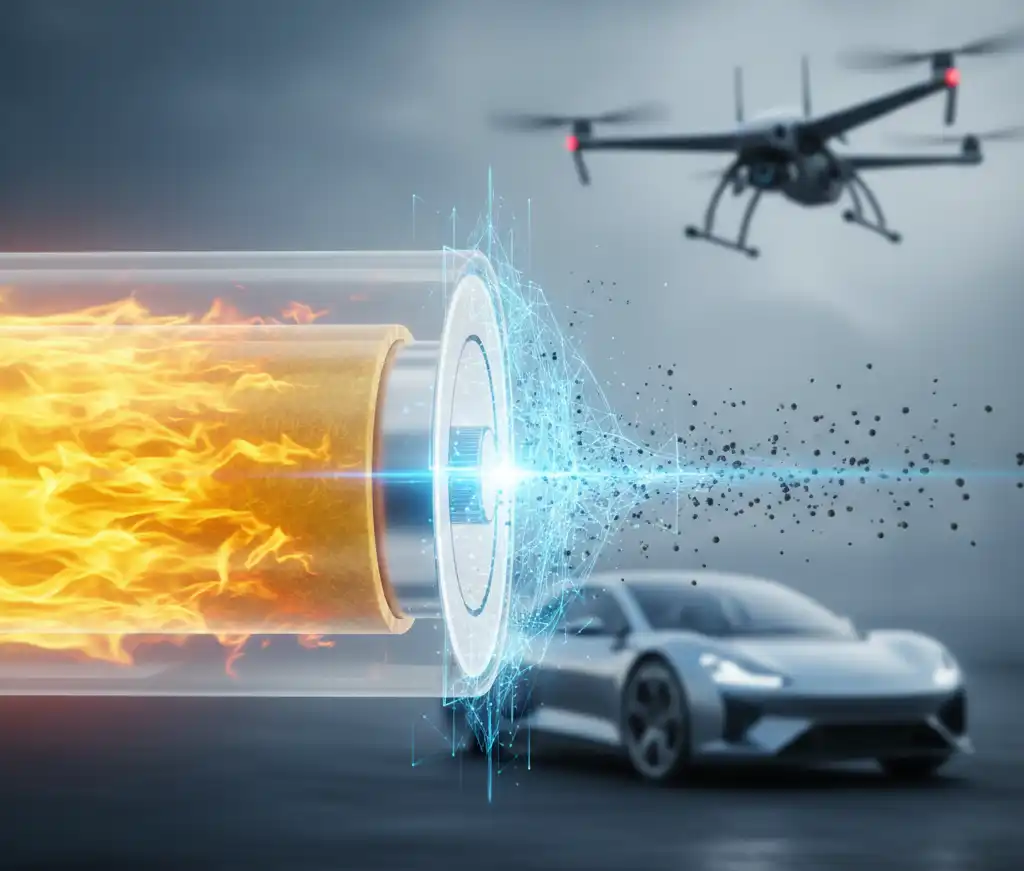
Energy storage technologies are on the cusp of a major transformation. Current lithium-ion batteries are reaching their theoretical limits, forcing scientists and engineers to seek alternatives. Lithium-sulfur (Li-S) batteries are rapidly gaining ground, promising not just an evolution, but a true revolution in energy capacity. They can store two to three times more energy per unit weight, opening new horizons for electric vehicles, drones, and large-scale energy storage systems.
Why Li-S: Unrivaled energy density and efficiency
The main advantage of Li-S batteries is their theoretical energy density, which reaches a phenomenal 500-600 Wh/kg. This is critical for weight-sensitive industries such as aviation and electric vehicles. By comparison, the best commercial lithium-ion batteries rarely exceed 250-300 Wh/kg.
In addition to their high performance, Li-S batteries offer a significant cost advantage. They use sulfur, a very common, inexpensive, and safe material often obtained as an industrial byproduct. This significantly reduces the potential cost of lithium-sulfur batteries and makes them more environmentally attractive, eliminating the need for scarce and expensive metals like cobalt.
Overcoming the Main Obstacle: The “Shuttle Effect” of Polysulfides
For decades, the main stumbling block to the commercialization of Li-S was a problem known as the “polysulfide shuttle effect.” During charge-discharge cycles, intermediate reaction products (soluble lithium polysulfides) migrate through the electrolyte and react with the lithium anode, causing rapid capacity degradation and an excessively short service life.
Thanks to innovative research, this problem has finally been solved. Scientists have developed new approaches that isolate or stabilize polysulfides.
Innovative solutions that extend battery life
- New electrolyte additives: Special functional molecules are added to the electrolyte. They help form a stable and protective film on the lithium anode, physically blocking contact between the polysulfides and the metal, significantly extending the lifespan of Li-S batteries.
- Porous carbon matrices: A cathode material based on highly graphitic multiporous carbon acts as a “trap.” It physically captures polysulfides, holding them in the cathode zone and preventing migration. Advanced nitrogen-doped matrices demonstrate remarkable efficiency and stability.
The combination of these breakthroughs has enabled research teams to achieve remarkable results, demonstrating prototypes that can withstand tens of thousands of charge cycles without significant capacity loss, making the technology competitive.
Speed and Power: A Battery for Today’s Needs
Another historical weakness of Li-S technology was its relatively slow recharge rate. However, recent advances in materials science have catapulted recharge rates to levels surpassing even some Li-ion counterparts.
The development of new highly conductive cathode materials has made it possible to create Li-S batteries that can be charged to high capacity in just 12-15 minutes. This speed is critical for electric vehicles, as it brings the refueling process as close as possible to the time required at traditional charging stations. This paves the way for mass adoption.
Where Li-S Will Change the World: Key Applications
The unrivaled combination of light weight, high energy density and potentially low cost makes Li-S batteries ideal for a number of key industries most affected by the limitations of modern batteries.
Electric vehicles (EVs)
With an energy density of over 500 Wh/kg, Li-S batteries can provide an electric vehicle with a range of over 800-1000 kilometers on a single charge while significantly reducing the overall weight of the battery pack. This solves the problem of “range anxiety” and makes electric vehicles more efficient and affordable.
Unmanned Aerial Vehicles (Drones) and Aviation
In drones and aviation, every gram of weight impacts flight time. Li-S batteries for drones are the gold standard, as they can increase flight time by 2-3 times, which is crucial for logistics, monitoring, and military applications.
Large energy storage systems (Grid Storage)
The use of inexpensive and abundant sulfur makes Li-S an ideal candidate for large-scale energy storage from renewable sources (solar, wind). Projected costs of less than $75 per kWh make them extremely competitive for grid stabilization.
The path to mass production and economic prospects
Companies and research institutes around the world are actively working to scale up Li-S technology. European research, for example, is focused on implementing innovative, environmentally friendly dry electrode coating methods (DRYtraec), which minimize the use of toxic solvents and significantly reduce production costs.
Analysts predict the first commercial Li-S batteries could hit the market in the next few years, initially targeting niche applications (aviation and high-end EVs) and then rapidly expanding into the mass market for electric vehicles and energy grids. Their arrival marks the next stage in global energy strategy, enabling the transition to a more powerful, lighter, and more sustainable world.
A breakthrough in Li-S technology is no longer just a laboratory dream, but a real commercial prospect that is poised to change the way we think about energy storage.


0 Comments