
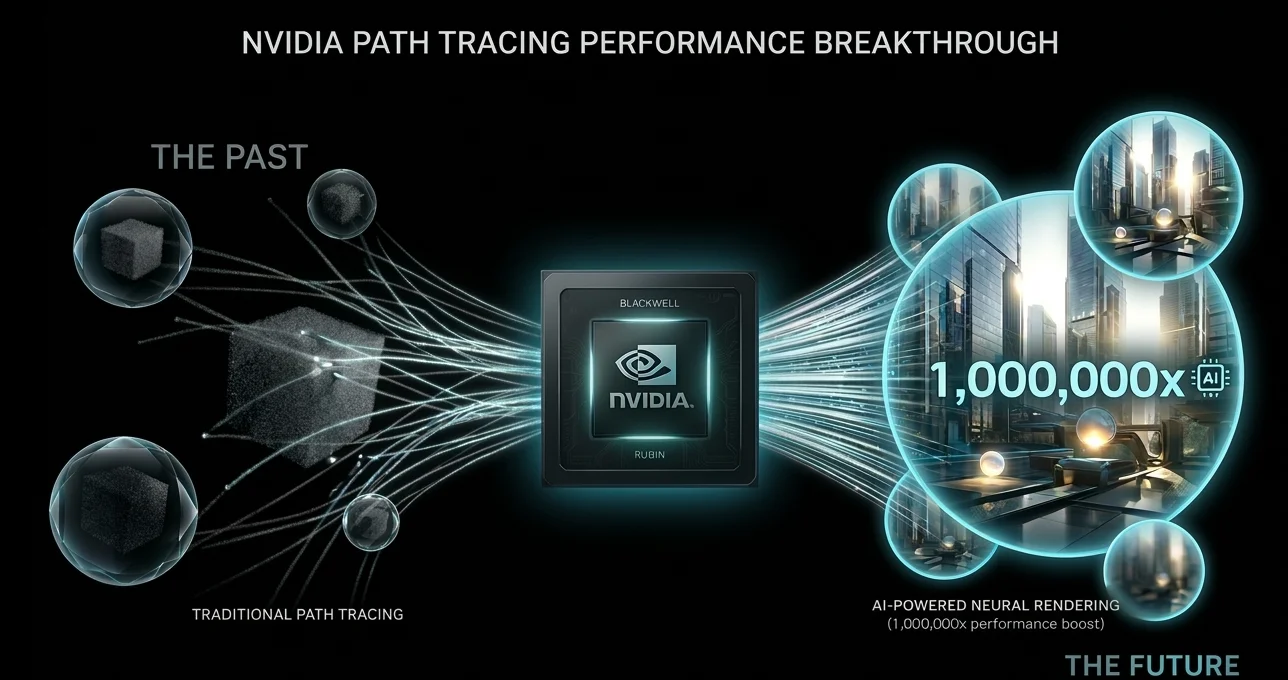
Learn how NVIDIA plans to revolutionize graphics with AI and Path Tracing, increasing the power of future GPUs by a million times.
NVIDIA is preparing a graphics revolution with Path Tracing
The world of computer graphics is on the verge of its biggest transformation in decades. NVIDIA, which has already changed the rules of the game with the release of the RTX line, is now making an even more ambitious statement. Jensen Huang has officially confirmed the course for exponential growth in power, predicting a 1,000,000x improvement in Path Tracing performance in the coming years.
Path Tracing as a new industry standard
Until recently, full path tracing was considered a technology available only for offline rendering at Pixar or Marvel studios. Unlike conventional Ray Tracing, which processes only a portion of light rays, Path Tracing simulates the physics of light in its entirety: from infinite reflections to complex refraction in translucent media. This requires enormous computations that previously took hours per frame.
NVIDIA plans to make this technology the standard for real-time games. The use of new algorithms will allow to abandon the “fake” lighting methods that developers have used for decades. Now every pixel on the screen will be the product of an honest physical calculation, which will bring the picture in games closer to reality, which is indistinguishable from a photograph.
The secret to success in neural rendering
How to achieve a million-fold growth when the physical limits of silicon are almost exhausted? The answer lies in AI. NVIDIA no longer relies solely on the “brute force” of transistors. The main increase is provided by Neural Rendering – the use of neural networks to predict how an image should look.
- AI Ray Tracing: Instead of calculating billions of rays, the GPU calculates only a small fraction and AI documents the rest without loss of quality.
- Next-Gen DLSS: The scaling technology transforms into a full-fledged frame and texture generator, where AI creates content faster than traditional blocks.
- Specialized Tensor Cores: Each new generation of architectures, like Blackwell, gets blocks optimized for specific AI mathematical operations.
Huang’s Law vs. Moore’s Law
For a long time, the industry was guided by Moore’s Law, which predicted that the number of transistors would double every two years. But Jensen Huang has heralded a new era. Huang’s Law states that through the combination of new GPU architectures, software stacks, and artificial intelligence, performance increases much faster. Over the past 10 years, NVIDIA has already increased computing speed hundreds of times, and the pace is only accelerating.
Economics and availability of new GPUs
While the development of such chips costs billions of dollars, NVIDIA is striving to maintain a balance between price and capabilities for consumers. It is expected that even mid-range cards of future generations will be able to provide stable 60 frames per second in full Path Tracing mode. This will be possible thanks to the transition to sub-2nm process technologies and the introduction of a new memory standard.
It is important to note that power consumption remains a challenge. Powerful graphics cards may require 600-800W power supplies, but the efficiency per projected beam of light will increase thousands of times. This means that for every Watt spent, the user will receive significantly more visual content.
A future without limits for creativity
For game developers, this breakthrough means the end of the era of complex lighting “baking”. Now you don’t have to spend weeks manually setting up shadows – just place a light source, and the Path Tracing system will do the rest. This will shorten the development cycles of AAA projects and allow small studios to create games with blockbuster-level graphics.
We are entering an era where AI is the master artist. The graphics cards of the future are not just hardware for crunching numbers, but intelligent systems that understand the physics of the world and are able to reproduce it with incredible accuracy. A million-dollar increase in performance no longer seems like fantasy, but is a logical step in the development of NVIDIA technologies.




0 Comments