
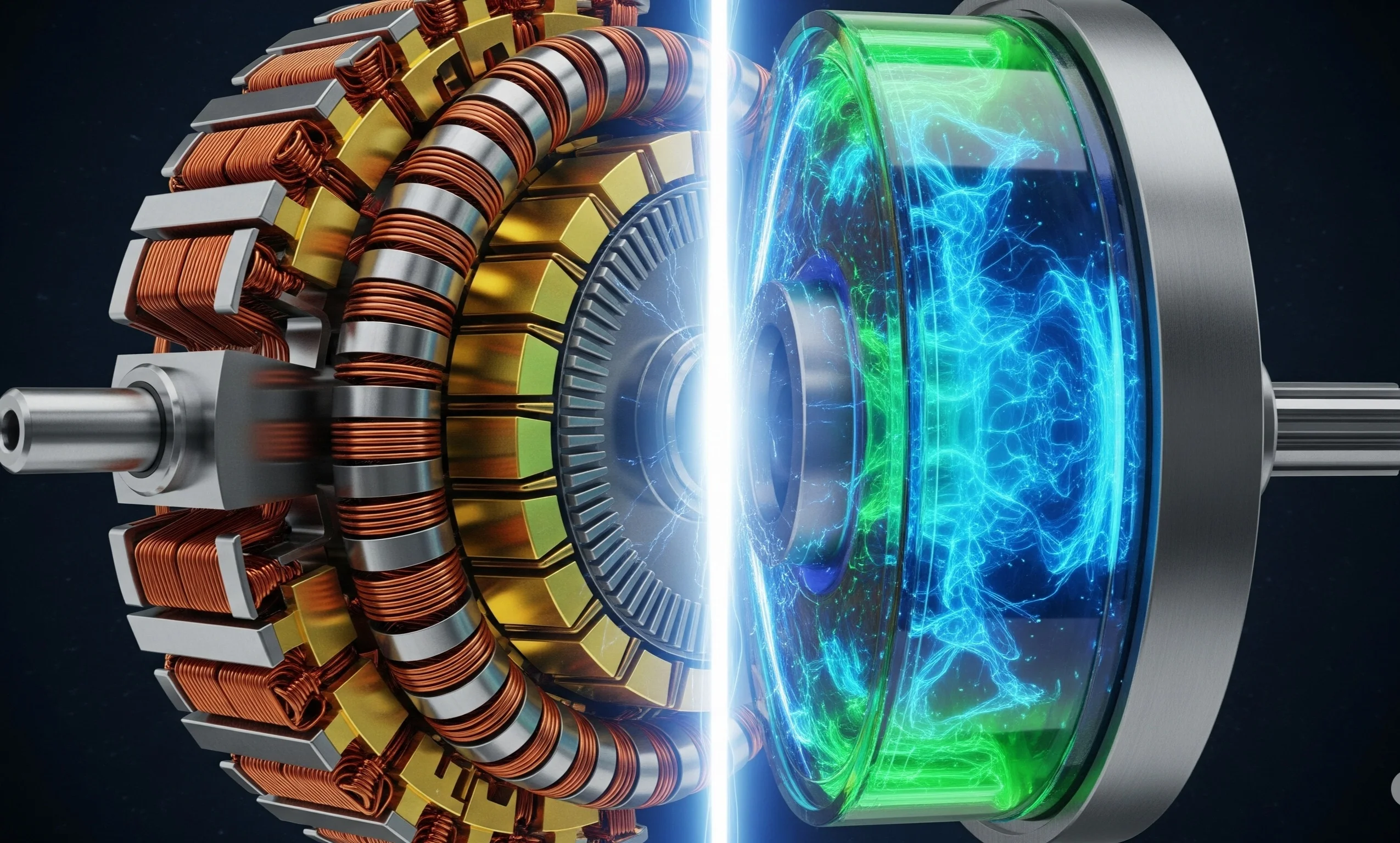
Electric motors are an integral part of our world, from household appliances to electric cars. Their design, based on metal coils, has remained unchanged for decades. However, a team of scientists from the University of Cambridge and the University of Houston has challenged this tradition by developing a fundamentally new electric motor that does not require solid metal windings. This invention has the potential to completely revolutionize the design of electric motors, making them more efficient, reliable, and durable.
How does a coilless motor work?
At the heart of every traditional electric motor is the principle of electromagnetic induction, where current passing through a winding of copper coils creates a magnetic field that interacts with permanent magnets, causing the shaft to rotate. This process is accompanied by friction, wear, and energy loss. A new invention replaces this complex and imperfect design with a ferrodyne motor.
Ferrodiene is a special fluid that is both magnetic and conductive. It flows freely within the motor and, when exposed to current, creates its own magnetic field. This field, interacting with the motor’s permanent magnets, generates the force that drives the shaft. Thus, movement is created without direct physical contact between the components, a key feature of this technology.
Pros: Why is this important for the future?
The elimination of metal windings gives the electric motor many advantages that can be applied in many industries:
- No friction or wear: Since the motor has no moving contact parts, the main cause of wear is eliminated. This significantly increases the durability and reliability of the unit and reduces the need for maintenance.
- High efficiency: Mechanical friction leads to energy loss as heat. Eliminating this process makes the electric motor more energy efficient. According to preliminary calculations, such a motor could be 15-20% more efficient than existing analogues.
- Potential Cost Reduction: Eliminating the complex process of winding copper coils and assembling the windings can make production simpler and cheaper.
Application prospects
Although the technology is still in its development stages, its potential is enormous. It is ideal for applications where high reliability and minimal maintenance are critical. For example:
- Medical Technology: Surgical procedures and medical equipment where every component must function perfectly.
- Robotics: Works that operate in hard to reach places where maintenance is not possible.
- Space applications: Satellites and research vehicles that must operate in extreme conditions for long periods of time without replacing parts.
This breakthrough proves that even in seemingly well-established industries, there’s room for radical innovation. This electric motor could become the foundation of a new generation of high-performance, durable, and environmentally friendly devices.



0 Comments