
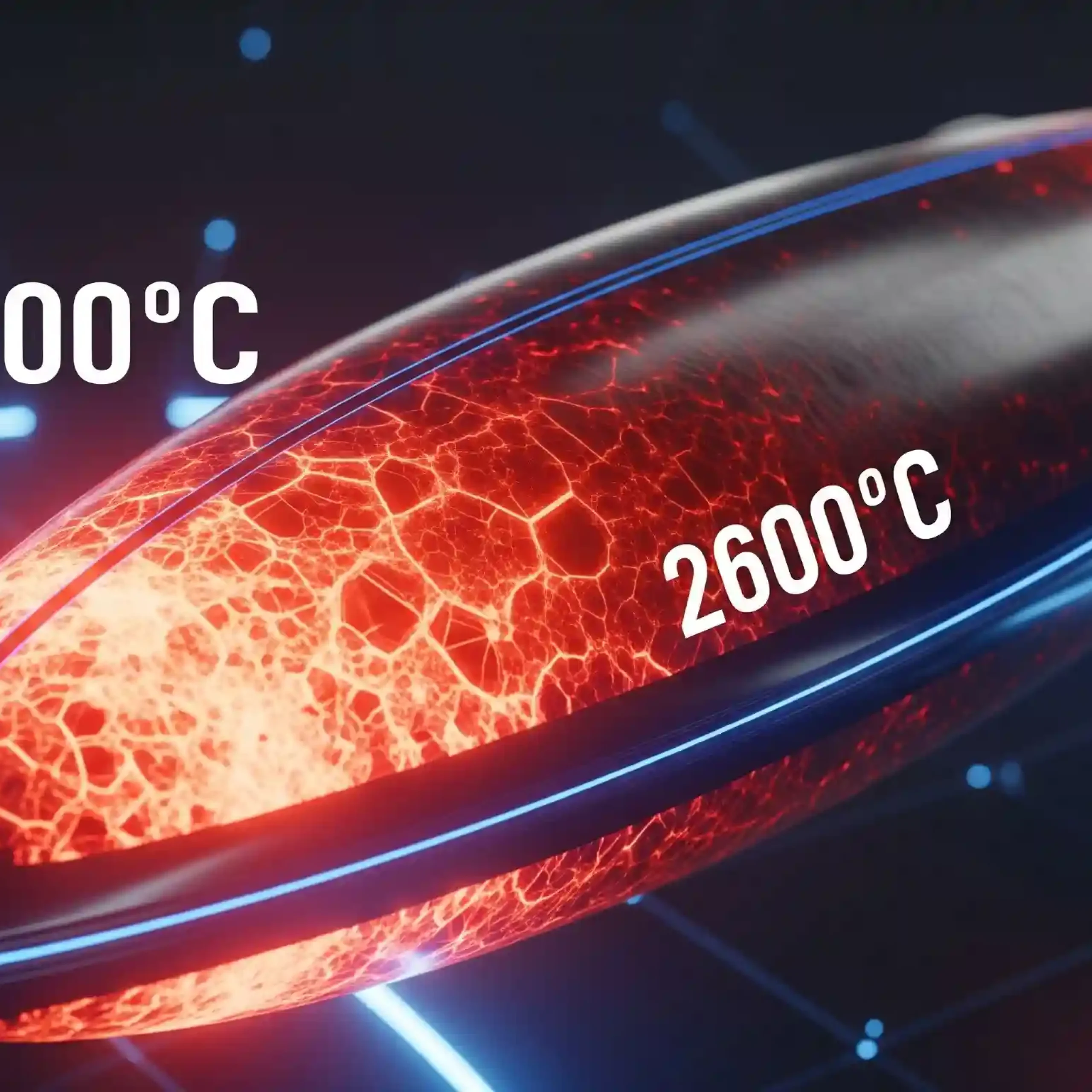
Scientists around the world are striving to develop materials that can withstand extreme conditions. One of the greatest challenges is creating substances that can withstand the ultra-high temperatures encountered in aerospace engines, nuclear reactors, or hypersonic flight. Recently, Chinese scientists announced a game-changing invention. They have succeeded in creating a material that does not melt at 2,600 degrees Celsius. This discovery is not just another step forward, but a true breakthrough, opening the way to technologies previously thought impossible.
The Secret of the Ingredients: Science Beyond the Possible
This new material belongs to the class of ultra-high-temperature ceramics. Its unique properties are the result of a carefully selected combination of chemical elements that create a highly durable crystal lattice. Although the exact composition remains a trade secret, experts believe it utilizes carbide and hafnium compounds, known for their exceptional durability. Previously, the most heat-resistant materials had melting points well below 2600 degrees Celsius. This means the invention surpasses existing analogues, opening up new engineering possibilities. In addition to its high melting point, the material also exhibits high hardness and oxidation resistance, making it ideal for use in aggressive environments.
Applications of the material: from space to industry
The potential applications of this revolutionary material span a wide range of areas where extreme temperatures are the norm.
- Hypersonic technologies: This material could become a key component in the creation of hypersonic aircraft. At speeds five or more times the speed of sound, external friction creates temperatures capable of melting conventional alloys. This heat-resistant material could create a reliable protective coating for the body and engines.
- Aerospace: Its durability makes it ideal for creating heat shields for spacecraft entering the Earth’s atmosphere, where temperatures can reach several thousand degrees.
- Nuclear power: The new material could be used for components operating inside nuclear reactors. Its resistance to high temperatures and radiation will make reactors safer and more efficient.
- Industrial production: The material can become the basis for ultra-strong tools used in metallurgy and other industries that require work at high temperatures.
The scientific race for high-temperature material
The development of heat-resistant materials is a priority area in global science and technology. The United States, Europe, and Asia are investing billions of dollars in research to gain an advantage in the aerospace and defense industries. The discovery by Chinese scientists demonstrates that China is rapidly consolidating its position as a global leader in materials science. This invention is not only a scientific achievement but also an important strategic step.
Overall, the invention of a material that doesn’t melt at 2600 degrees Celsius is a significant step forward for modern engineering. It outperforms existing materials and opens up new possibilities for creating technologies that until now existed only in science fiction films. This development is clear proof that human science and ingenuity are capable of overcoming the most complex challenges, opening up new horizons for innovation.




0 Comments