
- Why Lithium-Ion Batteries Need to Be Replaced
- Breakthrough Science: How the Al-ion Battery Works
- Key Benefits: Why Aluminum is Revolutionary
- Unprecedented Security
- Extremely economical
- High Durability and Speed
- From Lab to Market: Challenges and Prospects
- Applications: Where Al-ion Will Change the Game
- The Future of Energy Isn’t Lithium
The world is on the brink of an energy revolution, and energy storage technology plays a key role in it. After decades of dominance by lithium-ion batteries, scientists have announced the creation of the world’s first functional aluminum-ion (Al-ion) battery. This breakthrough not only opens a new chapter in the industry but has the potential to transform the economics and ecology of global energy.
Although the technology is still in its infancy, its fundamental advantages over existing solutions are so significant that Al-ion batteries are already being considered a leading candidate for the batteries of the future. Let’s consider what makes this technology a true breakthrough.
Why Lithium-Ion Batteries Need to Be Replaced
- Expensive and Limited Resources Lithium and cobalt, needed for Li-ion, are relatively rare elements that are constantly rising in price, driving up the cost of electric vehicles and stationary storage.
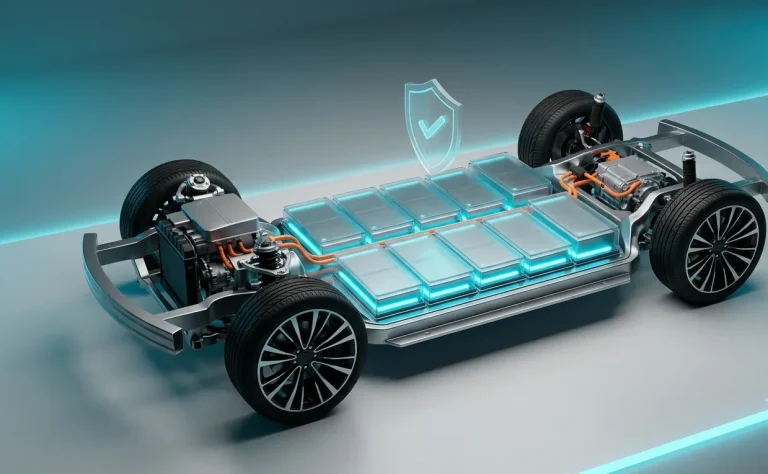
- Safety concerns: Lithium-ion batteries are susceptible to overheating, which can lead to thermal runaway and fire, requiring complex and expensive cooling systems.
- Limited Cycle Life: After a certain number of charge/discharge cycles, the performance of Li-ion batteries will inevitably decrease.
Breakthrough Science: How the Al-ion Battery Works
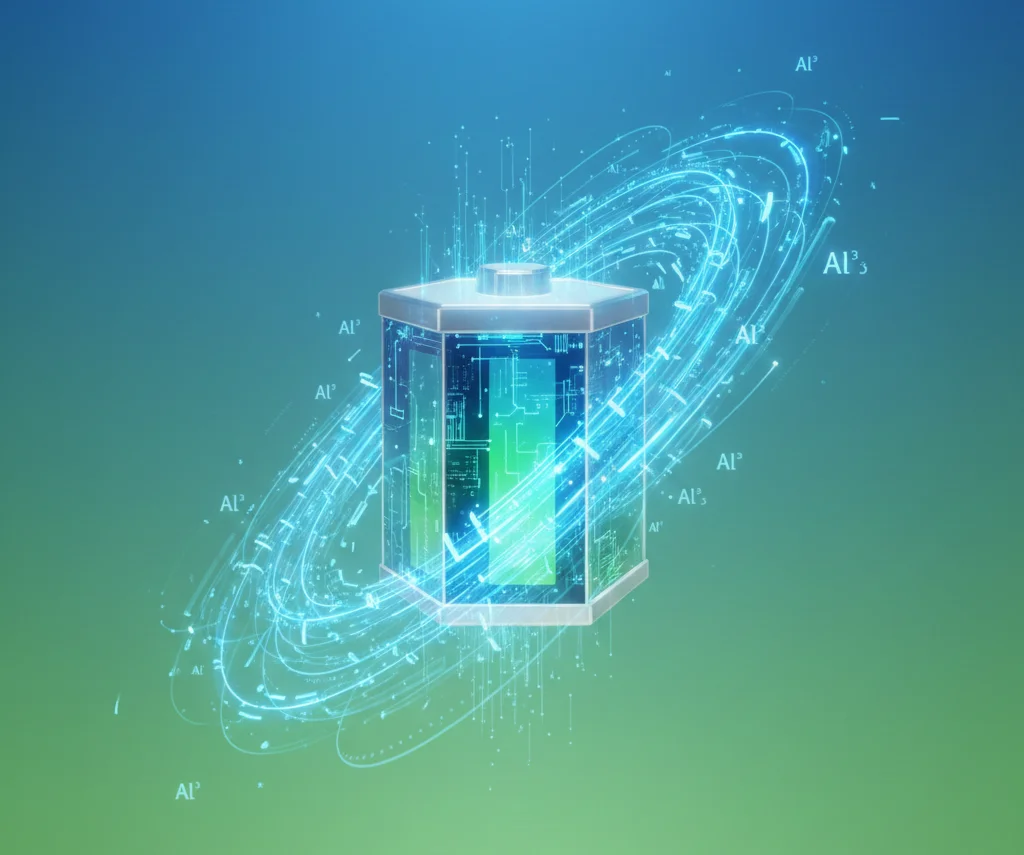
The heart of any battery is the movement of ions between the anode and cathode. Unlike the monovalent lithium ion (Li^+), the aluminum anode uses trivalent ions (Al^{3+}). This difference is fundamental.
A trivalent ion can exchange three electrons simultaneously, while a lithium ion can only exchange one. This theoretically allows aluminum-ion batteries to achieve a much higher energy density-the key indicator of battery efficiency.
Charging/discharging mechanism: During operation, aluminum ions migrate between the anode (often aluminum itself) and the cathode (often graphite or carbon nanostructures) via special electrolytes, often non-flammable ionic liquids. This technical solution ensures both high efficiency and a higher level of safety.
Key Benefits: Why Aluminum is Revolutionary
Unprecedented Security
One of the most important advantages of aluminum-ion technology is its inherent safety. The use of non-flammable electrolytes minimizes the risk of overheating, thermal runaway, and fire. This makes aluminum-ion batteries ideal for large-scale stationary energy storage and residential use.
Extremely economical
Aluminum is the third most abundant element on Earth. Its cost on the raw materials market is hundreds of times lower than that of lithium and thousands of times lower than that of cobalt. This means that aluminum-ion batteries can be produced significantly cheaper, potentially reducing the final cost of battery systems by tens of percent.
High Durability and Speed
The first laboratory samples demonstrated the ability to withstand over 7,500 charge/discharge cycles with virtually no capacity loss. By comparison, most commercial Li-ion batteries typically have a lifespan of around 1,000–2,000 cycles. Furthermore, some Al-ion prototypes can charge to full capacity in minutes, which is critical for electric vehicle applications.
From Lab to Market: Challenges and Prospects
Despite all the advantages, the transition of Al-ion batteries from the laboratory to mass production faces several significant technical challenges.
- Kinetics issue: Trivalent aluminum ions are larger and heavier than monovalent ions, making it difficult for them to quickly and effectively penetrate (intercalate) into cathode materials. This impacts the overall battery performance.
- The Search for the Ideal Cathode: Scientists continue to search for the ideal cathode material that would be capable of reliably and reciprocally interacting with Al3+ ions over long periods of time. Nanostructured and graphite solutions show the most promise.
Experts predict that commercial deployment of aluminum-ion systems for large-scale stationary energy storage could begin within the next five years, while applications in portable electronics and electric vehicles will require slightly longer to optimize the kinetics.
Applications: Where Al-ion Will Change the Game
The potential of the new technology includes almost all areas where batteries are used.
- Renewable Energy Storage: With its low cost, safety and durability, Al-ion is ideal for solar and wind power storage, ensuring grid stability.
- Electric Vehicles and Transport If the charging speed (kinetics) issue can be resolved, the high energy density and safety will make the aluminum-ion battery the most attractive technology for electric vehicles.
- Backup power for data centers: High reliability and security make them indispensable for critical infrastructure where power failure is unacceptable.
The Future of Energy Isn’t Lithium
The aluminum-ion battery is not just another scientific experiment, but a tangible demonstration that future energy storage can be cheaper, safer, and significantly more sustainable than lithium-ion technology previously envisioned. Thanks to the availability of aluminum, we can expect a reduction in dependence on expensive and environmentally unsafe resources. This paves the way for true global energy sustainability.



0 Comments