
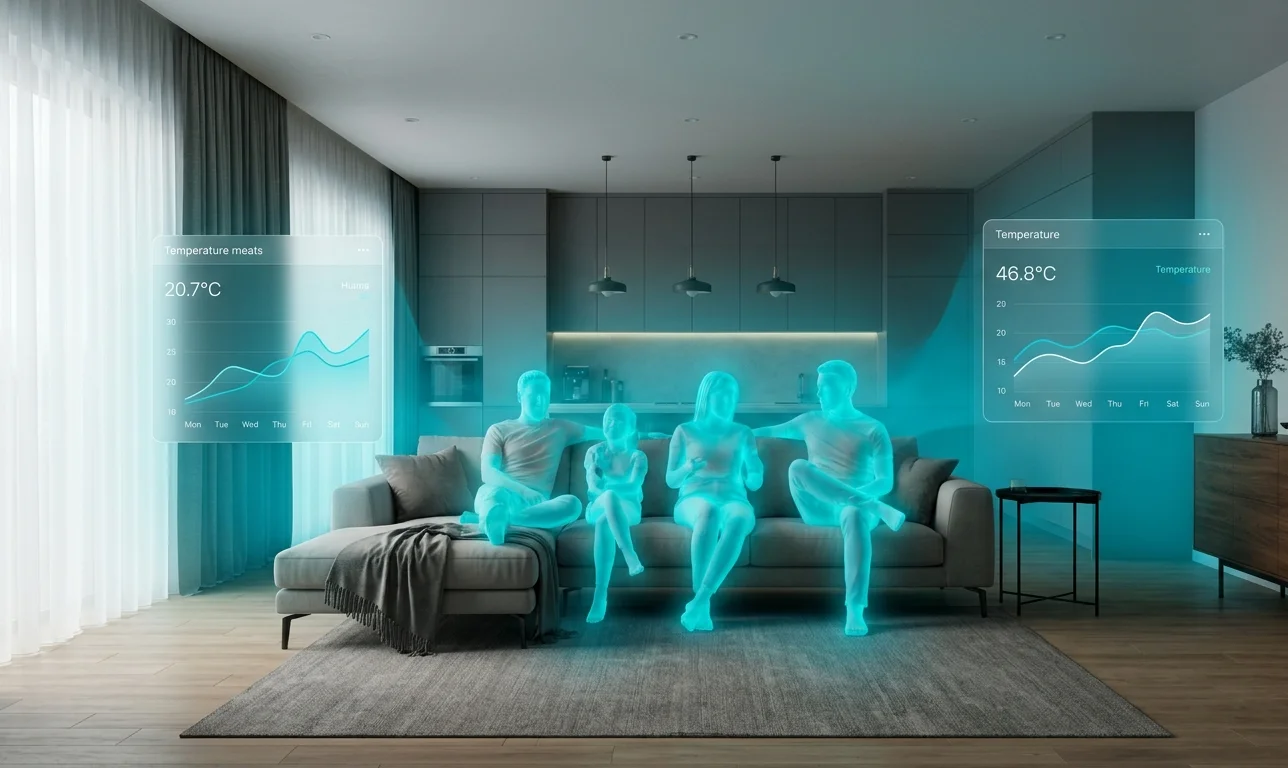
Human Body Heat as an Energy Source
In periods of extreme cold or emergency heating outages, a logical question arises: can the heat generated by people maintain a comfortable temperature in an apartment? This is not just a hypothetical assumption, but a matter of applied physics and residential thermodynamics. Every living person is a constant source of thermal energy generated through metabolism.
The amount of heat emitted by the human body depends on several factors, including the level of physical activity, age, gender, and individual metabolic characteristics. On average, a person at rest (for instance, sitting or lying down) generates about 80-100 Watts of energy. This figure increases significantly during movement or physical exercise, reaching 200 Watts or more. For heating calculations, it is practical to use a baseline value of about 100 Watts per person.
Calculating a Building’s Heat Losses
To determine the number of people needed to heat an apartment, one must first calculate the building’s heat losses. A living space loses heat through its envelope components such as walls, windows, doors, floors, and ceilings. The amount of heat loss depends on the thermodynamic properties of the materials (their thermal conductivity), the temperature difference between the indoor and outdoor environments, and the surface areas.
The general formula for calculating heat losses (Q) through a specific building element is:
Q = S * deltaT * (1/R), where
- S – surface area (m2);
- deltaT – temperature difference between indoor and outdoor environment (°C);
- R – thermal transmittance resistance (m2 * °C / W).
The higher the thermal resistance (R), the better the insulation properties of the material and the less heat the apartment loses. Modern building standards establish minimum requirements for thermal resistance across various residential building elements to ensure energy efficiency.
Example of Thermodynamic Calculation for an Average Apartment
Let’s consider an example of a typical one-room apartment with an area of 40 m2 in a building with average insulation. Suppose the outdoor temperature is -5 °C, and the desired indoor temperature is +20 °C. The temperature difference (deltaT) is 25 °C.
The total heat losses for this apartment are about 1100 W. This means that to maintain a temperature of +20 °C, this amount of thermal energy must be constantly generated. It should be noted that ventilation calculation is complex, as it depends on the air exchange rate required for respiration.
Is it Possible: Summary of the Calculation
Based on the data obtained, we can determine the number of people required to heat the apartment. Since one person emits an average of 100 W of heat, and the required power is 1100 W, to heat the considered 40 m2 apartment with an outdoor temperature of -5 °C, it would take approximately 11 people constantly in the room.
For a two-room apartment with an area of 60 m2, heat losses would be higher (e.g., 1600 W), requiring about 16 people. For a three-room apartment of 80 m2, over 20 people would be needed. Of course, these figures are approximate and can vary depending on the building’s insulation quality and the exact outdoor temperature.
Physically accommodating this many people in a small apartment for constant living is impossible. Furthermore, severe hygienic and psychological problems arise from overcrowding, lack of oxygen, and moisture accumulation.
Impact of Ventilation and Moisture Accumulation
In addition to heat emission, people also excrete moisture through breathing and sweating (about 40-60 g of water per hour per person). A large number of people in an enclosed space will lead to a rapid increase in air humidity, contributing to condensation forming on windows and walls, as well as mold growth. To avoid this, constant and intensive ventilation is necessary.
Maintaining a healthy level of humidity and carbon dioxide (CO2) concentration requires fresh air intake. The recommended minimum air exchange is about 30 m3/h per person. Introducing cold outdoor air significantly increases the apartment’s heat losses, as this air must be heated.
Natural ventilation through leaks or window airing substantially increases the load on the heating system (in our case, on the people). Ensuring standard air exchange for 11 people in a one-room apartment would increase total heat losses from 1100 W to 1800-2000 W, requiring already about 20 people for heating. Such air volume is simply physically impossible to replace in a standard dwelling without significant energy losses.
Air Quality and CO2 Accumulation
Even if one physically accommodates enough people, the air quality in such an apartment would rapidly deteriorate. An increase in carbon dioxide concentration causes feelings of fatigue, headache, and decreased concentration. The standard CO2 level indoors should not exceed 800-1000 ppm. Increasing the number of people without proper ventilation would result in this level being exceeded multiple times.
Therefore, the idea of heating an apartment solely with human heat is physically possible only in the theory of thermodynamics but completely impractical in real life. The main obstacles are not only the insufficient amount of heat emitted to compensate for losses and air heating for ventilation but also the critical deterioration of air quality and moisture accumulation, making living in such premises unbearable and harmful to health.




0 Comments