
New Data on the Scale of a Colossal Galaxy
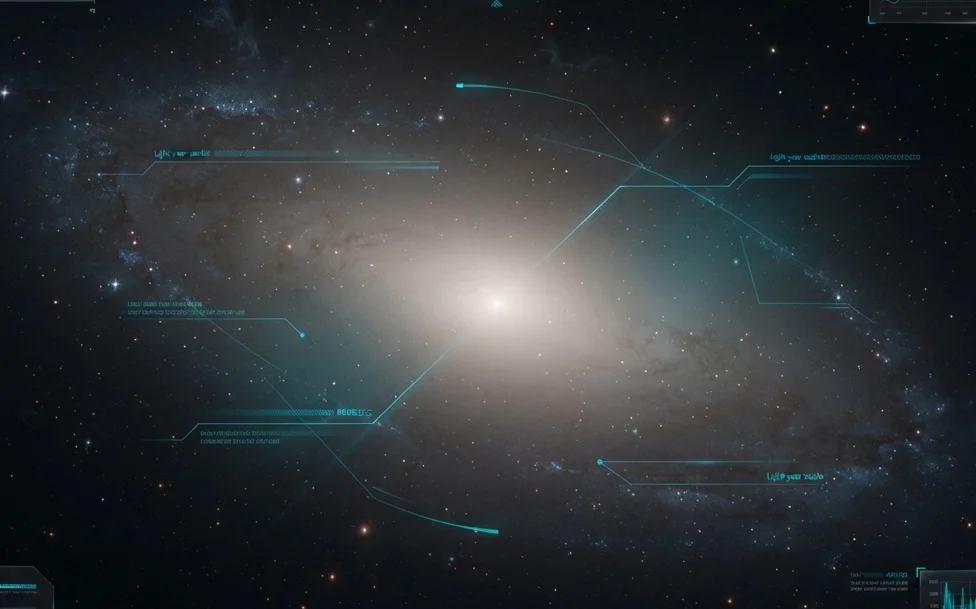
Astronomers using advanced computational methods and space telescopes have performed precise measurements of the galaxy IC 1101, which is considered the largest known structure of its kind in the universe. Updated data indicate that its dark matter halo and stellar disk extend significantly further than rough estimates suggested in past decades. The research results significantly refine current theoretical models of the evolution of supergiant elliptical galaxies at the centers of clusters.
Studying supergiant galaxies has always been accompanied by significant technical difficulties due to their distance and the faintness of their outer edges. The galaxy IC 1101 is located at the center of the Abell 2029 cluster and has long attracted researchers’ attention with its anomalous mass. However, older photometry methods did not allow for the correct separation of background radiation from the faint light of outer halos. The use of improved data processing algorithms has allowed astronomers to look at the structure of this object from a completely different perspective.
Measurement Methodology and Properties of the Dark Matter Halo
During the latest phase of research, scientists applied a combination of deep photometric surveys across various spectrum ranges. This made it possible to reveal an expanded stellar envelope that gets lost on standard images due to low surface brightness. The main discovery was that the stellar system does not have sharply defined boundaries, gradually transitioning into intergalactic space through sparse streams of stars stripped by tidal forces during past mergers.
Researchers paid special attention to the distribution of dark matter, which constitutes most of IC 1101’s mass. Thanks to gravitational lensing and analysis of the motion dynamics of globular clusters within the Abell 2029 cluster, physicists were able to build a three-dimensional model of the halo. It turned out that the dark matter radius exceeds previously known values by almost a third, making this object a unique natural laboratory for studying large-scale cosmological processes.
Technical Parameters and Scale Comparison
To understand the scale of such cosmic structures, it is appropriate to compare IC 1101 with other known objects of the local and distant universe. Our Milky Way galaxy looks extremely modest against the background of this giant.
Impact of Results on Modern Cosmology
The updated measurements of IC 1101’s size force astrophysicists to reconsider the growth rates of supergiant galaxies in the later stages of the universe’s evolution. Previously, it was believed that galaxies of this type stop active matter absorption a few billion years after the Big Bang. However, new data confirm a continuous process of accreting nearby dwarf galaxies and gas from the intergalactic medium.
These processes are accompanied by complex magnetohydrodynamic phenomena in the central part of the galaxy, where a supermassive black hole is located. Studying the interaction between the active nucleus and the extended hot gas atmosphere helps to better understand the mechanisms of suppressing star formation in giant elliptical systems. Further observations using new space telescopes will help to finally determine the upper limit of mass and size that a galaxy can achieve under real conditions in our era.




0 Comments