
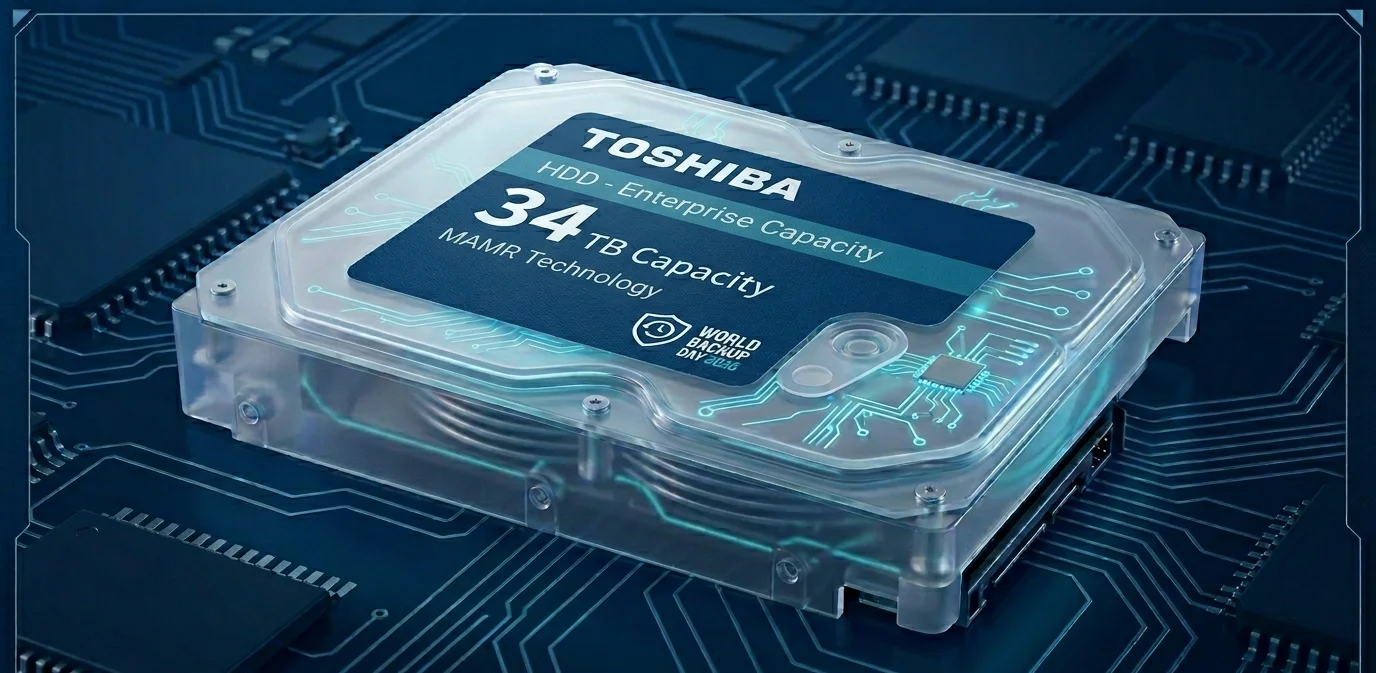
The Capacity Revolution: Why Toshiba’s 34 TB Matters
On World Backup Day, Toshiba made a significant leap forward by introducing a new generation of hard disk drives (HDDs) with an incredible capacity of up to 34 TB. This solution targets the enterprise segment and cloud storage operators facing exponential data growth. Utilizing innovative recording methods enables this density without compromising reliability, a critical factor for modern IT infrastructure.
The Technology: FC-MAMR and Energy Efficiency
At the core of the new drives is advanced Microwave-Assisted Magnetic Recording (MAMR), specifically the Flux Control MAMR (FC-MAMR) variant. This method stabilizes the magnetic switching process, ensuring high-precision recording on extremely narrow tracks. This allowed Toshiba to fit more platters into the standard 3.5-inch form factor.
- Density Increase: 11-platter design integration.
- Reliability: Improved helium sealing to reduce friction and power consumption.
- Compatibility: Standard SATA or SAS interfaces for seamless integration.
Economic Viability and TCO
For large data centers, shifting to 34 TB drives means a substantial reduction in Total Cost of Ownership (TCO). Increasing capacity per rack unit saves space, electricity, and cooling costs. While single-unit prices may range from 600 USD to 850 USD depending on volume, the cost per terabyte continues to decline.
The Future of Mechanical Storage
Despite the rise of SSDs, HDDs remain the leaders for ‘cold’ and ‘warm’ data storage. Toshiba proves that the potential of magnetic recording is far from exhausted, aiming for 40 TB and beyond in the coming years using HAMR and MAMR technologies.



0 Comments