
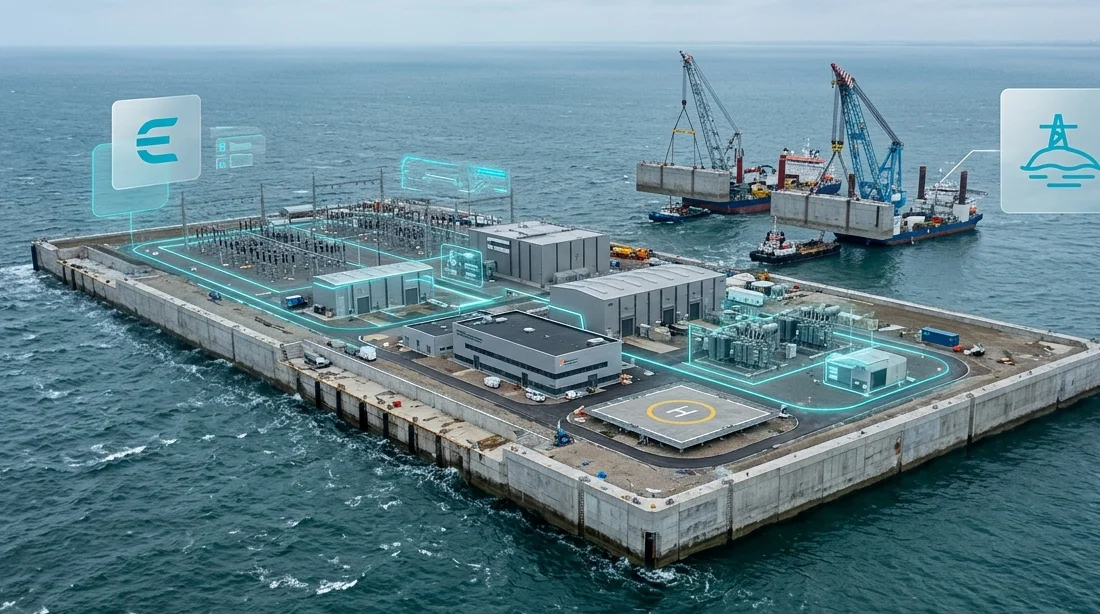
Engineering Outline of Princess Elisabeth Island
In the open waters of the North Sea, an offshore construction program is actively progressing to establish Princess Elisabeth Island, an engineered artificial energy hub. Commissioned by Belgian transmission system operator Elia, the island is positioned roughly 45 km off the coast of Ostend. The installation is not designed for human habitation, functioning instead as a high-voltage hub engineered to consolidate, convert, and route power generated by deep-water wind farms.
Encompassing roughly 5 hectares of operational surface, the island is configured to run fully automated under standard operating protocols. Supervisory control and real-time power modulation are directed from continental control stations via dedicated telemetry. Operating personnel will only visit the platform during programmed maintenance schedules, equipment overhauls, or fault diagnostics using specialized crew transfer vessels and helicopters.
Maritime Foundations and Concrete Caisson Placement
Constructing an artificial structure capable of enduring North Sea hydrodynamics requires high-capacity marine engineering standards. The structural envelope is formed by an array of 12 reinforced concrete caissons. These structures are built inside mainland dry docks, shifted via semi-submersible vessels to the site, and placed with high precision onto an engineered underwater rock bed.
Each structural caisson measures nearly 60 meters in length, exceeds 30 meters in width, and registers an unballasted mass of around 22000 metric tons. Once these modular segments are anchored along the boundary, the inner core is filled with over 2.5 million cubic meters of dredging sand and gravel fractions. The outer wave-absorbing perimeter is engineered to withstand ocean storms featuring wave heights topping 10 meters.
High Voltage Converter Systems and Direct Current Topology
Princess Elisabeth Island combines high-voltage alternating current (HVAC) infrastructure with high-voltage direct current (HVDC) transmission units. Wind generation fields direct energy to the island platform at an intermediate voltage of 66 kV through subsea collector lines. The island site accommodates modular step-up transformers, gas-insulated switchgear (GIS), and high-capacity converter yards.
The on-island HVDC converter platform converts incoming three-phase alternating current into direct current operating at 525 kV. This step addresses dielectric and capacitive loss factors inherent to high-capacity alternating current links over extended underwater paths. Because subsea interconnector routes span hundreds of kilometers, DC topology represents the most efficient method for moving bulk energy loads back to shore.
Interconnector Integration Across European Grids
The offshore hub acts as an interconnected grid node for regional power distribution across the North Sea basin. Beyond channeling power into Belgium, the installation is designed to anchor transnational subsea interconnector projects, such as Nautilus and TritonLink, which connect the Belgian network with the United Kingdom and Denmark.
This network configuration facilitates dual-directional energy balancing across international boundaries. Surplus wind yields can be routed directly to offshore consumer regions where spot market prices and network loads demand supplemental power. Consolidating these conversion platforms into a singular artificial island avoids the proliferation of disconnected steel topside platforms, optimizes seabed footprint, and cuts cumulative cabling expenditures.
Ecological Integration and Marine Design Criteria
Executing extensive marine construction works requires careful mitigation of physical impacts on surrounding aquatic life. The project integrates Nature Inclusive Design principles across all exterior revetments. The underwater scour protection systems surrounding the caisson footings use tailored stone sizes to provide artificial hard substrates for colonization by blue mussels, oysters, and local benthic organisms.
Acoustic emissions produced during placement stages are damped using subsea bubble curtain systems to keep acoustic pressure waves within safe limits for marine mammals. In addition, operational surface illumination profiles are calibrated to minimize nocturnal disruption for migratory birds crossing open flight paths across the North Sea.




0 Comments