
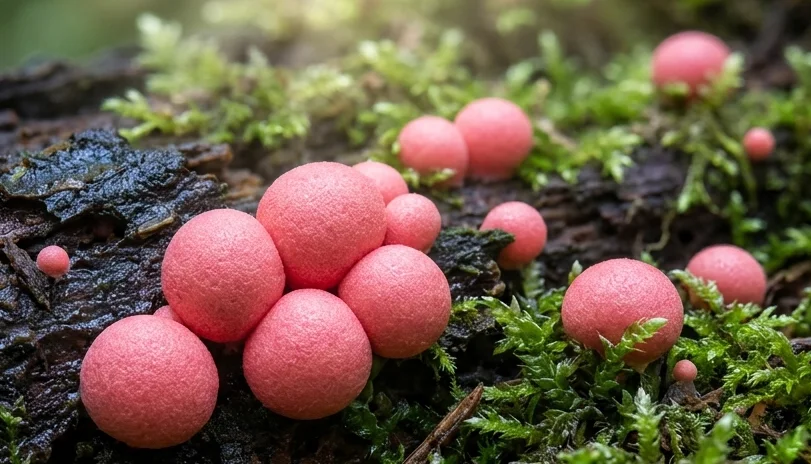
- The Enigmatic Wood Dwellers
- What are Myxomycetes and Where do They Stand?
- The Life Cycle of Lycogala epidendrum
- Amoeboflagellate Stage
- Formation of the Plasmodium
- Aethalia (Fruiting Body) Stage
- Ecological Role and Importance for the Forest
- Scientific Research and Biomedical Potential
- Interesting Facts about Lycogala epidendrum
The Enigmatic Wood Dwellers
As you wander through the wet forests of Ukraine, particularly after a long period of rain, you might notice unusual formations on old tree stumps and fallen trunks. They resemble bright coral or pinkish spheres emerging from the green moss or dark wood. Many people mistake them for puffballs or unusual fungi. However, these are actually representatives of an entirely different kingdom: myxomycetes, or slime molds. The most common and well-known among them is the species Lycogala epidendrum, also called Wolf’s Milk slime. This organism displays astonishing properties that blur the line between characteristics of animals and fungi, causing scientists to debate its classification for decades. Despite their outward similarity to fungi, Lycogala is part of the Amoebozoa group and has nothing in common with classical fungi other than its method of reproduction via spores.
Lycogala epidendrum is widely distributed across the globe and can be found at any time of year, though its peak activity occurs during the warm and wet period from spring to autumn. It can be found on both coniferous and deciduous wood, where it plays a significant ecological role, aiding in the decomposition of organic matter. In this article, we will examine in detail the life cycle of this amazing organism, its structure, lifestyle, and the scientific interest it generates.
What are Myxomycetes and Where do They Stand?
For a long time, myxomycetes were classified as part of the fungi kingdom due to their ability to form fruiting bodies and disperse spores. However, modern taxonomy places them in a separate group within the Amoebozoa phylum, as their vegetative state is fundamentally different from a fungal hyphal mycelium. Unlike fungi, which absorb nutrients through their cell walls (osmotrophy), the vegetative stage of a slime mold is a giant amoeboid cell capable of active movement and engulfing food (phagocytosis).
This means that a slime mold can literally ‘crawl’ across a substrate, consuming bacteria, fungal spores, and small organic particles. They are microscopic predators and saprotrophs at the same time. This unique combination of traits makes myxomycetes extremely fascinating to evolutionary biologists.
Thus, the Lycogala epidendrum we see in the forest is only one stage of the development of a complex life form that is hidden from sight for most of its life.
The Life Cycle of Lycogala epidendrum
The life cycle of Lycogala epidendrum includes several distinct stages, each with its own morphological and physiological characteristics. It all begins with a spore dispersed by wind or insects.
-
Amoeboflagellate Stage
When a spore lands in a moist environment, it germinates. Microscopic uninucleate cells – myxamoebae or swarms cells – emerge. They are capable of transforming into each other depending on the availability of water. These cells live independently, feeding on bacteria, and multiply by division. At this stage, they are indistinguishable from common soil amoebas.
-
Formation of the Plasmodium
When two compatible cells meet, they fuse, forming a zygote. The zygote begins to grow, but the cell’s nucleus divides repeatedly without the cytoplasm dividing. The result is a giant multinucleate cell – the plasmodium. The plasmodium of Lycogala can reach significant sizes, but it usually remains hidden within the crevices of decaying wood or under bark. It has a slimy consistency and is capable of amoeboid movement directed at searching for food and moisture. The color of the plasmodium is usually whitish or gray, though it can sometimes have hints of pink.
-
Aethalia (Fruiting Body) Stage
When unfavorable conditions arise (e.g., substrate drying out or food resources depletion), the plasmodium crawls to the surface and transforms. It stops moving, accumulates nutrients, and breaks down into separate rounded formations – aethalia. These aethalia are what we see in the forest.
Initially, they are soft, succulent, and bright pink or coral colored. Their content resembles a pink paste or thick cream, which is why the slime mold received the folk name ‘Wolf’s Milk’. The surface of the aethalia is smooth and shiny. The diameter of a single sphere is typically between 3 to 15 mm. Over time, the casing of the fruiting bodies hardens and changes color to gray-brown or olive, and the content turns into a dry powdery mass consisting of spores and capillitium (threads). This stage is the most noticeable and it is the one depicted in the photograph.
Ecological Role and Importance for the Forest
Myxomycetes, including Lycogala epidendrum, are an integral part of forest ecosystems. They act as decomposers, i.e., organisms that break down dead organic matter. Although their contribution to the overall process of wood decomposition is smaller than that of fungi, they play a specific role. Slime molds consume bacteria, which accelerates the colonization of wood by fungi, and regulate the size of microbial populations.
Furthermore, the plasmodium of Lycogala is a food source for many small invertebrates, such as mites, collembolans, and insect larvae. Some insect species even specialize in feeding on myxomycetes. Also, the aethalia of Lycogala are sometimes used by birds as nesting material.
Scientific Research and Biomedical Potential
Over the past few decades, Lycogala epidendrum has attracted scientific attention not only for its biology but also for its chemical composition. Research has identified a number of unique bioactive compounds in the aethalia of this slime mold that are not found in other organisms. In particular, specific alkaloids and terpenoids have been isolated.
These substances have shown promising properties in laboratory conditions. Some display antimicrobial activity against certain bacterial and fungal species. Studies on their potential as anticancer agents are also being conducted.
Despite the promise, these studies are in their early stages, and development of pharmaceutical drugs based on Lycogala compounds is still far off. However, this fact underlines the importance of studying forest biodiversity and the unexpected potential of even such seemingly unassuming organisms.
Interesting Facts about Lycogala epidendrum
- The plasmodium of Lycogala can move at a speed of about 1 mm per hour. This is very slow, but enough to change locations in search of food.
- Slime molds do not have a nervous system but are capable of demonstrating primitive forms of learning and memory. This is the subject of active research in behavioral biology.
- Despite not being poisonous, Lycogala is not considered edible due to its consistency and taste.
Thus, Lycogala epidendrum is a true wonder of the forests of Ukraine, demonstrating the complexity and diversity of the living world. It reminds us that even on old, decaying stumps, life teems, hidden from view but extraordinarily important for the ecosystem.




7 Comments
always saw these pink balls when picking mushrooms near Boyarka, thought it was some toadstool or forest caviar)) turns out it crawls across the stump on its own?? creepy stuff, feeling grossed out to touch it now
has anyone actually tried popping this thing? they say it has smelly liquid inside like pink paste. or is that a myth and it has no odor at all
super interesting about lycogalins and antitumor effects! are our local institutes even researching this or as usual only US and Japan get grants for this biodiversity stuff
Feels like people call every other slime mold 'smart' these days. What kind of memory can a cell have without a nervous system? Just basic chemical reactions to moisture and food, why hype it up
wait so it literally consumes bacteria and spores of other fungi? meaning it acts as a beneficial cleaner rather than a parasite tree killer like shelf fungi? always assumed it harms living wood
1mm per hour is actually insane speed for a single giant multinucleate cell! has anyone done a timelapse of it forming into aethalia? drop a link if you have a video
saw these on old alders back in autumn, color was greyish rather than pink. does that mean it already dried out and released spores or is it a different subspecies? didnt dare touch it with bare hands