
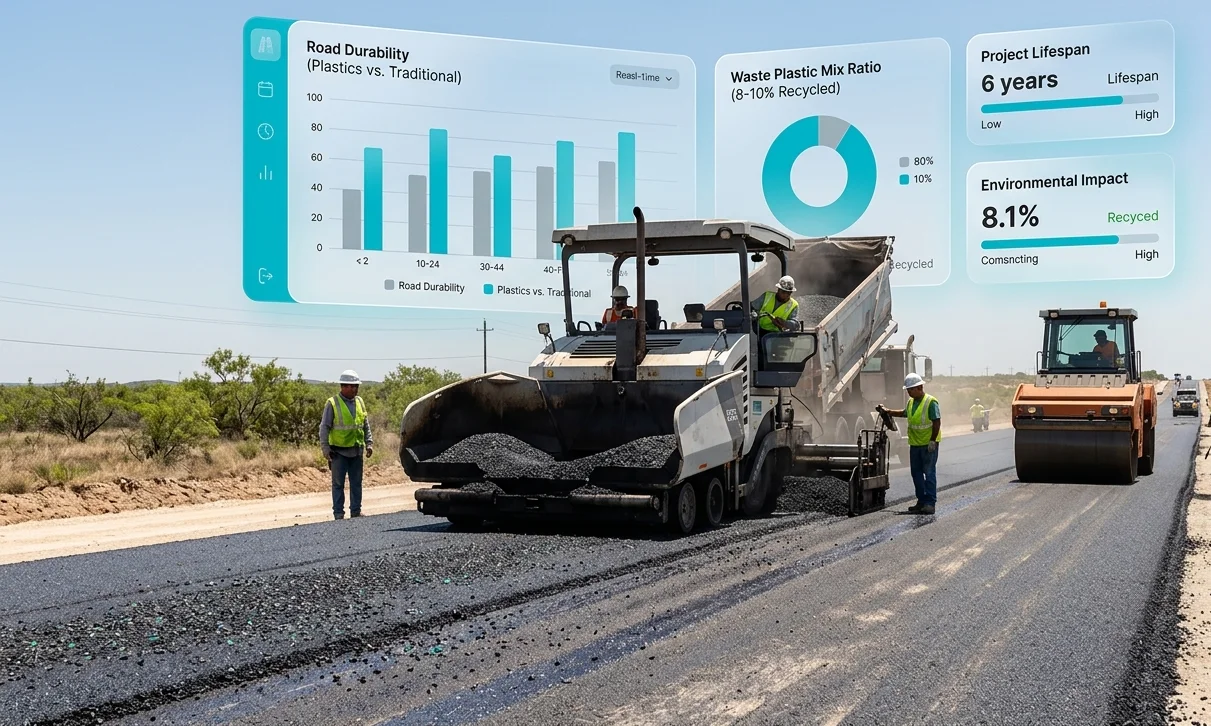
Experiment on Highway 205
The state of Texas has initiated a practical testing phase for an innovative road surface containing recycled plastic. A collaborative project between the Texas Department of Transportation (TxDOT) and the University of Texas at Arlington (UTA) aims to address two critical issues: plastic waste utilization and increasing the durability of road infrastructure under extreme temperature conditions.
Traditional asphalt consists of crushed stone, sand, and bitumen, which serves as the binding agent. The latter, being a petroleum product, is sensitive to temperature fluctuations, leading to rutting in summer and cracking in winter. The new technology involves partially replacing bitumen with shredded plastic waste, primarily single-use plastics like bottles and bags.
Technological Features and Advantages
The process of creating plastic asphalt involves shredding collected plastic waste into small granules. These granules are mixed with heated bitumen, altering its physicochemical properties. The resulting modified binder is then used to produce the asphalt concrete mixture.
Researchers from UTA claim that adding plastic improves the elasticity and viscosity of the surface. This makes the road more resistant to deformation under heavy vehicle loads, especially at high temperatures common in Texas. Furthermore, this surface better resists water penetration, reducing the risk of damage from freezing and thawing cycles.
Comparison of Surface Characteristics
Environmental Aspect and Sustainable Development
One of the main motivations for this project is the environmental component. Plastic utilization is a global problem, and its use in road construction offers a scalable solution. TxDOT estimates that on the approximately one-mile test section of Highway 205 alone, several tons of plastic waste will be used.
This allows not only for reducing plastic volume in landfills but also decreasing reliance on petroleum products in the road industry. Replacing even a small portion of bitumen with plastic on a statewide or national scale could have a significant positive environmental impact. Furthermore, the increased durability of plastic roads is expected to reduce the need for frequent repairs, which also saves resources and lowers carbon emissions.
Current Status and Prospects
Currently, the section on Highway 205 is actively used, and researchers are conducting regular monitoring of its condition. They analyze wear resistance, appearance of microcracks, and the impact of weather conditions on the surface. Testing will continue for several years to obtain reliable data on the long-term performance of plastic asphalt.
If the results are successful, TxDOT plans to expand the use of this technology to other state roads. The Texas experiment is part of a broader global trend, as similar projects are already being implemented in India, the United Kingdom, and other countries. The success of this project could be an important step toward creating more sustainable and eco-friendly road infrastructure.




0 Comments