
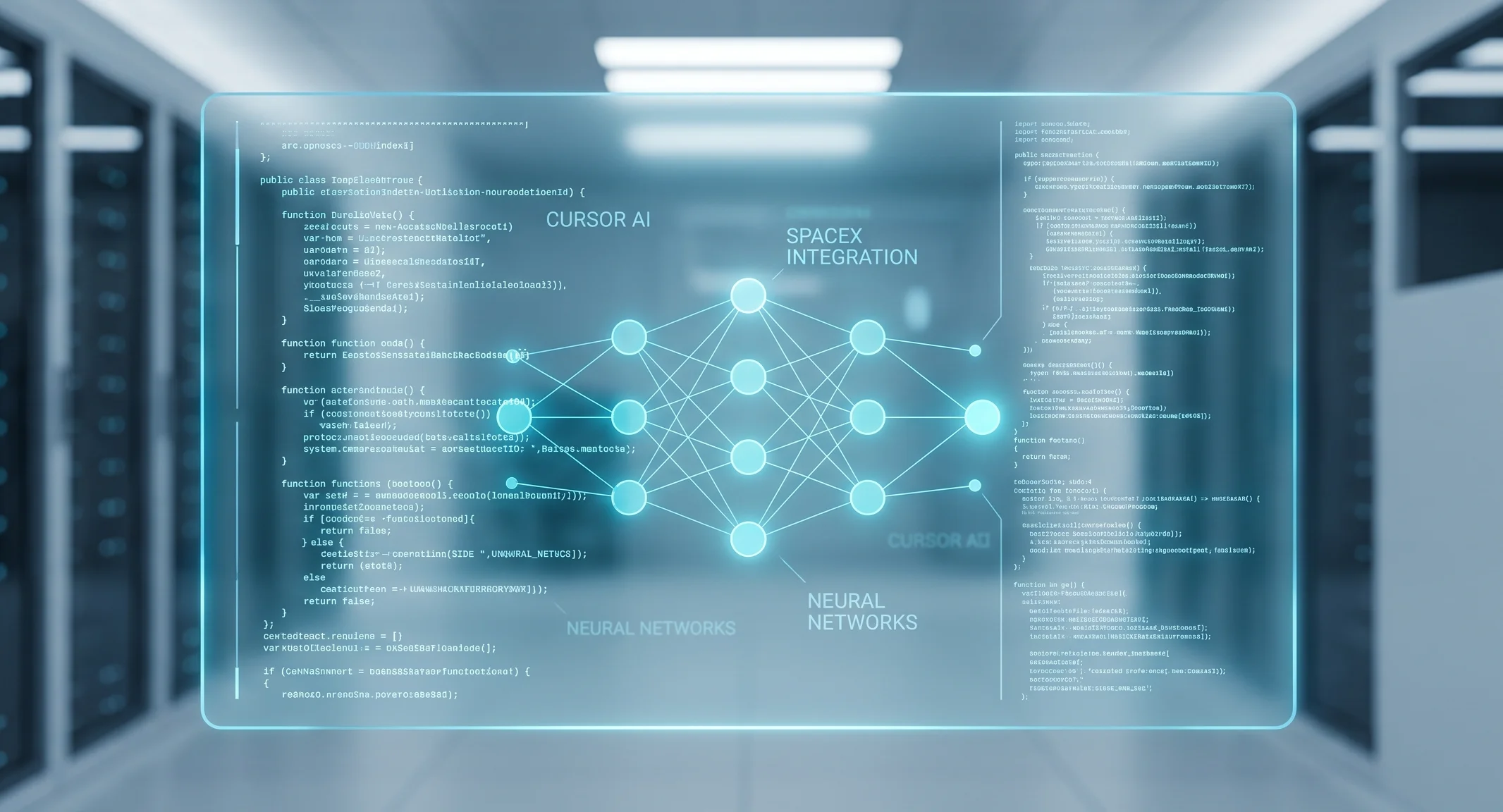
Details of the Strategic SpaceX and Cursor AI Deal
SpaceX has officially confirmed the completion of its acquisition of Cursor, an innovative startup specializing in AI-powered software development tools. While the exact terms of the deal were not disclosed, industry analysts, citing internal sources, estimate its value between 1.5 and 2.5 billion USD. This acquisition is a logical step in Elon Musk’s long-term strategy for vertical integration across his business empire. The agreement involves a full transition of Cursor’s development team, including key engineers and founders, to SpaceX’s payroll. All intellectual property, including patents, proprietary model training algorithms, and the core product’s source code, now belongs to the aerospace giant.
The primary goal of this acquisition is not so much to acquire a commercial product as to integrate advanced AI capabilities into internal software development processes. SpaceX faces unprecedented challenges in creating software for Starship rockets, the Starlink satellite constellation, and future interplanetary missions. The code volume and system complexity are growing exponentially. Traditional development methods no longer provide the necessary speed and reliability. Cursor’s technology is intended to help SpaceX engineers write code faster, detect critical errors earlier, and optimize complex flight control algorithms. The deal also gives Cursor access to SpaceX’s colossal computing resources, including clusters based on thousands of NVIDIA H100 and B200 GPUs, significantly accelerating the training of new model generations.
Why Cursor was SpaceX’s Choice for Code Automation
Several powerful AI coding assistants exist on the market, with GitHub Copilot being the most well-known. However, SpaceX chose Cursor due to its unique architecture and deeper understanding of the development context. Unlike Copilot, which functions as a plugin, Cursor is a standalone code editor built on the Visual Studio Code codebase. This allows it to analyze not just the current file but the entire project’s codebase. The AI model “understands” the structural relationships between different modules, classes, and functions, which is critical when working on complex systems.
Another crucial advantage of Cursor is its model customization flexibility. SpaceX engineers work with many proprietary languages and specific libraries for which standard LLMs are not optimized. Integrating Cursor will allow the team to train models on the company’s internal data, adhering to strict security and confidentiality standards. For instance, software for controlling Raptor engines requires strict adherence to real-time constraints. An AI tool trained on SpaceX’s specific architectural patterns will be able to automatically generate code that meets these requirements and warn of potential violations before the compilation stage. This significantly reduces the risk of errors that could lead to catastrophic consequences during launches.
Optimizing Software Development for Starship and Starlink
The Starship program is SpaceX’s most ambitious project. Creating a fully reusable transport system requires solving thousands of engineering problems, a significant portion of which lies in software. Autopilot, life support systems, fuel system management, telemetry – all require writing and testing millions of lines of code. Using Cursor will automate routine tasks such as writing unit tests, generating documentation, and basic refactoring. This will free up senior engineers’ time to focus on complex architectural solutions.
Regarding Starlink, the main challenge lies in its scale. Managing a constellation of thousands of satellites, coordinating their movement, optimizing traffic routing, and ensuring stable communication for millions of users requires extremely complex and reliable software. Cursor’s AI algorithms can be used for network performance analysis, automatic vulnerability scanning, and resource allocation optimization. Integrating Cursor’s technologies will accelerate development cycles, which is crucial in the highly competitive satellite internet market.
Strengthening the Grok and SpaceXAI Ecosystem
The Cursor acquisition cannot be viewed in isolation from Elon Musk’s other AI initiatives. The Cursor development team will likely work closely with the SpaceXAI division and xAI specialists developing the Grok model. There is a high probability that future Grok versions will receive enhanced programming capabilities based on Cursor technologies. This will create a synergistic effect across the entire ecosystem.
Engineers at Tesla, Neuralink, and The Boring Company could also gain access to specialized Cursor versions tailored to their needs. For Tesla, this could mean accelerating autopilot development; for Neuralink, creating reliable software for brain implants. Creating a unified, powerful platform for AI-powered software development will allow Elon Musk to significantly strengthen his companies’ positions in the technology race and reduce dependence on third-party tools like Microsoft or Google solutions.
The Future of Cursor as a Commercial Product
One of the key questions concerning the developer community after the acquisition is how this deal will affect Cursor’s future as a commercial product. No official statements have been made yet, but the experience of previous technology startup acquisitions by large corporations allows for certain assumptions. The most likely scenario is the gradual winding down of the public Cursor version and its transformation into an internal SpaceX tool.
Another option exists: SpaceX might maintain Cursor as a separate product but change its monetization model and development focus. For example, creating a specialized version for corporate clients with enhanced data security requirements, targeting the defense and aerospace sectors. In any case, it is obvious that the priority for the Cursor team will now be meeting SpaceX’s needs. Developers accustomed to this tool might need to look for alternatives in the near future. This acquisition highlights the growing importance of AI in software development and the willingness of major market players to invest billions of dollars to gain competitive advantages.


0 Comments