
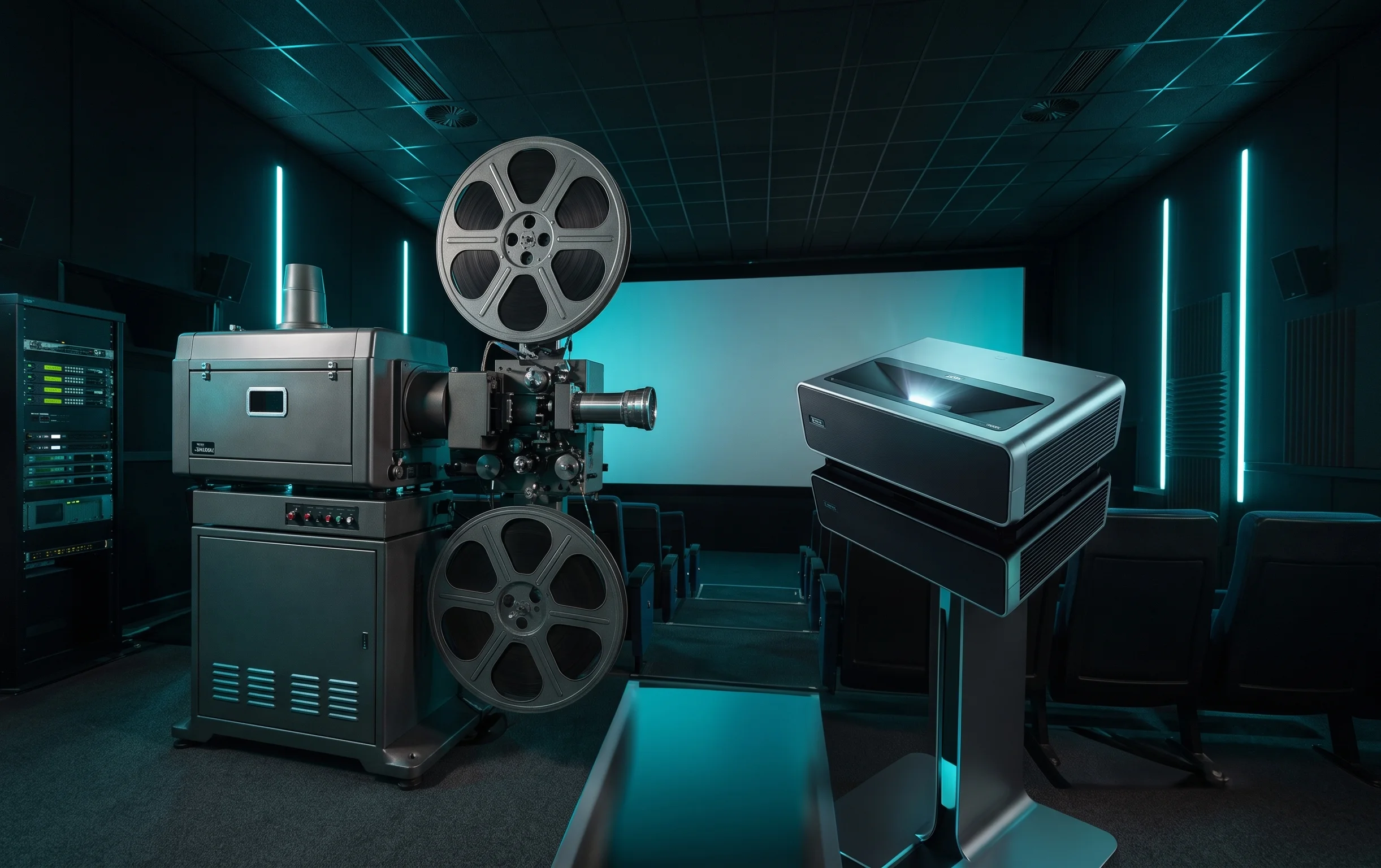
Why 15/70mm Remains the Gold Standard of Cinema
The world of big-budget cinema offers moviegoers various projection formats, but none generates as much discussion as IMAX. In everyday language, this brand often unites completely different projection technologies. On one side are the classic IMAX 70mm film complexes, and on the other are modern digital auditoriums with 2K, 4K, and laser projection systems. Understanding the technical differences between these formats clarifies why world-class directors continue to choose analog film for their most ambitious projects.
The primary distinction of the 15/70mm film format lies in frame scale and the mechanism used to pull film through the projector. Unlike standard 70mm film, where frames are oriented vertically and occupy 5 perforations, IMAX film moves horizontally. Each frame spans 15 perforations wide, making its surface area roughly 10 times larger than a standard 35mm frame and 3 times larger than regular 70mm film.
Analog Film vs Digital Projection – Technical Specs
The resolution of original 15/70mm IMAX film cannot be measured in pixels because it is an analog medium containing chemical silver halide grains. However, in terms of detail and optical clarity, experts estimate its equivalent in the range of 12K to 18K. By comparison, most standard digital IMAX theaters use dual-projector systems with 2K or 4K resolution.
Aspect Ratio and Screen Geometry
Image geometry plays a decisive role in creating an immersive experience. Classic film IMAX features an aspect ratio of 1.43:1. This creates a tall, nearly square image that fully engages the viewer peripheral vision. To display these films, massive custom screens are built, often reaching heights equivalent to a six-story building (around 18-24 meters).
Most modern digital IMAX venues utilize a 1.90:1 aspect ratio. This is a wider format that only slightly exceeds standard 16:9 or 2.39:1 aspect ratios. When watching a feature shot on IMAX 15/70mm cameras in a standard digital hall, viewers lose up to 26-40 percent of the original image area due to cropping at the top and bottom.
Operational Complexity and 15/70mm Mechanics
An IMAX film projector is a massive piece of machinery weighing over 1.8 metric tons. Due to the rapid film transport speed (24 frames per second equates to over 102 meters of film per minute), traditional intermittent mechanisms are unsuitable. The projection system utilizes a patented Rolling Loop technique that smoothly moves film using compressed air and secures each frame on registration pins with micron precision.
- A single film platter for a 3-hour movie weighs around 270 kilograms.
- Shipping film platters to theaters requires specialized cargo containers and forklifts.
- Total film strip length for a feature-length movie exceeds 18 kilometers.
- The projector xenon lamp power reaches 15 kilowatts, requiring active water and air cooling systems.
Current State of Technology and the Future of Film
Today, fewer than 30 commercial theaters worldwide remain capable of showing movies in the true 15/70mm IMAX format. Prominent filmmakers like Christopher Nolan, Quentin Tarantino, and Denis Villeneuve serve as the primary advocates for maintaining this technology. Releasing movies on physical film involves substantial financial costs for printing copies, shipping logistics, and maintaining rare projection units.
Concurrently, IMAX is advancing its digital technology with IMAX Laser, employing dual 4K matrix systems and laser light engines. Laser installations provide high contrast and can project a 1.43:1 aspect ratio on compatible screens, yet 15/70mm analog film remains an unmatched benchmark for optical resolution and image depth in cinema.




0 Comments