
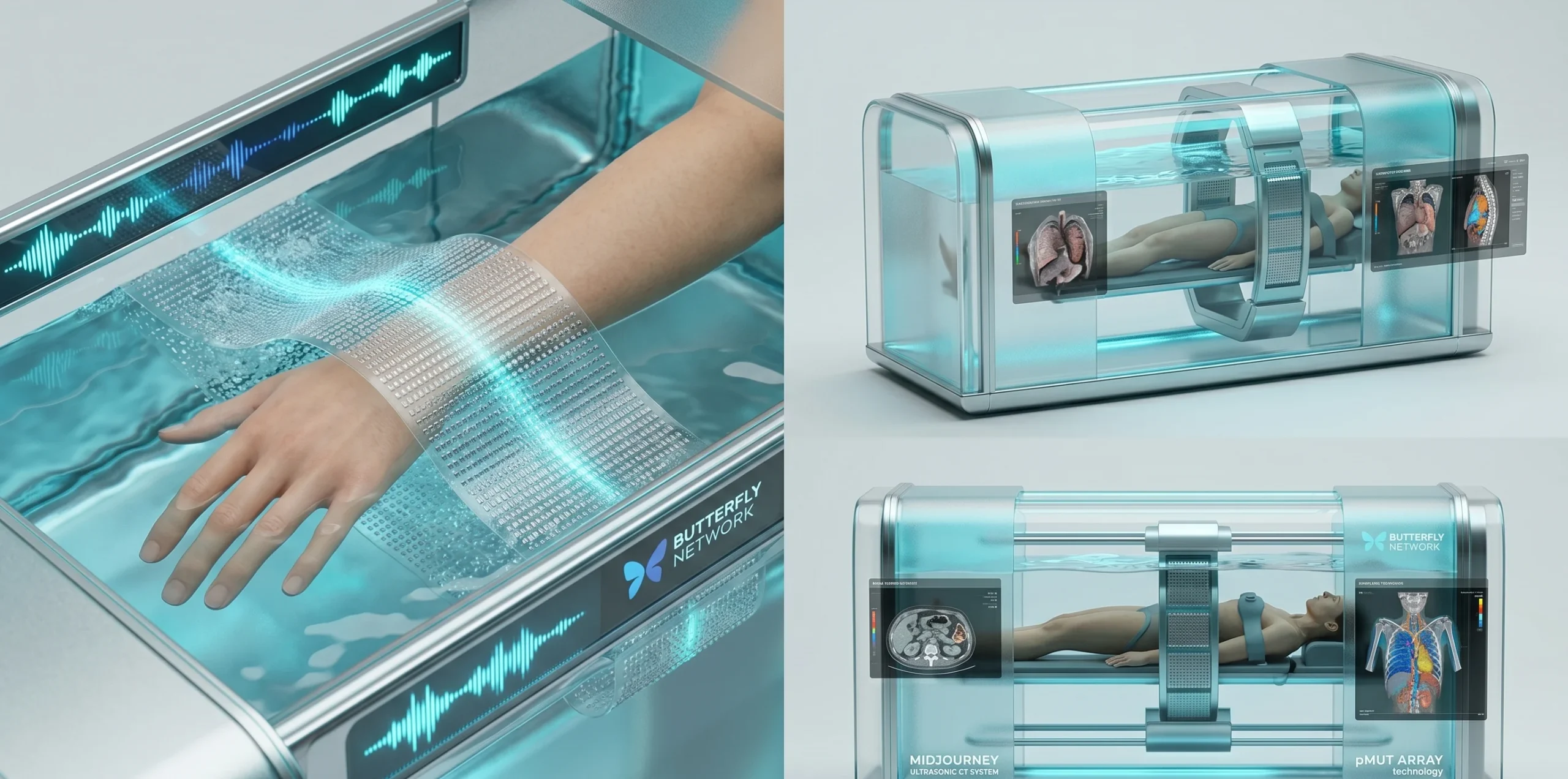
New Division Midjourney Medical Launches
Midjourney, widely known for its generative AI image platform, has officially announced its expansion into the medical hardware industry. In partnership with ultrasound chip pioneer Butterfly Network, the company is developing the Midjourney Scanner – an advanced device for three-dimensional full-body ultrasound imaging. The initiative aims to provide a safe, radiation-free alternative to CT and MRI scans by eliminating ionizing radiation and intense magnetic fields.
While the agreement between the two firms was initially registered in SEC financial filings late last year, official details regarding the hardware specifications and the establishment of Midjourney Medical have only recently been made public. This partnership merges Butterfly Network’s Ultrasound-on-Chip semiconductor expertise with Midjourney’s proprietary artificial intelligence models for high-speed data processing and structural visualization.
The Mechanics of Ultrasonic Computed Tomography
The operational core of the new scanning system relies on pMUT (Piezoelectric Micromachined Ultrasonic Transducers) technology. Unlike conventional ultrasound setups where a technician manually guides a probe across the patient’s skin, the Midjourney Scanner utilizes a stationary cylindrical chamber. The patient lies inside a capsule filled with water, which serves as an optimal conductive medium for acoustic waves. A specialized ring containing thousands of microscopic sensors embedded on semiconductor chips rotates around the body.
This configuration enables a method known as ultrasonic computed tomography. The sensors simultaneously transmit and capture reflected signals from multiple angles, collecting vast datasets of internal organs, soft tissues, and vascular networks in a single pass. The entire full-body scanning process takes approximately 60 seconds, significantly reducing the examination time compared to standard MRI protocols.
Data Processing and Compute Infrastructure
The primary barrier to practical 3D ultrasound tomography has historically been the massive volume of raw acoustic data requiring real-time reconstruction. Conventional rendering pipelines cannot handle such data influxes without major processing delays. Midjourney’s specialized artificial intelligence models and high-performance computing arrays were integrated specifically to bypass this limitation.
To support image reconstruction, Midjourney Medical is deploying dedicated compute infrastructure. Preliminary specifications indicate that the image rendering pipeline requires roughly 1 petaflop of computing power per scanning session to achieve real-time visualization. The AI models analyze acoustic wave distortions, neutralize motion artifacts caused by patient breathing or heartbeats, and instantly generate a highly precise 3D anatomical layout.
Applications in Preventive Healthcare
The companies are positioning the system primarily as an entry point for routine screening and preventive diagnostics. Because the procedure introduces zero radioactive exposure, patients can undergo scans regularly to monitor overall health metrics, detect anomalies at early development stages, or trace the progression of chronic conditions. The swift nature of the scan allows medical facilities to dramatically scale up the volume of daily diagnostic assessments.
Beyond traditional clinical infrastructure, sports medicine and elite athletic organizations represent key target markets. The scanner can accurately differentiate between muscle and adipose tissue layers, evaluating deep muscle groups, tendons, and ligament integrity under controlled tension. The compiled 3D structural model can be exported directly into third-party analytical applications for tailored rehabilitation and training regimens.
Integration with Butterfly Network Ecosystem
The engineering contribution of Butterfly Network ensures a highly mature hardware foundation. Butterfly has established a strong industry presence with its handheld iQ ultrasound probes, which consolidate components onto a single silicon chip linked to mobile platforms. However, the full-body scanner required scaling this infrastructure up, linking thousands of transducer arrays into a unified, synchronized network architecture.
The upgraded pMUT chip layout permits micro-level control over each individual piezoelectric element. The system dynamically alters wave frequencies and focal points based on the variable density of the tissue layers currently being traversed. This targeted adjustments minimize signal degradation often observed when imaging patients of differing body compositions or when capturing organs located beneath dense rib structures.
Regulatory Timeline and Market Entry
Bringing new medical hardware to market involves complex clinical trial phases and regulatory clearings from oversight agencies like the FDA in the United States. Since ultrasound technology is inherently well-characterized and non-invasive, the path to clearance may face fewer obstacles than entirely new radiological methods. However, the heavy reliance on machine learning models for raw medical data reconstruction demands rigorous validation to prevent imaging artifacts or synthetic anomalies.
Midjourney Medical has not disclosed a specific release date for commercial hospital deployments, nor has it finalized retail pricing tiers for the hardware. Nevertheless, the allocation of extensive computing infrastructure and the formal launch of the medical division emphasize a long-term strategy to establish a foothold in biomedical tech, converting generative software capabilities into practical tools for clinical diagnostics.




0 Comments