
- The Scaling Problem: Why Traditional Upscaling Doesn’t Work
- AI Video Quality: How Deep Learning Recovers Lost
- Super-Resolution (SR) technology and its mechanism
- Combating noise, artifacts, and blur
- From Servers to Smart TVs: Real-Time Challenges
- Why the update focuses on TVs
- A New Era of Content: Benefits for Creators and Viewers
- The role of neural networks in the future
- Bottom Line: Visual Excellence and Investing in Experience
The world of streaming video is constantly evolving, and one of the key challenges has always been image quality on large screens. When viewing YouTube content on a modern Smart TV, especially one with high resolution 4K or 8K, the difference between high-quality and low-quality video becomes all too noticeable. This is where artificial intelligence (AI) comes in, promising a true revolution. YouTube announced the implementation of the latest AI technologies that automatically improve clarity, detail, and overall image quality on TVs. This is YouTube’s strategic update for large screens, aimed at ensuring every viewer has the best viewing experience.
The Scaling Problem: Why Traditional Upscaling Doesn’t Work
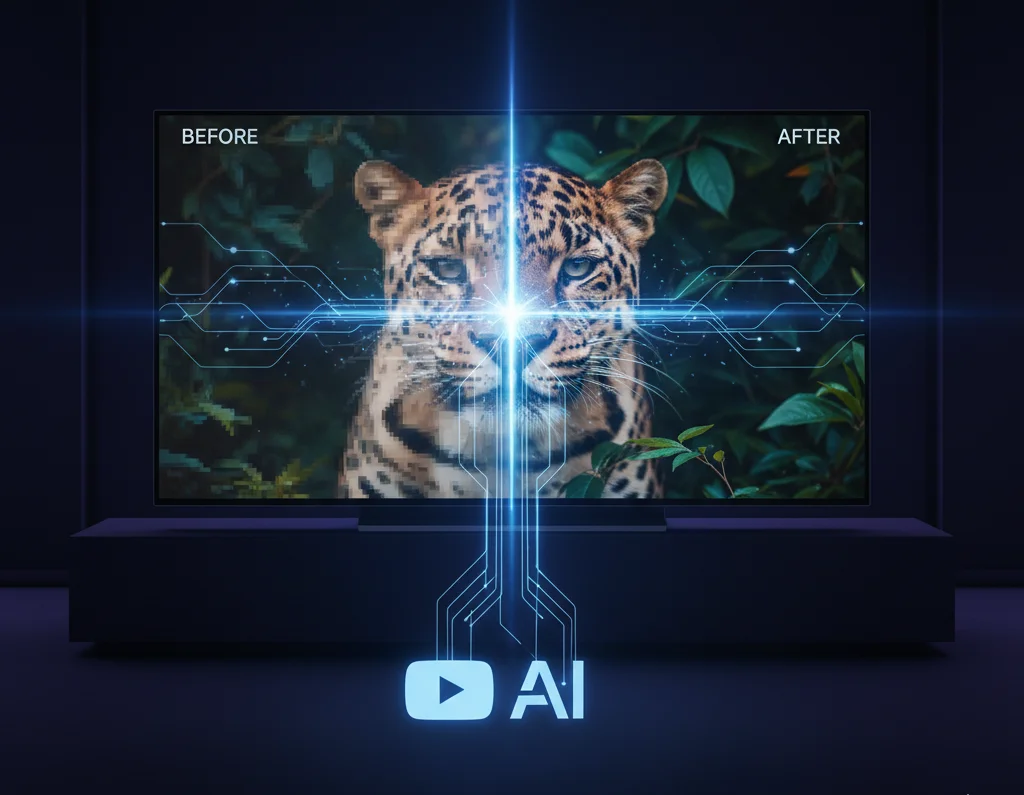
Before this innovation, if the original high-definition video was, say, 720p or 1080p, TVs used traditional zooming methods, also known as upscaling. These methods, such as bilinear or bicubic interpolation, are simple: they “compose” additional pixels based on the color of adjacent pixels. The result is often a blurry image, blocky appearance, or noticeable artifacts, especially when viewing fast-moving scenes. On a large screen, where a significant portion of the screen real estate is used, this drawback is critical and significantly degrades the YouTube experience on TV.
AI Video Quality: How Deep Learning Recovers Lost
The new approach is based on the use of complex deep learning models. Instead of simply enlarging pixels, as traditional upscaling does, the AI is trained to “see” the image and restore lost detail. Trained on millions of video pairs (low quality/high quality), the model can predict what a highly detailed image should look like. This effectively makes it possible to achieve the Super-Resolution effect on any content. Integrating AI video enhancement into YouTube’s infrastructure is a massive engineering project.
Super-Resolution (SR) technology and its mechanism
A key element is YouTube’s Super-Resolution technology, which uses convolutional neural networks (CNNs). These networks can analyze a video frame, identify patterns and textures (such as facial features, hair, and leaves), and generate pixels that correspond to these textures, rather than simply averaging color. In some cases, generative adversarial networks (GANs) can even be used, creating such realistic details that the human eye cannot distinguish them from the real thing. This results in AI-powered video upscaling that looks incredibly natural and accurate.
Combating noise, artifacts, and blur
In addition to upscaling, YouTube TV’s AI video engine actively addresses defect removal. Videos uploaded years ago often contain compression artifacts, block noise, or grain. SI models are specially trained to identify these defects and remove them while preserving natural detail. This is a multi-component process that includes:
- AI Video Noise Reduction: Removes unwanted grain and noise typical of old or low-quality footage without blurring useful information.
- Edge Restore: Make the edges of objects sharper, eliminating the “staircase effect” or blurring.
- Color Stabilization: Corrects color distortions and restores natural balance.
From Servers to Smart TVs: Real-Time Challenges
Implementing this technology requires significant computing resources, as processing millions of hours of video in real time is a colossal task. AI’s work to improve video quality occurs on YouTube’s powerful servers. The models must operate quickly to avoid latency during streaming. Each hardware upgrade required to support this feature costs the company millions of dollars, but it is an investment in the future of AI-powered streaming services. For viewers, the process remains transparent: they simply see YouTube’s AI video quality being activated and the image improving.
Why the update focuses on TVs
Choosing large screens as the primary platform for this feature launch is logical. It’s on TVs that the disadvantages of low resolution become most apparent. Users who have invested in watching 4K video on a Smart TV or QLED display expect the same quality. YouTube is responding to this demand by using deep learning for streaming, making the large screen the ideal place to consume content.
A New Era of Content: Benefits for Creators and Viewers
This update opens up new possibilities for the entire ecosystem. Viewers will not only get a better picture but also a deeper immersion into the content, which is especially important for gaming streams, documentaries, and cinematic videos. Content creators, for their part, benefit, as their old archived material is automatically upgraded to modern quality standards. This effectively gives a “new life” to thousands of videos shot with lower technical capabilities.
The role of neural networks in the future
This move by YouTube confirms that the evolution of AI in media is irreversible. YouTube’s neural networks are becoming more than just a recommendation tool, but an active participant in content production and distribution. Similar technologies are already being tested by other AI streaming services, but YouTube, as the largest video platform, is setting the pace. Integration, like YouTube’s AI-powered video quality improvements, is just the beginning. We expect further innovations in video compression and personalized optimization.
Bottom Line: Visual Excellence and Investing in Experience
Using AI to improve video quality is a significant step forward. It solves the long-standing problem of the gap between the capabilities of modern displays and the quality of available online content. Thanks to this innovation, image quality on TVs will no longer depend on the file’s original resolution. YouTube viewers on TVs will immediately notice the quality, enjoying a sharper, more detailed picture. This is a strong signal that YouTube is committed to investing in the visual experience of its users.


0 Comments